
Attorney Search Firm vs Recruiter: Making the Right Hire
July 23, 2026 · 12 min read · Five Star Placements

Table of contents
You're staring at an open seat that shouldn't be open this long. The practice group keeps moving, clients still expect answers, and every week that passes makes the hiring mistake more expensive. At that point, the question isn't whether you need help. It's whether you need an attorney search firm or a recruiter, because those two choices push risk, cost, and candidate quality in very different directions.
| Criterion | Attorney Search Firm | General Recruiter |
|---|---|---|
| Core purpose | High-stakes legal hiring | Broader, more routine hiring |
| Candidate pool | Passive, pre-vetted attorneys | Often active job seekers |
| Confidentiality | Built for discreet searches | Usually less specialized |
| Search depth | Market mapping and outreach | Faster, broader sourcing |
| Payment model | Often retained, staged fees | Often contingent, pay on placement |
| Best fit | Partner, GC, niche practice, confidential replacement | Volume hiring, junior roles, less specialized needs |
Table of Contents
- The High Cost of a Misaligned Legal Hire
- Defining the Players in Legal Talent Acquisition
- A Head-to-Head Comparison of Service Models
- How Each Model Impacts Your Talent Pool and Timeline
- When to Choose Each Option Scenarios and Use Cases
- A Practical Decision Matrix for Your Next Legal Hire
- Key Questions to Ask and Your Next Steps
The High Cost of a Misaligned Legal Hire
A managing partner calls because a critical practice lead left three months ago and the replacement search has gone sideways. The resumes look fine on paper, but the candidates aren't portable in practice, the practice fit is off, and the client team is already feeling the strain. That's the kind of problem that turns a vacancy into a business issue, not just an HR issue.
The direct fee matters, but the larger cost is what happens while the seat stays open. Work gets redistributed, service levels wobble, and the remaining lawyers absorb the pressure. If the eventual hire is wrong, the firm pays twice, once in recruiting spend and again in transition time, morale loss, and lost momentum.
Practical rule: if the role touches client relationships, revenue, or succession, the hiring method should be judged on risk allocation, not just convenience.
This is why the attorney search firm vs recruiter decision shouldn't start with who is cheaper. It should start with who is better at reducing the chance of a bad fit and who can reach the right candidates without broadcasting the move. The right partner gives you a cleaner shortlist and less noise. The wrong one gives you speed in the short term and a problem later.
For legal buyers, the core issue is not “can someone send resumes?” Anyone can do that. The issue is whether the partner understands how a legal market works, especially when the hire is confidential, senior, or hard to replace. That distinction drives the whole comparison.
Defining the Players in Legal Talent Acquisition
An attorney search firm is a specialist. It works inside the legal market, usually on roles where discretion, market access, and practice fit matter more than volume. A general recruiter is broader, often handling multiple industries or multiple job families, and may have a legal desk without living in the legal market every day.
Specialists versus generalists
Think of it this way. A specialist surgeon doesn't replace a family doctor, and a family doctor doesn't replace a surgeon. Both matter, but they solve different problems. Attorney search firms are built for lateral partners, in-house counsel, confidential executive hires, and niche legal roles where the candidate universe is narrow and the hiring decision carries significant weight.
General recruiters are more useful when the role is standard enough to standardize. If the job can be described cleanly, filled from a broad market, and evaluated with a lighter screening burden, a broader recruiter model can make sense. That's especially true when you're staffing around volume rather than scarcity.
The distinction is more than branding. Legal-specialist firms can discreetly approach passive candidates, verify bar admissions across jurisdictions, and calibrate compensation and practice-fit expectations before they present a shortlist, which is a real technical advantage in senior or niche searches as noted in this legal staffing overview. That level of precision is hard to replicate with a generalist model.
Why coverage depth matters
The best way to judge a partner is to ask how deep they go before they show you names. A shallow search gives you activity. A deep search gives you options. In legal hiring, those are not the same thing.
I'd use attorney search firms when the vacancy is confidential, the practice is specialized, or the hire has to work across jurisdictions and internal stakeholders. I'd use a broader recruiter when the hiring need is more routine and the internal team can handle more of the screening load. Five Star Placements fits the specialist side of that spectrum, with permanent legal recruiting across attorneys, legal support staff, partners, in-house counsel, and legal operations leaders, and you can review their firm background on their about page.
A Head-to-Head Comparison of Service Models
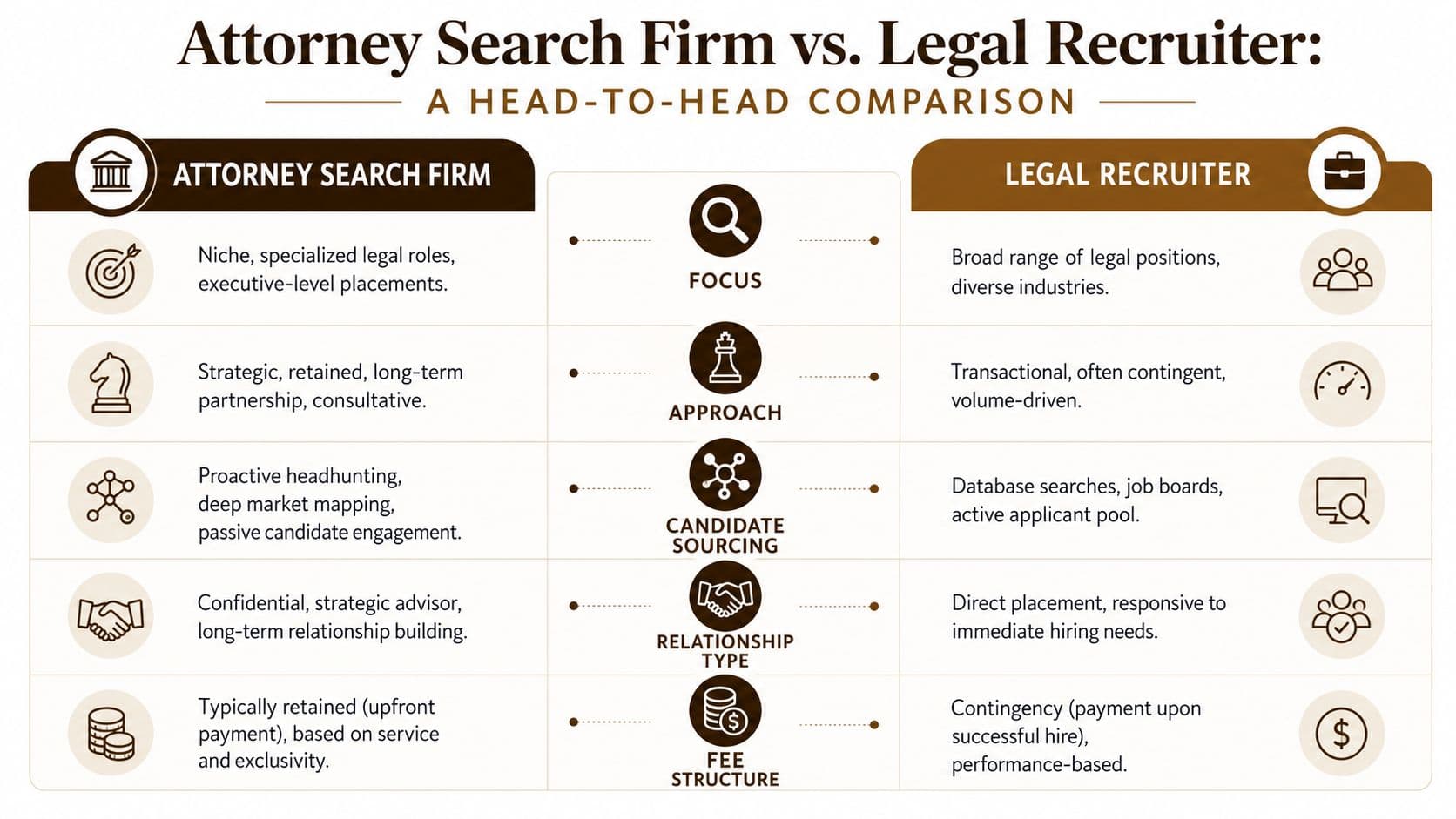
A fee alone does not tell you whether a search is being run with the right level of risk control. What matters is how the firm is being paid to behave, because that shapes how much of the market it will cover, how hard it will press on fit, and how much exposure you take if the hire misses. Legal recruiters commonly charge 20% to 30% of first-year compensation, with many legal recruiting contexts cited at 25% to 35% according to this employer guide. In law-firm hiring, searches are often contingent and paid only after placement, while high-stakes in-house searches are almost always retained and billed in installments.
| Criterion | Attorney Search Firm | General Recruiter |
|---|---|---|
| Payment structure | Often retained or staged | Often contingent |
| Search focus | Senior, niche, confidential roles | Broader hiring needs |
| Candidate access | Passive market mapping | Active applicants and database search |
| Screening depth | Practice fit, bar status, discretion | Resume screening and basic fit |
| Best use case | Leadership and scarce talent | Routine or higher-volume roles |
Payment model changes behavior
A contingent recruiter gets paid only when a placement lands. That creates pressure to move fast and stay responsive, which helps when you need a quick slate and can live with a wider funnel. Retained search works differently. It pays for market coverage, accountability, and disciplined follow-through when the role is too important to leave to chance.
A senior retained executive-search mandate can run at roughly 25% to 38% of first-year total compensation, billed in stages, which is why firms reserve it for leadership-level roles like partners as described in this legal recruiting analysis. A $2 million partner package can therefore produce a fee of about $350,000 in that model, which makes the economics plain. You pay more up front to reduce the risk of a weak shortlist, a missed jurisdictional issue, or a hire who cannot carry the book, the team, or the practice.
Sourcing logic is not the same
Contingency searches usually draw from candidates already in motion. Retained searches map the full market and approach passive candidates, which makes them better for confidential or business-critical roles as explained in this recruiter guidance. That difference changes the quality of the pool before you ever get to interviews. An active applicant list fills time on the calendar. A properly run search identifies people who are already succeeding where they sit and then tests whether the move is worth making.
A recruiter can fill a seat. A search firm can shape the shortlist before you see it.
Confidentiality and accountability
Confidentiality is where the split becomes obvious. If a general counsel is being replaced, a partner is being recruited from a competitor, or a practice leader move has to stay quiet, broad outreach creates exposure you do not need. A specialist firm is built to keep the move discreet until the right moment.
Ask one blunt question: who owns the market map, and who is accountable for the full search? If the answer is vague, the search is probably too shallow for a serious legal hire. For roles that affect strategy, succession, or practice growth, you want a partner that can show clear process control, not just a stream of resumes.
How Each Model Impacts Your Talent Pool and Timeline

The model you choose shapes the market you can reach. Contingency searches usually surface candidates who are already active, while retained search expands the field and pulls in passive talent, which changes the shortlist before interviews ever begin. That difference is not cosmetic. It affects risk, quality, and how much confidence you can have in the final hire.
Active candidates versus passive candidates
Active candidates are easier to contact, quicker to engage, and more visible to general recruiters. That can make the front end of a search move fast. But for a partner, a senior in-house attorney, or a niche-practice specialist, the strongest option is often already performing well somewhere else and has no reason to respond to broad outreach.
Specialist search firms know how to work that passive market without creating noise. They can test interest discreetly, check compensation expectations early, and confirm whether the move makes sense before your team spends time on interviews. That is the right kind of speed. It keeps you from filling calendars with people who were never going to move.
Timeline is not just about urgency
A fast slate only helps if the slate is good. General recruiters often move quickly because they are working from a broader, more active pool, and that can be the right fit for roles where volume matters more than precision.
For business-critical legal hiring, speed without control creates rework. A weak finalist, a missed jurisdictional issue, or a candidate who cannot carry the book, the team, or the practice pushes the timeline back further than a slower, better-run search would have. The smarter decision is to accept more time at the front end when the role has real business consequences.
The core trade-off
Choose the model that matches the risk profile of the hire. If the role is broad and replaceable, use the option that gets you faster intake and lower upfront friction. If the role is scarce, confidential, or high-impact, choose the option that gives you a more curated pool and tighter market control.
General recruiters are useful when the hiring brief is wide and the internal team can sort through a larger flow of candidates. Attorney search firms are the better fit when the role is narrow and the decision risk is high. That is the line that matters.
When to Choose Each Option Scenarios and Use Cases
A lateral partner hire with a real book of business is not a standard recruiting assignment. Use an attorney search firm. You are paying for a retained process because the firm is doing more than collecting names. It is mapping the market, controlling confidentiality, and focusing on candidates who need to be credible on revenue, portability, and fit.
A confidential General Counsel replacement belongs in the same category. So does a rare compliance lead, a practice-specific partner, or an in-house lawyer connected to a transaction, restructuring, or expansion. These roles are not suited to a “send me resumes” approach. They require discretion, and the cost of a disclosure problem is real.
Choose a specialist when the role is hard to replicate
A specialist search firm makes the most sense when the market is small and the expectations are tight. That includes:
- Lateral partner searches: The candidate has to be portable, credible, and commercially relevant.
- Confidential replacements: The firm needs discretion, not visible posting activity.
- Niche practice hires: The market may be too thin for broad recruiting.
- Leadership roles: The hire changes strategy, not just staffing.
In those situations, the value is not only access to candidates. It is judgment about risk, quality, and who can make the move.
Choose a broader recruiter when the need is operational
A general recruiter can be the right call when you are hiring multiple paralegals, legal assistants, or junior attorneys in a practice that already knows how to train and absorb talent. The role definition is usually clearer, the market is larger, and the internal screening load is easier to handle.
That is also where volume matters. If you need to keep pipelines moving and the cost of a miss is lower, a broader recruiter model can be practical. You are buying reach and responsiveness, not market mapping. For a useful reference point on permanent legal recruiting options, I would also review Five Star Placements' blog.
The line I'd draw
If a hire changes the direction of the practice, use a search firm. If a hire supports the current operating rhythm, a recruiter may be enough. That is the cleanest way to frame attorney search firm vs recruiter.
A Practical Decision Matrix for Your Next Legal Hire
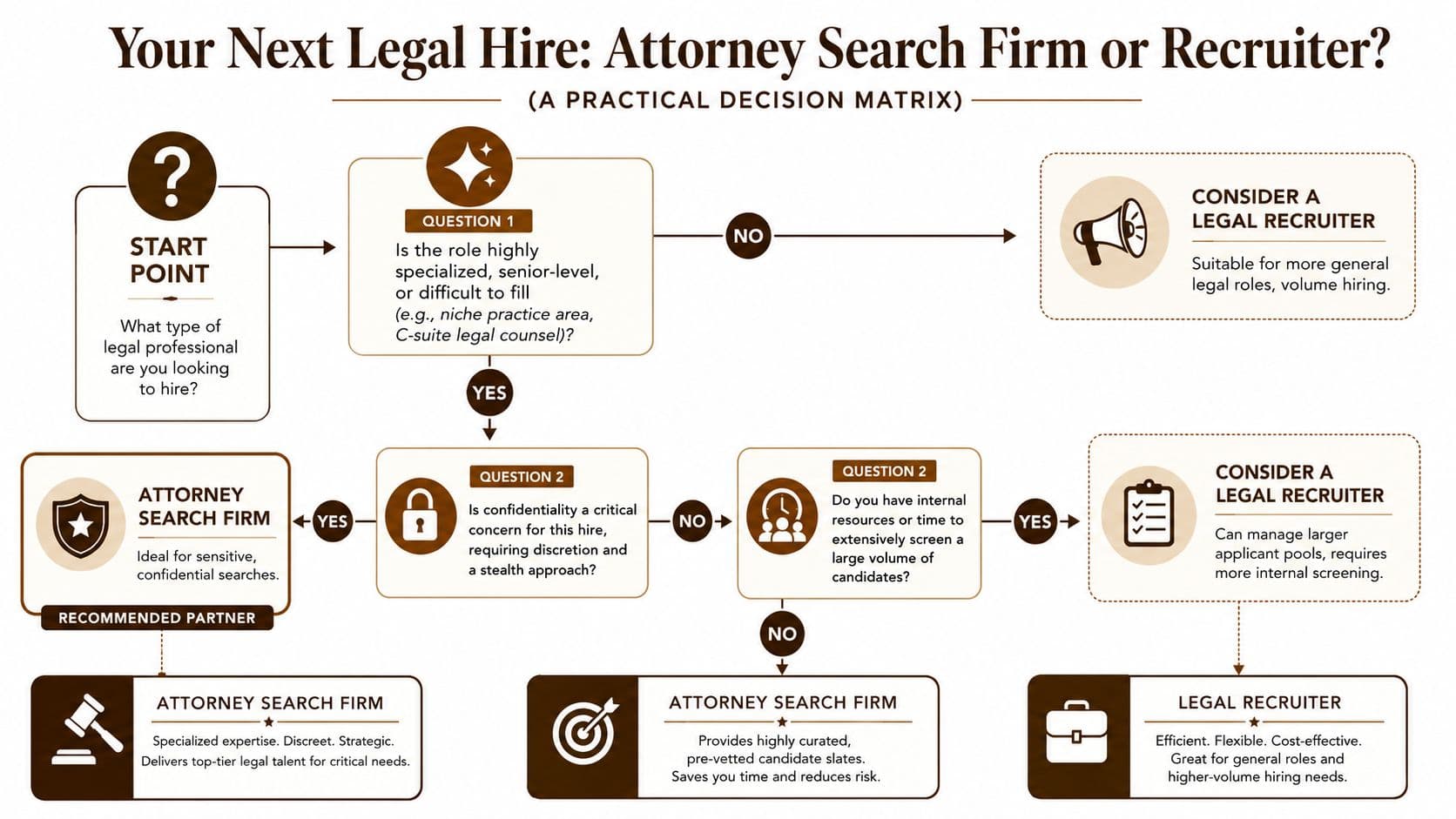
Start with the role, not the vendor.
- Is the hire senior, specialized, or hard to source? If yes, lean toward a search firm.
- Is confidentiality a real requirement? If yes, lean harder toward a search firm.
- Can your team screen a broad pool without slowing down? If no, the curated model is the better fit.
- Is the role routine, high-volume, or easy to benchmark? If yes, a recruiter may be enough.
A quick internal filter helps too. If you're hiring for a private, strategic role, the search should protect risk first. If the role is public, repeatable, and lower stakes, speed and volume are more useful than market depth.
For a more detailed hiring checklist, I'd also use the guidance in Five Star Placements' blog as a reference point when you're sorting between permanent legal recruiting options.
Simple decision matrix
| Your situation | Better fit |
|---|---|
| Confidential partner or GC search | Attorney search firm |
| Niche practice or hard-to-fill role | Attorney search firm |
| Multiple routine legal support openings | General recruiter |
| Junior associate hiring with clear specs | General recruiter |
| Need for passive candidate outreach | Attorney search firm |
Key Questions to Ask and Your Next Steps
Before you hire anyone, ask how they manage search risk allocation. The point of a contingency model is that payment follows a successful placement, which makes it optimized for speed and lower upfront cost. The point of retained search is completeness and confidentiality when the role is business-critical or hard to fill as outlined in this recruiter interview guide.
Use these questions in your next call:
- How do you source passive candidates? I want to hear a real market-mapping process, not just “we have a database.”
- What do you screen for beyond the resume? In legal hiring, practice fit and discretion matter.
- How do you protect confidentiality? If the answer is fuzzy, stop there.
- What kinds of roles do you fill most often? Look for alignment with your exact search.
- How do you define success? A good partner talks about shortlist quality, not only speed.
Then take the next step. Define the role's seniority, confidentiality, and scarcity. Decide how much risk you're willing to carry internally versus outsource. If you want a contingency-based legal recruiting conversation, use this contact page and ask for a search discussion built around your specific hiring need.
A CTA for Five Star Placements.
Need help filling a legal role?
Five Star Placements partners with law firms and legal departments nationwide.
Schedule a Call