
7 Candidate Selection Form Templates for Legal Hiring
October 2, 2026 · 16 min read · Five Star Placements
Table of contents
A hiring partner, recruiter, and practice-group leader are comparing the same three candidates, but each person is using a different standard. One focuses on pedigree, another on technical answers, and a third relies on general impressions from a brief conversation. By the time the team meets, the discussion sounds confident but the underlying evidence is inconsistent.
A well-designed candidate selection form creates a shared record without pretending that legal judgment can be reduced to one number. It separates minimum qualifications from differentiating skills, ties ratings to interview evidence, and records why the team advanced or rejected each candidate. That makes the process easier to manage and more defensible across attorneys, paralegals, legal support professionals, in-house counsel, and legal operations leaders.
The seven resources below follow the actual legal hiring workflow, from structured interviews and practice-area validation through pipeline management, references, and offer acceptance. Each includes practical scoring guidance, limitations, and implementation advice so your team can combine forms into one coherent process rather than collect disconnected paperwork.
Table of Contents
- 1. Structured Interview Scorecard Form
- 2. Competency-Based Assessment Form
- 3. Legal Practice Area Expertise Evaluation Form
- 4. Cultural Fit and Values Alignment Assessment Form
- 5. Multi-Stage Candidate Pipeline Tracking Form
- 6. Reference Check and Background Verification Form
- 7. Negotiation and Offer Acceptance Form
- Candidate Selection Forms: 7-Point Comparison
- Turn Individual Forms Into One Hiring System
1. Structured Interview Scorecard Form
A structured interview scorecard is the foundation of a consistent legal hiring process. It gives every interviewer the same competencies, rating scale, and evidence fields, while allowing the weighting to reflect the role. An associate search may emphasize legal analysis and writing. A General Counsel search may place more weight on judgment, executive communication, compliance knowledge, and business partnership.
The form should distinguish essential criteria from differentiating criteria. Essential criteria might include active bar admission where required, relevant practice experience, or the ability to perform a defined technical task. Differentiating criteria might include client development, team leadership, or experience working with a particular industry.
A practical scorecard can include:
- Technical legal expertise: Record the matter types, jurisdictions, and responsibilities the candidate has handled, not just a general practice-area label.
- Communication: Capture evidence from explanations, written exercises, client-facing examples, and the candidate's ability to make complex issues understandable.
- Role-specific judgment: Note how the candidate identified risk, weighed competing interests, and recommended a course of action.
- Organizational alignment: Evaluate working preferences and collaboration through defined behaviors, not personality impressions.
SHRM benchmarking data shows that structured evaluation methods are widely used, including background checks and behavioral or competency-based interviews across executive, management, and nonmanagement hiring. The same dataset reports that only 33% of organizations measure quality of hire in SHRM's talent access benchmarking report. A scorecard should therefore preserve the criteria that can later be compared with performance and retention outcomes.
Scoring guidance and limits
Use anchored ratings such as “does not meet,” “meets,” and “exceeds,” with a short behavioral description for each. Have interviewers score independently before the panel discusses candidates. This reduces the risk that the most senior partner's first impression becomes everyone else's conclusion.
Practical rule: Score the evidence presented in the interview, not confidence, familiarity, school prestige, or personal similarity.
The form won't eliminate judgment. It will make judgment visible, comparable, and easier to challenge constructively. For additional context on structured evaluation, legal hiring teams can review these candidate selection methods.

2. Competency-Based Assessment Form
A resume can show where a lawyer has worked, but it can't fully show how that person analyzes a difficult question, manages a demanding client, or responds when the facts change. A competency-based assessment form addresses that gap by requiring interviewers to record demonstrated behaviors against a defined framework.
For a General Counsel, the framework might include strategic thinking, stakeholder management, legal acumen, and leadership. A litigation attorney may be assessed on case strategy, legal writing, oral advocacy, and opposing-counsel management. For a legal operations director, financial management, process improvement, team leadership, and technology integration may matter more than traditional legal credentials.
CIPD's 2022 Resourcing and Talent Planning Report found that 61% of organizations conducted thorough CV or application screening, while 77% considered previous work history or experience, 77% conducted some form of interview, and 59% considered educational qualifications in its reported hiring practices. Those figures illustrate why competency assessment should supplement resume review rather than merely repeat it.
Build behavioral anchors
Choose a limited set of competencies before sourcing begins. Each should have observable indicators. For example, a strong legal research rating might require the candidate to explain how they framed the issue, evaluated authority, communicated uncertainty, and delivered a recommendation under a real deadline.
Ask open questions such as:
- Complex research: “Tell us about a time you had to answer a difficult legal question under significant time pressure.”
- Stakeholder management: “Describe a situation where a business leader disagreed with your risk recommendation.”
- Leadership: “Give an example of how you improved the performance of a team or process.”
Record concrete examples and, where appropriate, the candidate's exact wording. Don't turn the form into a collection of broad adjectives such as “excellent” or “strong communicator.” Those labels are conclusions, not evidence.
The trade-off is administrative effort. Interviewers need training and a short briefing before the process starts. That investment is worthwhile when several stakeholders assess the same candidate asynchronously, but a small, straightforward search may need only a focused scorecard with a few competency prompts.
3. Legal Practice Area Expertise Evaluation Form
A candidate who describes themselves as a corporate attorney may have spent most of their time on routine contracts, complex M&A transactions, or a narrow industry niche. Those profiles can all be legitimate, but they aren't interchangeable. A practice-area expertise form tests whether the candidate's claimed experience matches the work the firm or legal department needs performed.
The form should combine foundational questions with advanced, role-specific prompts. For a litigation search, it might cover discovery strategy, dispositive motions, trial preparation, and the candidate's role in recent matters. For M&A counsel, it could examine deal structure, due diligence, negotiation decisions, and post-closing issues. A tax attorney may need to explain how they approached transaction tax planning and how they monitor changes in applicable authority.
Test practical depth
Use recent work as the center of the discussion. Ask the candidate to describe a matter without requesting confidential information, then explore their specific contribution, the legal issue, the alternatives considered, and the outcome. This distinguishes direct experience from familiarity with terminology.
A useful form separates:
- Practice-area breadth: The types of matters, clients, industries, and jurisdictions the candidate has handled.
- Technical depth: The complexity of the candidate's personal responsibility and decision-making.
- Current knowledge: Awareness of relevant legal developments and their practical effect.
- Practice readiness: The amount of supervision, onboarding, or matter transfer the role is likely to require.
The form should not become an artificial exam. A newer attorney may have less exposure to major matters but stronger knowledge of recent developments and a clear ability to learn. Conversely, a senior candidate may have an impressive matter list but limited hands-on involvement in the work the client needs.
Use an evidence threshold
Define what counts as sufficient evidence before interviews begin. For example, a candidate might need to explain their own role in a representative matter, identify a meaningful issue, and describe how they communicated the recommendation. Don't reject someone solely because they don't use the same terminology as the interviewer.
Practice-area questions should be refreshed as the role changes and as material legal developments affect the work. They should also be used early enough to identify exaggerated claims before multiple partners invest time in later interviews. The best form supports judgment by clarifying what the team still needs to verify.
4. Cultural Fit and Values Alignment Assessment Form
A strong attorney can still struggle in a workplace that expects constant collaboration, rapid escalation, or unusually direct client communication. A cultural fit form helps legal hiring teams test those working conditions explicitly instead of relying on whether an interviewer personally likes the candidate.
Start by describing how the role operates. A litigation boutique may expect hands-on advocacy and direct feedback. A corporate legal department may require counsel to work closely with finance, sales, compliance, and senior executives. A family law practice may place greater weight on empathy and consistent client communication. The form should reflect those differences rather than apply a generic questionnaire.
Use essential working requirements and flexible preferences as separate categories. For example, regular collaboration and prompt risk escalation may be required, while communication style or scheduling preferences may allow flexibility. Scenario questions create more useful evidence than asking whether someone “fits” the team:
- Workload expectations: “How would you handle a period when a transaction requires sustained late-day availability?”
- Disagreement: “Describe a time you challenged a senior colleague's legal or business recommendation.”
- Client service: “Tell us about a client relationship that required more empathy or explanation than technical advice.”
- Change: “Give an example of adopting a new process or technology that initially disrupted your routine.”
Score each answer against defined indicators, such as clarity, judgment, respect for professional disagreement, and willingness to communicate risk. Record the candidate's example separately from the interviewer's interpretation. A simple rating scale can support comparison, but it should not outweigh capability, relevant experience, or evidence from other interview stages.
The main risk is bias. A candidate who prefers independent work may perform well in a collaborative department if the position permits that pattern. Include more than one partner or employee in the assessment, and require each reviewer to connect ratings to a job-related example. Institutional hiring guidance also recommends documenting interviewers, applied criteria, and the reason for the final decision in this staff hiring process guidance.
Culture should describe how work gets done, not which personalities the team finds comfortable.
Review the form whenever the role or team structure changes. For further guidance, compare its questions with this culture fit assessment framework.
5. Multi-Stage Candidate Pipeline Tracking Form
A candidate can perform well in every interview and still disappear from consideration because an owner missed a follow-up, a scorecard remains incomplete, or the team cannot explain the last decision. A multi-stage pipeline form keeps the record aligned from initial screening through offer acceptance. It tracks movement and evidence, rather than replacing professional judgment.
For a law firm, stages may include recruiter review, phone screening, practice-group interview, partner panel, team meeting, reference checks, and offer. A corporate legal department may add HR screening, finance or operations interviews, executive review, and board approval. Set the stages to match the actual decision path, then assign an owner and next action for each candidate.
Make status meaningful
“Interview complete” says too little. Define the evidence required to advance. A phone-screen pass might confirm practice experience, location, compensation expectations, and interest. A practice-group pass might require completed technical ratings from designated interviewers. The form should also show whether a candidate is active, on hold, rejected, or awaiting approval, with a reason attached.
Use fields that support an audit trail:
- Stage owner: The person updating the record and coordinating the next action.
- Decision date: When the decision was made or is expected.
- Evidence status: Which scorecards, assessments, references, or approvals are complete.
- Decision rationale: The job-related reason for advancement, hold, or rejection.
- Candidate communication: What was communicated, by whom, and what happens next.
- Contingency plan: The next qualified candidate if the leading candidate declines.
Applicant screening forms can collect structured candidate information and track progress in a centralized workflow, through its applicant screening form resource. That structure helps when recruiters, hiring partners, HR leaders, and business stakeholders review the same search at different times. The trade-off is administrative effort. Require only fields that support a decision, compliance need, or timely candidate communication.
Pipeline data can expose weaknesses in the process. Repeated rejection for communication may reflect a genuine requirement, or it may show that interviewers are applying an undefined preference. Stalled candidates may indicate indecision rather than weak qualifications. Update records promptly, restrict sensitive information to appropriate users, and tell candidates what happens next.
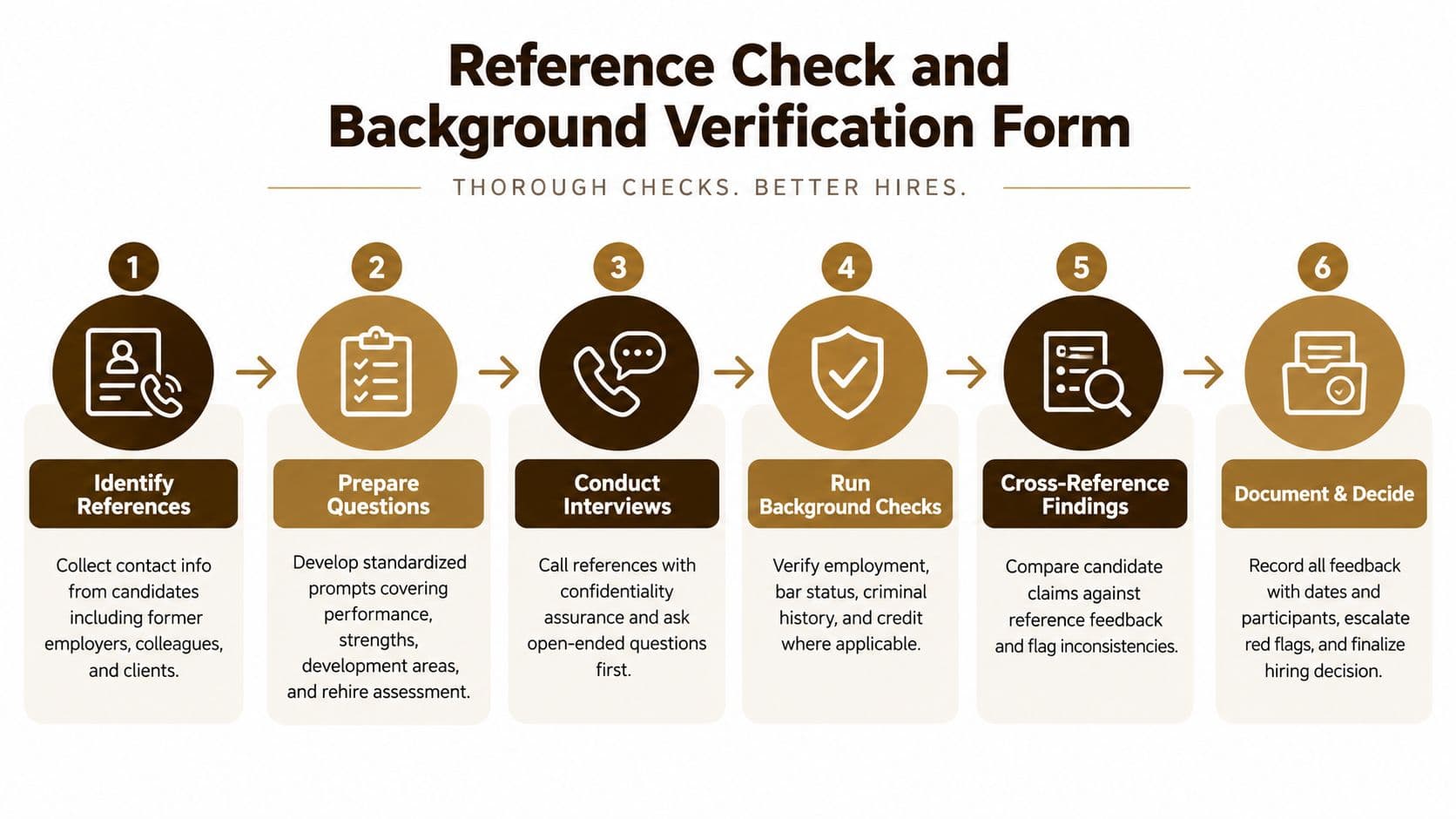
6. Reference Check and Background Verification Form
References and background verification should confirm material facts and provide additional performance evidence. They shouldn't serve as an informal opportunity to collect gossip or introduce criteria that weren't applied to other candidates.
For a lateral partner, the form might cover client development, team relationships, matter ownership, and transition considerations. For a paralegal, it may focus on accuracy, reliability, technical skills, and client interaction. For a General Counsel, references can address strategic judgment, leadership, ethics, and the ability to advise senior stakeholders.
Start with open questions. “Tell me about your working relationship with the candidate” often produces more useful information than a list of leading questions. Then ask focused follow-ups tied to the role:
- Performance: What work did the candidate perform particularly well?
- Reliability: How did the candidate manage deadlines and competing priorities?
- Judgment: How did they respond when facts or instructions were unclear?
- Leadership: How did they develop or manage other people?
- Integrity: Can you describe how they handled a difficult ethical or professional issue?
Record facts separately from interpretation
The form should capture the reference's name, role, relationship to the candidate, date of contact, questions asked, and specific answers. Use separate fields for verified facts, direct observations, and the hiring team's interpretation. If two references give materially different accounts, document the discrepancy and decide what additional verification is appropriate.
Legal teams should also verify professional credentials through the relevant official authority rather than relying only on a candidate or reference. Background checks must follow applicable law, authorization requirements, confidentiality controls, and consistent procedures. Don't ask a reference for protected or irrelevant personal information.
A reference form is strongest when it confirms a decision standard already defined, not when it creates a new standard at the end of the process.
Run references early enough to resolve questions before the final decision, but coordinate timing with the candidate, particularly when a current employer must not be contacted without permission. A documented process also helps clients and recruiters understand how sensitive information was gathered and used. This employment screening process guide provides additional context for organizing that work.
7. Negotiation and Offer Acceptance Form
A partner lateral may accept the role only after the firm clarifies client-transition duties, compensation, equity, authority, and timing. An in-house General Counsel may focus on board access, executive title, reporting lines, and control of the legal function. A paralegal or corporate counsel may need clear answers about salary, benefits, relocation, technology, schedule, and start date. The negotiation and offer acceptance form captures those decisions before informal promises become disputes.
Use the form as a shared record between the recruiter, hiring partner, HR leader, and legal reviewer. Give each item a status such as proposed, requested, approved, or final, and record who authorized any change. This makes judgment visible without treating an unapproved concession as an agreed term.
Keep the final terms easy to verify
Final compensation terms should point to the official offer documentation and identify salary, bonus, equity, or other agreed components. The form should show whether a term is confirmed or still under review, rather than relying on an email summary.
Start and transition dates should cover notice requirements, client communications, and restrictions the parties must address. A start date that looks workable for the firm may conflict with a candidate's current obligations.
Role conditions should state reporting lines, location, remote arrangements, equipment, mentoring, and travel expectations. These details often affect acceptance more than a title alone, especially for attorneys comparing private-practice and in-house roles.
Open contingencies should identify background verification, credential confirmation, conflicts review, or other conditions. Keep these items separate from final promises so the candidate and hiring team can see what remains unresolved.
Acceptance record should include the acceptance date, signatory, and copy of the final executed document. The form supports the process, but it does not replace an employment agreement, partnership agreement, or legal review. Its limitation is clear: it cannot make an unauthorized term binding or resolve ambiguity that the final agreement leaves open.
Discuss counter-offer risk before issuing the offer. If the candidate may remain with the current employer, explain the role's authority, team, client expectations, and long-term rationale in concrete terms. After acceptance, communicate promptly during the notice period. Silence can create doubt and give unresolved conditions room to become withdrawal risks.
Candidate Selection Forms: 7-Point Comparison
| Tool / Form | Core features (✨) | Quality (★) | Value (💰) | Target (👥) | Unique strength (🏆) |
|---|---|---|---|---|---|
| Structured Interview Scorecard Form | ✨ Weighted numerical scales, sectioned legal/soft skills, notes, customizable by practice | ★★★★ | 💰 Low setup cost, boosts comparability & faster decisions | 👥 Hiring partners, interview panels, recruiters | 🏆 Standardizes evaluation and creates audit trail |
| Competency-Based Assessment Form | ✨ Competency framework, behavioral anchors, STAR prompts, proficiency levels | ★★★★★ | 💰 High impact for senior hires; higher prep effort | 👥 GC, partners, senior counsel, hiring teams | 🏆 Measures demonstrated capability and development needs |
| Legal Practice Area Expertise Evaluation Form | ✨ Practice-specific Qs, case/transaction review, depth & breadth ratings | ★★★★★ | 💰 High, reduces onboarding ramp and mis-hires | 👥 Practice leads, lateral partners, specialty hires | 🏆 Validates practice-ready expertise for immediate impact |
| Cultural Fit & Values Alignment Form | ✨ Values mapping, work-style, scenario prompts, career preferences | ★★★★ | 💰 High retention value; must balance with D&I | 👥 Hiring partners, HR, practice groups | 🏆 Improves long-term fit and reduces turnover risk |
| Multi-Stage Candidate Pipeline Tracking Form | ✨ Stage visualization, consolidated interviewer notes, timeline & decisions | ★★★★ | 💰 Critical operational ROI, prevents lost candidates | 👥 Recruiters, engagement coordinators, hiring teams | 🏆 Centralizes workflow and exposes bottlenecks |
| Reference Check & Background Verification Form | ✨ Standard reference Qs, background check tracking, red-flag escalation | ★★★★ | 💰 Essential for risk mitigation and compliance | 👥 Hiring partners, HR, risk/compliance | 🏆 Documents due diligence and uncovers integrity issues |
| Negotiation & Offer Acceptance Form | ✨ Tracks offer terms, counter-offers, contingencies, acceptance & start date | ★★★★ | 💰 High, secures placements and fee triggers | 👥 Recruiters, HR, candidates, hiring partners | 🏆 Formalizes agreement and reduces post-offer fallout |
Turn Individual Forms Into One Hiring System
Seven separate forms can improve a legal hiring process, but seven disconnected forms can create a different problem. Recruiters may track candidates in one place, partners may score interviews in another, and HR may hold the offer and background information elsewhere. The result is more documentation without a reliable decision record.
Start with the role-specific scorecard. Define the minimum qualifications, critical responsibilities, and differentiating criteria during the intake meeting. Then create the competency framework that explains what strong evidence looks like for the role. A legal operations director, senior litigator, paralegal, and General Counsel shouldn't be evaluated against the same generic dimensions.
Add the practice-area evaluation when technical depth is central to the search. Use it to validate the candidate's actual contribution to relevant matters, not only the labels on a resume. Add the values assessment when the work environment or client-service model is a meaningful selection factor, but keep culture criteria tied to observable job behaviors and separate from personal similarity.
The pipeline form should become the system of record for stage status, owners, evidence, next steps, and decisions. Interviewers can complete their own scorecards, but one person should maintain the overall record. That prevents missing feedback, unexplained delays, and inconsistent candidate communication.
Complete references and background verification before the final decision where practical, with appropriate authorization and privacy controls. Record verified facts separately from conclusions. When an offer is accepted, document the final negotiated terms, contingencies, transition arrangements, and acceptance record in a form that matches the official employment documentation.
ATD's sample candidate selection form demonstrates the value of weighted criteria and predefined readiness bands such as currently ready, ready within the year, and ready in 3 to 5 years in its candidate selection form example. Legal hiring teams can adapt that principle without forcing every search into an artificial formula. Weights should clarify priorities, not disguise weak evidence behind a precise-looking total.
Forms support qualified legal judgment. They don't replace interviewer training, calibrated questions, compliant handling of sensitive information, or transparent communication with candidates. They also need periodic review. If the same criterion produces inconsistent ratings, revise its definition. If a supposedly important score never affects decisions or later performance discussions, question whether it belongs on the form.
Organizations that need more sourcing or screening capacity may consider Five Star Placements for customized legal recruiting and permanent placement across attorneys, legal support staff, partners, in-house counsel, and legal operations roles. Service details may change, so confirm current offerings and engagement terms directly with the firm.
Five Star Placements provides customized sourcing and screening for law firms and corporate legal departments, including evaluation of experience, skills, role fit, and culture alignment. If your team needs help building a more consistent candidate selection workflow or filling a specialized legal role, visit Five Star Placements to discuss the search.
Need help filling a legal role?
Five Star Placements partners with law firms and legal departments nationwide.
Schedule a Call