
Corporate Legal Department Structure: Roles and Staffing
November 11, 2026 · 16 min read · Five Star Placements

Table of contents
Lawyers represented 68.2% of total inside legal staff on average in the Thomson Reuters Legal Department Operations Index 2025. Nearly a third of a typical department, in other words, does something other than practice law. That share is the right starting point for understanding corporate legal department structure.
A legal department works like an operating unit, not a miniature law firm. Legal judgment is the raw material. Paralegals, legal operations staff, non-legal specialists, and administrators are the machinery that turns that judgment into signed contracts, resolved disputes, and decisions the business can act on. Understaff the machinery and the judgment sits in a queue.
Judge every design choice that follows by two questions. Does it move work faster without adding risk? Does it produce a result the business can see? A chart that looks tidy but leaves intake, contracts, or reporting unowned fails both tests, no matter how senior the lawyers on it are.
Table of Contents
- The Typical Org Chart and Headcount by Department Size
- Core Legal Roles and Who They Report To
- Legal Operations and Support Staff by Company Revenue
- Centralized, Embedded and Hybrid Counsel Models Compared
- How to Measure Whether Your Structure Creates Business Value
- How AI Adoption Reshapes Legal Roles and Accountability
- Choose Your Structure by Revenue Band
The Typical Org Chart and Headcount by Department Size
A corporate legal department is usually a small team, not a floor of lawyers. The classic shape is simple. A General Counsel or Chief Legal Officer sits at the top, practice-area lawyers sit beneath that leader, and paralegal, legal operations, and administrative support sit around them. Growth mostly adds specialization inside that shape rather than replacing it.
The ACC's 2025 Law Department Management Benchmarking Report found median staffing of five lawyers, one paralegal, and one administrative employee, or seven core personnel in total. The same report recorded a median of eight total legal staff in 2025, following six in both 2021 and 2022, seven in 2023, and 11 in 2024. Median lawyer headcount moved from four between 2021 and 2023 to seven in 2024 before settling at five in 2025.
What the movement tells you
Don't treat those swings as a hiring target. They show that department size changes with transactions, business conditions, and the mix of companies reporting in a given year. A department can look larger during a deal-heavy year and leaner after work moves to outside counsel or a business unit.
| Department size | Lawyers | Paralegals | Administrative staff |
|---|---|---|---|
| One-lawyer department | 1 | 0, work handled by the lawyer or shared support | 0, work handled by shared company support |
| ACC median (2025) | 5 | 1 | 1 |
| ACC benchmark average | 24.3 | 5.4 | 3.7 |
Read the last row carefully. It's an average pulled upward by large multinational departments, so it isn't a typical department size. The useful comparison is the ratio. As departments grow, they add paralegal support and dedicated roles such as intellectual property lawyers and legal operations professionals, while smaller departments rely on generalist lawyers supported by paralegals and administrative staff.
Pressure explains why having an advantage matters. Thomson Reuters reported that 79% of corporate legal departments experienced increasing matter volumes, while 67% reported flat or declining attorney headcount and 58% reported flat or decreasing total department budgets. More work, flat lawyer numbers, and flat money push departments toward process management, technology, and selective outside counsel.
Practical test: Map every lawyer, paralegal, and administrator onto the basic chart, then mark each box that's empty or doubled up in one person.
That map shows your real bottleneck. If five lawyers share one paralegal and nobody owns intake, your constraint probably isn't legal judgment. It's conversion of requests into finished work. Keep that distinction in mind when you choose a structure by revenue band at the end of this guide, because adding a sixth lawyer won't fix an unowned queue.
Core Legal Roles and Who They Report To
Start at the top. The General Counsel or Chief Legal Officer is a senior executive who advises the CEO and board, owns legal risk, sets department strategy, and controls the budget. Everyone else in the chart exists to extend that accountability into daily work, not to dilute it. If a serious matter goes wrong, the business still looks to the GC for the answer.
The hierarchy below shows how those responsibilities usually divide.
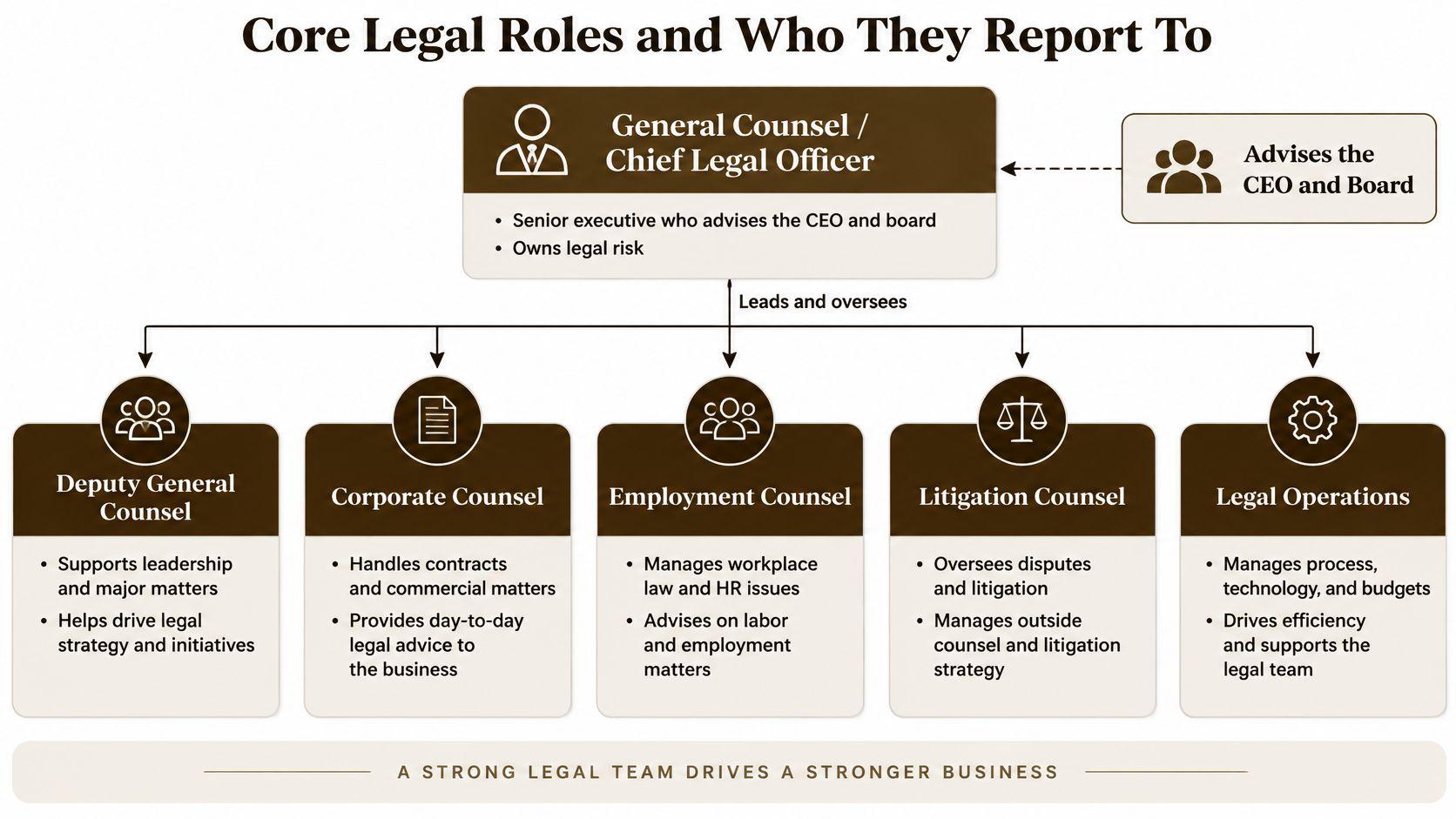
In a one-lawyer department, one person covers most rows in the table. As matter volume and risk grow, the department splits those rows into named jobs. The sequence matters because readers often hire titles they recognize rather than work that is piling up, so it's worth understanding what in-house counsel does day to day before deciding which box you need first.
| Role | What it owns | Typical reporting line |
|---|---|---|
| General Counsel or Chief Legal Officer | Legal strategy, executive advice, legal risk, department budget | Chief executive officer in most departments |
| Corporate counsel | Day-to-day commercial advice, governance, business contracts | General Counsel |
| Compliance counsel | Regulatory programs, policies, investigations, training | General Counsel, sometimes with a compliance officer |
| Intellectual property counsel | Patents, trademarks, licensing, IP disputes | General Counsel or senior corporate counsel |
| M&A counsel | Acquisitions, divestitures, due diligence, deal structure | General Counsel |
| Contracts counsel or manager | Templates, high-volume agreements, negotiation playbooks | General Counsel or legal operations |
| Legal operations lead | Intake, workflow, technology, vendor management, reporting | General Counsel or chief operating function |
Why the CEO reporting line matters
The 2025 Association of Corporate Counsel Chief Legal Officers Survey analyzed responses from 772 CLOs representing 48 countries and 20 industries. Globally, 79% of CLOs reported directly to the chief executive officer, and the proportion was 83% in the United States. That line gives the CLO direct access to central decision-making, so legal can shape a deal, product, or market entry while choices are still open.
Reporting through another executive isn't automatically wrong, but it changes the job. Advice arrives later, gets filtered, and competes with that executive's priorities. Readers often confuse access with status. The point isn't prestige. It's timing. A GC who hears about an acquisition at signing can only react, while a GC in the strategy discussion can change structure, price protection, or walk-away points.
The GC's wider span of control
The same survey found that 70% of CLOs managed at least two functions beyond traditional legal work, including risk, compliance, privacy, and ethics. It also found that 44% considered advising the CEO and shaping business strategy their greatest organizational impact, while 58% were heavily involved in mergers and acquisitions or other corporate transactions.
That's why modern charts often attach compliance, privacy, investigations, risk, and legal operations to the GC. The trade-off is capacity. A broad span improves coordination across control functions, but it can turn the GC into a bottleneck if deputies and functional leads don't have clear authority.
Draw your own chart now. Mark which boxes have a named owner, which roles report to the GC, which functions report elsewhere, and which work is shared without a final decision maker. Shared boxes are where matters stall.
Legal Operations and Support Staff by Company Revenue
Legal operations used to be whatever the GC or a senior lawyer handled between matters. That informal model breaks once intake, workflow design, technology administration, vendor management, budgeting, and performance measurement start competing with legal advice. The lawyer reviewing a contract shouldn't also be rebuilding the contract queue, chasing invoices, and producing the quarterly spend report.
Legal operations works like the department's operating system. Lawyers keep authority over legal risk. Operations owns how work enters, moves, gets measured, and gets improved. If you're defining that seat for the first time, the responsibilities in a legal operations director role show how far the job now extends beyond administration.
Staffing for this function scales with revenue, but not smoothly.
| Company revenue | Average legal-operations staff |
|---|---|
| Under $500 million | 4.4 |
| $500 million to $2 billion | 3.1 |
| $2 billion to $10 billion | 6.8 |
Those averages come from Thomson Reuters' 2023 Legal Department Operations Index, which reported 4.4 employees in companies with less than $500 million in revenue, 3.1 in companies generating $500 million to $2 billion, and 6.8 in companies generating $2 billion to $10 billion. The dip in the middle band doesn't prove midsize companies need less support. It shows staffing is irregular and often set by history rather than workload. Read the table as a starting point, not a quota. The right test is whether the team you have can keep matters moving at the pace the business requires, not whether you match an average.
A function that's formal, but often frozen
The same report found that more than 60% of departments had kept internal legal-operations headcount unchanged during the preceding year. Dedicated legal-operations capability has gone from uncommon to standard across corporate legal departments. Adoption moved faster than staffing. Many departments named the function before they funded enough people to run it.
Give the function explicit metrics or it becomes a help desk. Legal operations should own:
- Cycle time: How long matters take from intake to closure, by matter type.
- Contract turnaround: Time spent waiting on legal, the business, and the counterparty, shown separately.
- Outside-counsel spend: Cost by firm, matter type, and business unit, compared with budget.
- Matter aging: Work that's passed its target date and the reason it's stuck.
- Workload by practice area: Where demand is rising before it becomes a staffing crisis.
Splitting turnaround time into those three buckets matters more than it looks. A slow contract blamed on legal is often a counterparty sitting on redlines, and the fix is different in each case.
List every process currently run by the GC or practicing lawyers, then assign each one to a named owner, whether that's a legal operations manager, a paralegal, or a lawyer with protected time. During rapid growth, a systems implementation, or multi-office expansion, create the legal operations lead earlier than a lawyer-centric model suggests. You'll recover senior lawyer time faster than you'd gain it by adding another generalist to a broken queue.
Centralized, Embedded and Hybrid Counsel Models Compared
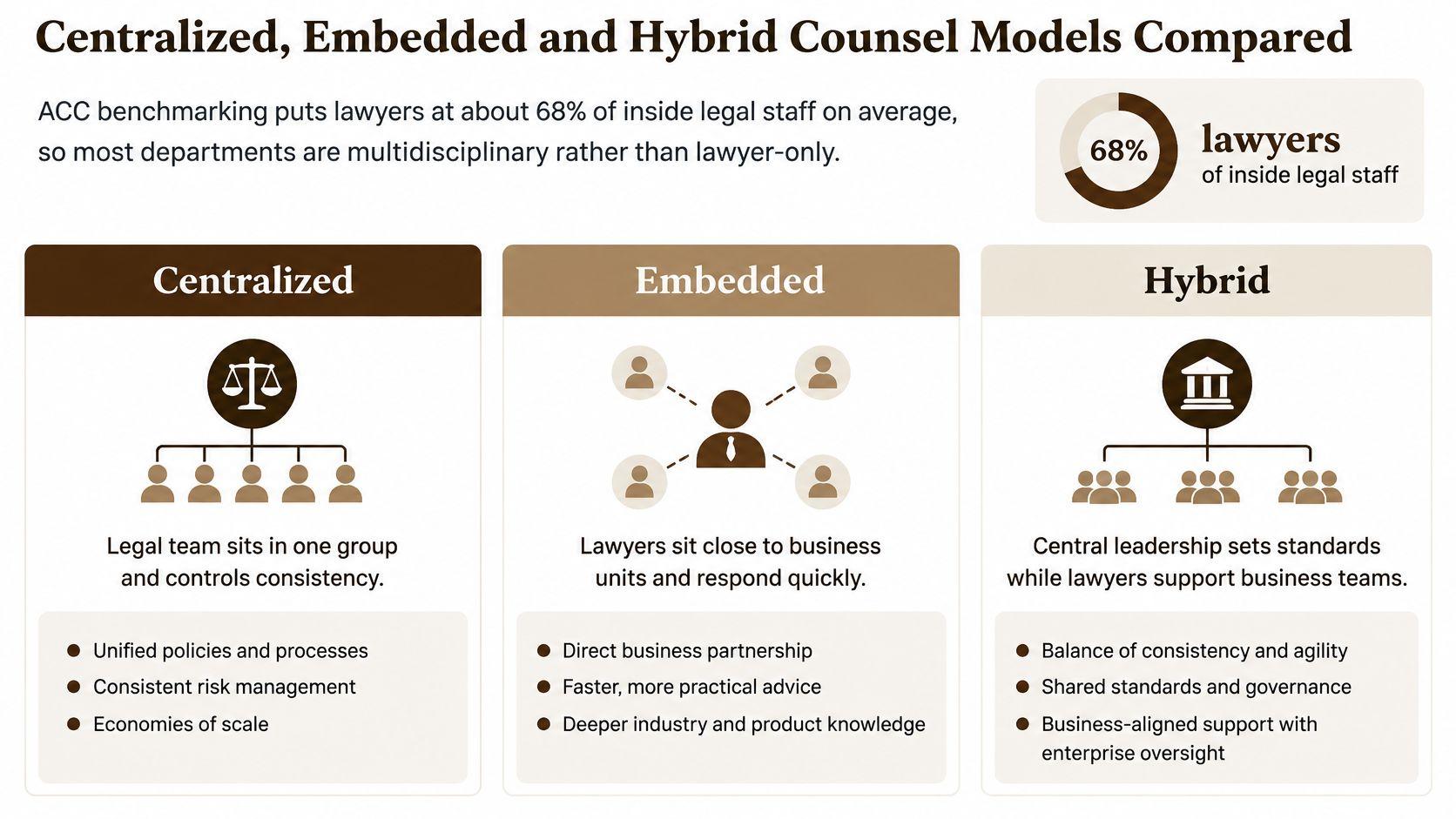
Most departments aren't lawyer-only teams, so the placement model decides how a mixed group of lawyers, paralegals, operations staff, and administrators works together. Readers often treat this as a seating question. It isn't. It's a decision about consistency, speed, and who sets priorities when legal and a business unit disagree.
Use three plain analogies. Centralized counsel is a fire station. Specialists wait in one place and go where they're sent. Embedded counsel is a paramedic in each neighborhood. Help is close and fast, but practice can drift between neighborhoods. Hybrid counsel keeps specialists at the station and places generalists in the neighborhoods, with shared dispatch.
The comparison below sets out the trade-offs.
| Model | How lawyers sit | Main strength | Main risk | Best fit |
|---|---|---|---|---|
| Centralized | Lawyers work in one legal team organized by specialty | Consistent advice and deep specialist skill in IP, M&A and compliance | Can feel distant from business teams and slow for routine requests | Companies with many repeatable matters and one headquarters |
| Embedded | Lawyers sit inside business units and take direction partly from them | Fast, business-aware advice on sales, products and deals | Advice drifts between units and knowledge stays siloed | Companies with distinct, fast-moving business units |
| Hybrid | Specialists are central, generalists are embedded, legal operations is shared | Balances speed with consistency | Needs clear reporting rules and named ownership | Mid-size and large departments with several business units |
Assign work by risk and repeatability
Don't choose a model by fashion. Sort the work first.
Complex, high-risk matters belong with specialists. A large acquisition, a patent dispute, or a government investigation needs deep expertise, consistent privilege handling, and direct GC oversight. Scattering that work across business units creates inconsistent positions the company may have to defend later.
Repeatable, high-volume work belongs in a system. NDAs, standard supplier agreements, and routine sales terms should move through templates, playbooks, paralegals, and legal operations, with lawyers handling exceptions. If a senior lawyer redlines the same limitation clause every week, your structure is wasting judgment on process failure.
Business-facing judgment belongs near the decision. Product launches, pricing changes, and nonstandard customer terms need counsel who understands the unit's customers, margins, and deadlines. That's the strongest case for embedded generalists, provided the GC still owns professional standards, escalation, and final legal positions.
A hybrid model fails when embedded lawyers have two bosses and no rule for whose priority wins.
List the top ten matters your department handled last year. Tag each one as specialist, embedded, or repeatable work. If most tags are repeatable, invest in templates and operations before lawyers. If most are specialist, centralize. If the list splits, hybrid is probably your honest answer.
How to Measure Whether Your Structure Creates Business Value
More lawyers don't automatically mean more value. That's the assumption to challenge before you approve headcount. A department can close more matters, work longer hours, and still leave executives convinced that legal slows the business down.
Recent Thomson Reuters research found that 86% of general counsel view legal as a significant business contributor, while only 17% of C-suite respondents agree. Nearly half of GCs also identify staffing and resource constraints as their top barrier to delivering additional value. Both sides may be telling the truth. Legal sees the work it absorbs. Executives see launch dates, deals, and problems that still reach them.
Judging a restaurant by how many plates leave the kitchen says nothing about whether guests come back. Legal has the same measurement problem. You need two tracks, and you need to connect them.
Track one activity, track two outcomes
Activity metrics show whether the machine runs. Use matter volume, cycle time, contract turnaround, outside-counsel spend, and matters aged past target. Reliable matter management systems make those numbers collectible without turning lawyers into data-entry staff.
Enterprise metrics show whether the machine matters. Use revenue enabled by deals closed, losses avoided, product-launch speed, compliance outcomes, and executive satisfaction with legal advice. These are harder to attribute, so don't pretend legal owns them alone. Show legal's contribution and the business owner who confirms it.
Link the tracks practice group by practice group. For commercial contracts, pair turnaround time with launch or signing dates. For litigation, pair matter aging and outside spend with losses avoided or settlement value against exposure. For compliance, pair training and investigation cycle time with repeat findings and regulatory outcomes.
Choose one activity metric that predicts an enterprise outcome, not ten activity metrics that predict nothing.
This framework also disciplines structure. If contract turnaround predicts launch speed, you may need a contracts manager and a playbook, not another corporate generalist. If executives rate advice poorly despite fast cycle times, embedded counsel may be too distant from decisions. If specialist matters keep aging, central capacity or outside counsel is the constraint.
Pick three metrics only. Assign an owner to each one, agree the definition with the business user who'll judge it, and set one quarterly review date. Without shared value metrics, added lawyers increase capacity while leaving the C-suite's view of legal unchanged.
How AI Adoption Reshapes Legal Roles and Accountability
Adopting AI is an org-chart decision because it moves production, review, and accountability to different seats. A drafting model works like a tireless junior associate: fast output, uneven judgment, and no ability to take the blame when a filing is wrong.
The operating picture below is where many departments now sit, with the tool available before governance catches up.

Thomson Reuters reports in its State of the Corporate Law Department Report that nearly half of corporate legal departments have an enterprise-wide generative-AI tool, yet very few collect implementation-success metrics or connect AI use to business revenue. That gap leaves legal leaders approving licenses before they know who answers when the tool invents a citation, exposes privileged material, or creates work that takes longer to check than to write.
Name the owner for each AI task
Six responsibilities need a name beside them. AI policy sets approved uses and prohibited data. Vendor risk covers confidentiality, retention, and model changes. Workflow redesign decides which steps disappear rather than speed up. Training teaches prompting and checking. Validation tests output against known answers. Escalation states when a lawyer must stop the process and take over.
The owner can sit in different places. A small department may give policy to the GC, workflow to a senior paralegal, and vendor review to IT with compliance support. A larger department may assign product ownership to legal operations and review standards to knowledge management or practice leaders. Size changes the seat. It doesn't remove the need for a seat.
The short briefing below is useful background before you assign those owners.
New hybrid roles follow from that map. A legal operations product manager runs the tool like a product, with users, releases, and adoption metrics. An AI governance counsel sets review rules and audit trails. Practice lawyers increasingly supervise automated drafting and research instead of producing every first draft themselves, which means their value shifts from volume to exception handling, judgment calls, and final accountability.
Hiring profiles shift with them. You'll screen less for a practice label alone and more for legal judgment, process design, data literacy, and change management in the same person. Judge the change by throughput and risk, not enthusiasm: cycle time, rework rate, outside-counsel dependence, audit findings, and whether partners trust the output enough to stop rechecking every line. Write the responsibility map before you write the job description. One named owner for each of the six tasks, plus one escalation path to the GC, is enough to start.
Choose Your Structure by Revenue Band
Match the structure to your revenue band first, confirm it against your metrics, and only then add headcount. Revenue isn't destiny, since a regulated company needs more compliance depth than an unregulated company of the same size. It's still the best starting filter because it tracks transaction volume, headcount, and the number of business units legal must serve.
Under $500 million in revenue
Run a small, centralized team of generalist lawyers supported by a paralegal and administrative help. One legal operations or senior paralegal owner can handle intake, templates, matter tracking, and outside-counsel invoices. Centralized counsel usually fits because decision makers sit around one headquarters, and a generalist who sees everything spots patterns a narrow specialist would miss.
Hire first for the bottleneck in your most valuable workflow. If sales contracts stall revenue, that's a contracts owner and playbook. If the GC drowns in intake and reporting, that's operations capacity. Don't split roles until one person carries two full queues.
$500 million to $2 billion in revenue
Move toward a hybrid model. Add specialists in intellectual property, M&A, and compliance as matter volume and consequence grow, keep them central, and embed generalists in the largest business units. Legal operations staffing in this band is irregular, so size that team from matter volume, systems load, and reporting demands rather than from last year's headcount.
This is the band where structure debt appears. Business units start asking their embedded lawyer for local answers that conflict with company positions. Solve it with clear escalation to central specialists, shared playbooks, and one intake record even when advice is delivered locally.
$2 billion to $10 billion in revenue
Fund a dedicated legal operations leader and a full hybrid model with shared metrics. At this scale, legal operations can support vendor management, technology administration, data reporting, and AI governance as distinct workstreams rather than side tasks. Specialists protect consistency, embedded generalists protect speed, and operations protects visibility across both.
In every band, use the same hiring order. First, hire the role that moves your most important enterprise metric. Second, hire or assign the owner of the process that metric depends on. Before approving either, test the choice against your value metrics and your AI responsibility map. If the new hire doesn't change a number an executive cares about, or doesn't own a process that's currently unowned, you don't have a staffing case yet.
That's the discipline behind a sound corporate legal department structure. Size follows work, roles follow accountability, and headcount follows evidence. Companies hiring in-house counsel can schedule a call with Five Star Placements to discuss the roles their structure identifies. We charge a contingent fee, with nothing due until the attorney starts.
If your revenue-band review points to a GC, specialist counsel, contracts lead, paralegal, or legal operations hire, Five Star Placements can run a legal-only search built around the metric that role must move and the process it'll own. Schedule a call to walk through your open roles, timing, and reporting lines, and you'll pay our contingent fee only when your hire starts.
Need help filling a legal role?
Five Star Placements partners with law firms and legal departments nationwide.
Schedule a Call