
Legal Assistant Interview Questions: 2026 Hiring Guide
July 3, 2026 · 21 min read · Five Star Placements
Table of contents
Hiring a legal assistant isn't just a resume-matching exercise. A pivotal question is whether your interview process can uncover the person who will protect deadlines, catch avoidable errors, manage pressure without drama, and represent your office well when attorneys are unavailable. Too many firms ask broad questions, get polished answers, and still miss the habits that drive performance.
That gap matters. In highly selective legal hiring environments, fewer than 1% of applicants may be hired, which means the interview has to separate serious talent from candidates who know how to sound prepared, as noted in Indeed's legal assistant interview guidance referencing highly selective legal hiring environments. Surface-level legal assistant interview questions won't do that.
The best interviews test judgment, work style, and technical readiness in ways that mirror the job. A strong candidate won't just say they're organized. They'll explain how they track deadlines, flag risks early, verify filings, learn unfamiliar terminology, and maintain confidentiality when facts are incomplete and pressure is high.
That's the standard this guide uses.
You'll find eight core legal assistant interview questions, plus the practical framework behind each one. For every question, I'll cover what a strong answer sounds like, how to evaluate it, what should worry you, and how a recruiter screening at a high level would use the answer to decide whether the candidate belongs in your process at all.
Table of Contents
- 1. Tell Me About Your Experience with Legal Document Management and Organization
- 2. Describe Your Experience Supporting Multiple Attorneys and Managing Competing Priorities
- 3. Walk Me Through Your Familiarity with Legal Terminology and How You Fill Knowledge Gaps
- 4. Describe Your Experience with Client Interaction and How You Maintain Confidentiality and Professionalism
- 5. What Skills Do You Bring to Legal Writing Support and How Have You Assisted with Motions, Briefs, or Legal Correspondence?
- 6. Describe Your Technical Proficiency and Experience with Legal Technology, Practice Management Software, and Learning New Systems
- 7. How Do You Handle Mistakes or Missed Deadlines, and What's Your Approach to Quality Assurance
- 8. Why Are You Interested in This Role, This Practice Area, and This Firm What Are Your Career Goals
- 8-Point Comparison: Legal Assistant Interview Questions
- Making the Right Hire Your Next Steps
1. Tell Me About Your Experience with Legal Document Management and Organization

This question sounds basic. It isn't. The answer usually tells you whether the candidate has supported legal work or has only touched administrative tasks around it.
A strong legal assistant will describe a repeatable filing logic, not just say they're “very organized.” Listen for how they name folders, track versions, separate draft from final documents, handle email attachments, maintain matter-specific records, and confirm that the right document lands in the right place at the right time. In litigation, that may mean pleadings, discovery, exhibits, and correspondence. In real estate, it may mean title work, closing packages, and signature sets. In corporate support, it often means contracts, approvals, and matter-based records.
What a Strong Answer Sounds Like
The best candidates explain their system in sequence. They'll tell you how a file is opened, how documents are labeled, where key dates are tracked, and what quality checks happen before anything is circulated or filed. They also tend to mention the platforms they've used instead of hiding behind generic phrases like “case software.”
Legal assistant interviews increasingly test real workflow competence, including software familiarity, flexibility, attention to detail, communication, and confidentiality, with employers specifically looking for experience relevant to document management systems and case management platforms, as discussed in Virtual Latinos' overview of legal assistant hiring criteria.
Practical rule: If a candidate can't explain their organizational method clearly, they probably can't execute it consistently under pressure.
What to Listen for in the Interview
Push past broad claims. Ask which systems they used, who set up the process, and what they personally improved. If they say they managed large volumes of documents, ask how they prevented duplicate versions or filing errors.
Use follow-ups like these:
- Ask about naming conventions: “How did you label drafts versus execution copies?”
- Ask about retrieval: “If an attorney needed an exhibit or client email in two minutes, how would you find it?”
- Ask about cleanup: “What did you do when a prior assistant left behind a disorganized file?”
Red flags are usually obvious once you press for detail. Candidates who've only worked at the surface will answer with soft traits. Strong candidates answer with process.
Five Star Placements uses this question early because it quickly shows whether someone can step into a practice and become productive in the firm's actual environment, not just interview well.
2. Describe Your Experience Supporting Multiple Attorneys and Managing Competing Priorities
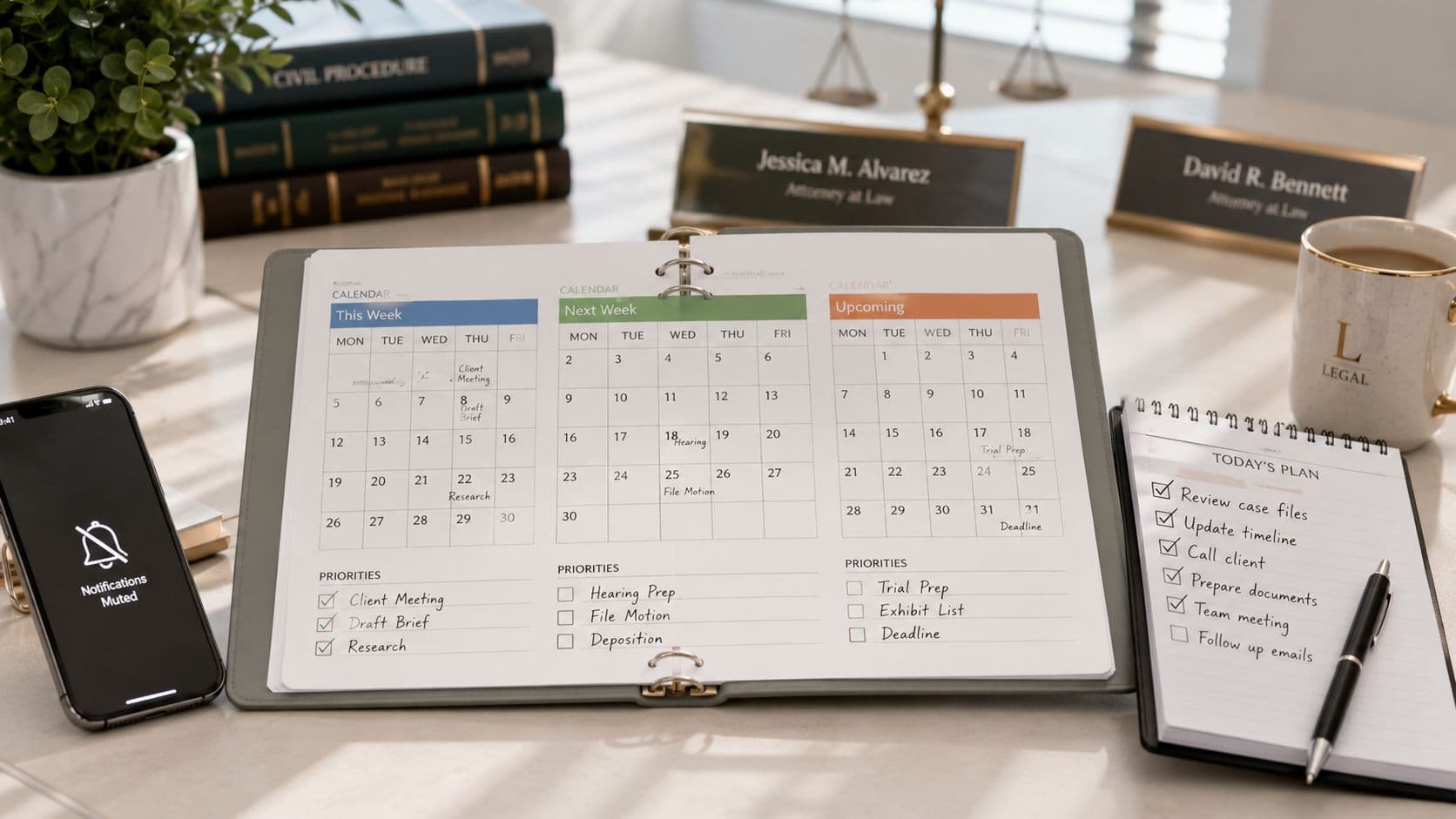
Some candidates confuse busyness with prioritization. They'll tell you they handled a lot, stayed calm, and worked hard. That isn't enough. You need to know how they decided what moved first, who they updated, and what happened when two attorneys wanted something at the same time.
The strongest answers include triage. A good legal assistant won't automatically react to the loudest request. They'll compare deadlines, court requirements, client impact, and attorney expectations. Then they'll communicate clearly. If a filing deadline conflicts with a non-urgent formatting request, they should know which one gets protected first and how to explain that professionally.
What Good Prioritization Actually Looks Like
A candidate worth moving forward can usually describe a real pressure scenario in plain language. They'll explain the moving pieces, the constraint, the decision they made, and how they kept others informed. That's much more useful than hearing, “I'm excellent at multitasking.”
Timed assessments are common in legal assistant interviews, including exercises that require candidates to type documents, identify typos, or demonstrate proofreading speed and workflow awareness under time pressure, according to paralegal professionals discussing common legal assistant interview practices on Reddit. That lines up with what firms already know. Prioritization is rarely theoretical in this role.
When a candidate describes priorities well, they usually mention communication before you even ask. That's a good sign.
Red Flags That Usually Show Up Fast
Watch for candidates who frame every heavy-workload story as heroic chaos. If someone's answer depends on staying late, skipping breaks, and “just making it happen,” that may sound committed, but it often signals weak systems.
Use a short probe set:
- Missed-deadline probe: “Tell me about a time a deadline slipped or almost slipped.”
- Conflicting-authority probe: “How did you handle two attorneys giving competing directions?”
- Feedback probe: “What happened when someone told you that your priority call was wrong?”
Five Star Placements often uses this question to calibrate fit by environment. A candidate who's excellent in a steady trusts and estates office may struggle in a litigation team where priorities shift by the hour. Neither candidate is wrong. The match matters.
3. Walk Me Through Your Familiarity with Legal Terminology and How You Fill Knowledge Gaps
Many interviews go off track. Firms either expect too much from junior candidates or too little from experienced ones. You don't need every legal assistant to sound like a lawyer. You do need them to know when they understand something, when they don't, and how they close the gap without risking errors.
A useful answer has two parts. First, the candidate explains what they already know in the practice area. Second, they explain how they learn unfamiliar terms, procedures, or document types. That second part matters more than most interviewers think.
What You Want from Entry-Level and Career-Changer Candidates
Entry-level candidates don't need deep substantive command. They do need a disciplined learning approach. Good answers mention taking notes, keeping a terminology list, reviewing prior filings, using internal templates, asking targeted questions, and checking court or procedural requirements rather than guessing.
Certification or vocational legal training can support candidacy even when someone doesn't have a formal law degree, and employers also screen for procedural knowledge such as filing protocols, court clerk coordination, drafting precision, and research using tools like Westlaw and LexisNexis, as outlined in this legal assistant career video on required technical specifications.
How to Separate Curiosity from Bluffing
Ask the candidate to explain a term or process from the practice area they've supported. Then ask what they do when they hear an unfamiliar term in a live conversation. Strong candidates won't pretend they know everything. They'll explain how they clarify without disrupting the attorney or exposing uncertainty to a client.
Try follow-ups like these:
- Check real familiarity: “What terms came up often in your last role?”
- Check live judgment: “If an attorney uses a term you don't know while dictating, what do you do next?”
- Check active learning: “What legal concept did you learn recently, and how did you get comfortable with it?”
Candidates who bluff usually overstate their understanding and give definitions that sound memorized but shallow. Candidates who are coachable sound more grounded. They'll say, in effect, “Here's what I know, here's what I'd verify, and here's how I'd learn it quickly.”
That's the answer you can build on.
4. Describe Your Experience with Client Interaction and How You Maintain Confidentiality and Professionalism

Many legal assistant interview questions treat confidentiality like a script test. They ask whether the candidate understands discretion, and the candidate says yes. That tells you almost nothing. Confidentiality is really a judgment question. It shows up when a caller wants more than they should have, when an attorney sends incomplete instructions late at night, or when a stressed client pushes for updates the assistant isn't authorized to give.
That's why this question should be scenario-based. Generic answers about passwords and locked cabinets are fine as a baseline, but they don't reveal how someone behaves under pressure.
What a Mature Answer Includes
A mature answer includes boundaries, escalation, and tone. The candidate should explain how they protect privileged or sensitive information, how they handle requests they can't fulfill, and how they maintain a calm professional presence without becoming cold or evasive.
Current hiring discussions increasingly point to scenario-based confidentiality questions because firms want to evaluate ethical reasoning in real time, not just hear textbook definitions, as described in Northwest Career College's discussion of legal assistant confidentiality interview questions.
For firms that want candidates screened beyond résumé claims, Five Star Placements builds this kind of judgment testing into the evaluation process. That matters when the role is client-facing from day one.
How to Judge Readiness for Client-Facing Work
Ask for a specific example. “Tell me about a time a client wanted information you couldn't share.” Then listen carefully to the language. Strong candidates don't sound defensive. They sound composed. They explain what they said, what they withheld, and when they looped in the attorney.
Hiring note: The best client-facing assistants know how to be warm without getting loose with information.
You can also test professionalism with edge-case scenarios:
- Boundary test: “What would you say if a client asked about another matter in the office?”
- Pressure test: “How would you handle an upset client who says the attorney never calls back?”
- Judgment test: “If you received a sensitive document with unclear instructions, what would you do before sharing or acting on it?”
Candidates ready for direct client contact answer with judgment. Candidates who need close supervision answer with policy words only.
5. What Skills Do You Bring to Legal Writing Support and How Have You Assisted with Motions, Briefs, or Legal Correspondence?
Legal writing support isn't limited to drafting from scratch. In many offices, the legal assistant's real value shows up in formatting, editing, cite-checking, assembling exhibits, proofreading, preparing signature packets, and making sure the final version is usable. A candidate who understands that distinction usually has stronger instincts than one who overclaims authorship.
Ask this question broadly enough to cover litigation, transactional, and administrative work. A litigation assistant may talk about discovery responses, notices, and motion support. A corporate legal assistant may talk about contract redlines, approval summaries, and internal correspondence. A real estate assistant may focus on closing documents and transaction checklists.
What Strong Writing Support Sounds Like
Good answers are specific about role boundaries. Strong candidates can explain what they drafted, what they revised, what attorneys reviewed, and how they checked accuracy before a document went out. They also understand that tone shifts by audience. A letter to opposing counsel isn't written like a client status email. An internal matter summary isn't written like a filing.
If the candidate says they proofread, ask how. If they say they checked citations, ask what that meant in practice. If they say they prepared motions, ask whether they drafted shells, assembled exhibits, updated captions, or managed filing readiness.
A Better Way to Test Writing During Hiring
Don't rely on self-report alone. Give a short exercise. Ask the candidate to revise a sample client email, proofread a marked-up pleading, or format a simple letter with obvious errors left in. Short, controlled exercises reveal more than polished interview answers.
Look for these indicators:
- Precision: Can they catch small mistakes without overediting?
- Tone control: Can they write clearly without sounding casual or stiff?
- Version discipline: Do they ask which draft controls before making changes?
- Instruction-following: Do they answer the assignment you gave, not the one they preferred?
Candidates who are strong in writing support often talk about preventing downstream mistakes. They know that a clean document isn't just attractive. It saves attorney time, reduces filing risk, and protects credibility with clients, courts, and opposing counsel.
6. Describe Your Technical Proficiency and Experience with Legal Technology, Practice Management Software, and Learning New Systems
A legal assistant who can't adapt to technology creates drag for everyone else. That doesn't mean every candidate needs the same software background. It does mean they need a believable learning curve and comfort with the tools that drive legal work.
The best answers name systems and explain actual usage. I'd rather hear, “I used Westlaw for case lookup, LexisNexis for research support, Adobe Acrobat for Bates labeling, Outlook for calendar coordination, and a case management platform for deadlines and document storage,” than hear, “I'm very tech-savvy.”
The Systems That Matter Most
Employers regularly prioritize organizational agility, attention to detail, professional communication, confidentiality, and proficiency with legal research tools such as Westlaw and LexisNexis when screening legal assistants, according to this breakdown of key legal assistant competencies on the Five Star Placements blog. Those tools don't matter because they sound impressive. They matter because they affect speed, quality, and supervision burden.
Ask candidates to rate their skill level by system, then justify it with a real task. Anyone can say they know a platform. Fewer can explain how they used it to support filing, research, document retrieval, matter tracking, or correspondence management.
How to Interview for Learning Speed
This question should test adaptation, not just software familiarity. Legal offices change systems. Migrations happen. New portals roll out. Practice groups adopt different workflows. A strong candidate won't panic when the interface changes.
Use practical follow-ups:
- Transition probe: “Tell me about a time you had to learn a new platform quickly.”
- Problem-solving probe: “If a document wouldn't format correctly for filing, what would you try first?”
- Research probe: “What's your experience with Westlaw or LexisNexis, and what did you use each for?”
A candidate doesn't need to know your exact stack on day one. They do need to show they can become reliable in it without being hand-held through every step.
Five Star Placements typically uses this question to separate trainable candidates from those who overstate technical confidence. That distinction saves firms from hiring someone who interviews well but slows down the practice after onboarding.
7. How Do You Handle Mistakes or Missed Deadlines, and What's Your Approach to Quality Assurance
This is one of the most revealing legal assistant interview questions you can ask. It tells you whether the candidate protects the firm when something goes wrong or protects themselves first.
No one in legal support is error-free. That isn't the point. The point is whether the candidate identifies mistakes quickly, escalates them appropriately, and changes the process so the same problem is less likely to happen again.
What Accountability Really Sounds Like
Strong answers are plain and direct. The candidate names the mistake, explains the impact, describes how they addressed it immediately, and then walks through the prevention step they put in place. That prevention step matters. It may be a calendar redundancy, a filing checklist, a second-pass proofread, a naming convention, or a better handoff process with the attorney.
Weak answers usually go one of two ways. Either the candidate insists they never make mistakes, which isn't credible, or they tell a story where every problem was someone else's fault. Neither response inspires confidence.
The safest hire often isn't the person with the smoothest history. It's the person who responds cleanly when something goes wrong.
How to Probe for Risk Without Creating a Trap
Don't make this question punitive. If candidates feel cornered, they'll give rehearsed, defensive answers. Instead, acknowledge the nature of legal work and ask for specifics.
Good follow-ups include:
- Ownership test: “What was your part in the mistake?”
- Response test: “Who did you tell, and how quickly?”
- Process test: “What changed afterward?”
- Pattern test: “What checks do you use now before anything is sent or filed?”
This is also where culture fit becomes visible. Some candidates come from offices where errors were hidden out of fear. Others come from teams where issues were surfaced fast and fixed responsibly. You want the second group. They reduce risk because they communicate early.
Five Star Placements pays close attention to this answer because honesty under pressure is one of the clearest predictors of whether a placement will strengthen or strain a legal team.
8. Why Are You Interested in This Role, This Practice Area, and This Firm What Are Your Career Goals
This question is often treated like a soft closer. It shouldn't be. It's one of the best ways to spot mismatch before you make an offer.
Motivation matters in legal support hiring because the day-to-day work is demanding and often repetitive in ways candidates don't fully appreciate at first. A person who likes the idea of law but has no real interest in your practice area, team style, or role structure is more likely to disengage quickly.
What Motivation Tells You About Retention
Listen for evidence of research and self-awareness. Strong candidates can explain why your practice area fits their interests, what kind of legal environment they work best in, and what they want to learn next. Their answer doesn't need to sound grand. It needs to sound informed.
There's also a culture dimension that many interview guides miss. Discussions among paralegal professionals point to hiring teams valuing personality and team contribution, including how a candidate would shape office dynamics rather than merely adapt to them, as reflected in this Reddit discussion about legal interview culture fit and first-entry-level interview advice.
For firms evaluating long-term fit, the Five Star Placements team uses this part of the interview to assess whether a candidate's goals align with the actual role, not an imagined one.
How to Use This Answer in Final-Round Decisions
Don't just ask why they want the job. Ask why this practice, why this firm structure, and what they expect the role to involve. Then compare the answer to reality.
A useful final-round probe set looks like this:
- Research test: “What stands out to you about our practice or reputation?”
- Career-fit test: “Where do you want this role to take you?”
- Expectation test: “What parts of this job do you think will be most demanding?”
- Contribution test: “How do you improve a team, not just fit into one?”
Candidates with staying power usually answer in a balanced way. They're interested, but not romantic. They understand the workload, they've thought about the environment, and they can connect their goals to the role you're hiring for.
8-Point Comparison: Legal Assistant Interview Questions
Which of these eight questions changes a hiring decision?
All eight matter, but not equally, and not in the same way for every opening. A litigation team with heavy filing volume should weigh document control, calendaring discipline, writing support, and quality assurance more heavily than a practice where the role is mostly front-end client communication. A managing partner hiring for a float assistant should care more about adaptability across attorneys and systems than narrow experience in one specialty.
That is the practical use of this comparison. It is not a scorecard to fill out mechanically. It is a way to decide where to press harder, where to verify skills with follow-up questions, and where one weak answer is a concern versus a deal-breaker.
The fastest way to improve interviews is to sort the eight questions into three groups.
Questions that test immediate job readiness
- Legal document management and organization
- Supporting multiple attorneys and competing priorities
- Legal writing support
- Technical proficiency with legal software
These answers tell you how quickly the candidate can step into the daily workload. If the firm needs someone productive in the first few weeks, these questions deserve close scrutiny. Vague answers here usually lead to slow onboarding, rework, and attorney frustration.
Questions that test judgment and risk control
- Client interaction, confidentiality, and professionalism
- Handling mistakes, missed deadlines, and quality assurance
These are the questions that protect the practice. A candidate can be pleasant and organized and still create risk if they do not know when to escalate, how to own an error, or how to protect sensitive information under pressure. I put extra weight on these answers for any role with direct client contact, court deadlines, or exposure to privileged material.
Questions that test long-term fit
- Legal terminology and filling knowledge gaps
- Interest in the role, practice area, firm, and career goals
These answers matter most when two candidates are otherwise close. One may have stronger current technical skills. The other may have better judgment about what they know, what they do not know, and whether they want the role you are offering. That difference often shows up six months later in retention and team stability.
A stronger hiring process also treats these questions differently depending on the seniority of the role. For an entry-level or junior legal assistant, I can accept lighter direct experience if the candidate shows a disciplined learning process, strong communication, and honesty about limits. For a mid-level or senior assistant, I expect specific examples, established systems, and a clear explanation of how they prevent errors before they reach the attorney or the client.
That is also how recruiters at firms like Five Star Placements separate polished interviewing from real capability. They do not treat every question as equal. They look at which answers predict performance in that specific seat, then test those areas more aggressively.
If you want a practical rule, use this one. Weight the questions based on the actual pain points behind the hire. If attorneys are missing deadlines, focus on prioritization and quality control. If work is bottlenecked in drafting and formatting, press on writing support and document handling. If turnover has been the problem, pay closer attention to motivation, expectations, and fit.
Making the Right Hire Your Next Steps
The strongest legal assistant interviews don't revolve around clever questions. They revolve around disciplined evaluation. That means asking questions that map to the actual work, pressing for examples, and judging answers based on evidence of process, judgment, communication, and accountability.
That's where many hiring teams lose traction. They ask reasonable legal assistant interview questions, but they don't probe sufficiently to separate polished candidates from capable ones. A candidate says they're organized, detail-oriented, and good under pressure. Nearly everyone says that. What matters is whether they can explain how they organize files, how they catch errors, how they prioritize when three things are urgent, and how they respond when they don't know something.
The framework in this guide helps you make those distinctions. If a candidate gives a vague answer, you now know where to push. If they overstate software ability, you know how to test it. If they claim strong confidentiality judgment, you know to use a scenario instead of accepting a scripted response. If they say they work well with multiple attorneys, you know to ask what happened when those attorneys wanted different things.
That approach improves consistency across your hiring process. It also gives you better internal alignment. Hiring partners, office managers, HR leaders, and supervising attorneys can evaluate the same candidate against the same standards instead of relying on instinct alone. In legal hiring, that consistency matters because one weak support hire can create daily friction across an entire team.
It also helps to remember that not every strong candidate is strong for every environment. Some legal assistants excel in structured, process-driven practices. Others are at their best in fast-moving litigation or high-volume client service settings. The right hire isn't just the most polished person in the interview. It's the candidate whose habits match your deadlines, your communication style, your client exposure level, and your supervision capacity.
For firms that want to reduce that guesswork, working with a legal recruiter who understands support roles can make the process much more efficient. Five Star Placements focuses on legal hiring and screens candidates for the same practical issues that matter once someone is on the job. That includes readiness for your practice area, comfort with your pace, communication style, technical fit, and the culture factors that often drive success or failure after the offer is signed.
That kind of front-end screening is valuable when your team doesn't have time to interview broadly or recover from a weak hire. It shortens the path to candidates who are already more likely to succeed in your environment. It also gives hiring managers a more informed starting point for final interviews, reference checks, and offer decisions.
The best result isn't merely filling the seat. It's hiring a legal assistant who improves attorney efficiency, protects workflow, supports clients professionally, and becomes reliable enough that your team stops worrying about the role. That's the standard worth interviewing for.
If you're hiring legal assistants and want a stronger shortlist, Five Star Placements can help you identify candidates who meet the technical, organizational, and culture-fit demands of your practice before they ever reach the final interview.
Need help filling a legal role?
Five Star Placements partners with law firms and legal departments nationwide.
Schedule a Call