
Legal Assistant Recruitment: Your 2026 Playbook for Success
July 1, 2026 · 19 min read · Five Star Placements

Table of Contents
61% of legal leaders say finding skilled professionals is harder than it was the year before, even as 58% plan to add permanent staff and the market logged more than 24,300 paralegal and legal assistant jobs according to Robert Half's legal hiring data. This is the overarching situation for legal assistant recruitment in 2026. The issue isn't whether firms need support staff. They do. The issue is whether they know how to hire people who can step into live matters, handle pressure, and stay.
That pressure isn't going away. The U.S. Bureau of Labor Statistics projects little or no percentage growth in paralegal and legal assistant employment from 2024 to 2034, yet the role is still expected to produce about 39,300 annual openings driven mostly by replacement needs rather than new demand. In practice, that means legal assistant recruitment is less about catching a hiring wave and more about running a disciplined replacement and retention system.
The firms that hire well don't treat recruiting as a transaction. They build for fit from the first draft of the job description through onboarding. That's where the return comes from.
Table of Contents
- Why Finding the Right Legal Assistant Is Harder Than Ever
- Defining the Role and Writing a Magnetic Job Description
- Sourcing Talent Where Your Competitors Arent Looking
- Screening for Skill and Assessing for Culture Fit
- Conducting Effective Interviews and Setting Compensation
- Onboarding for Success and Driving Long-Term Retention
Why Finding the Right Legal Assistant Is Harder Than Ever
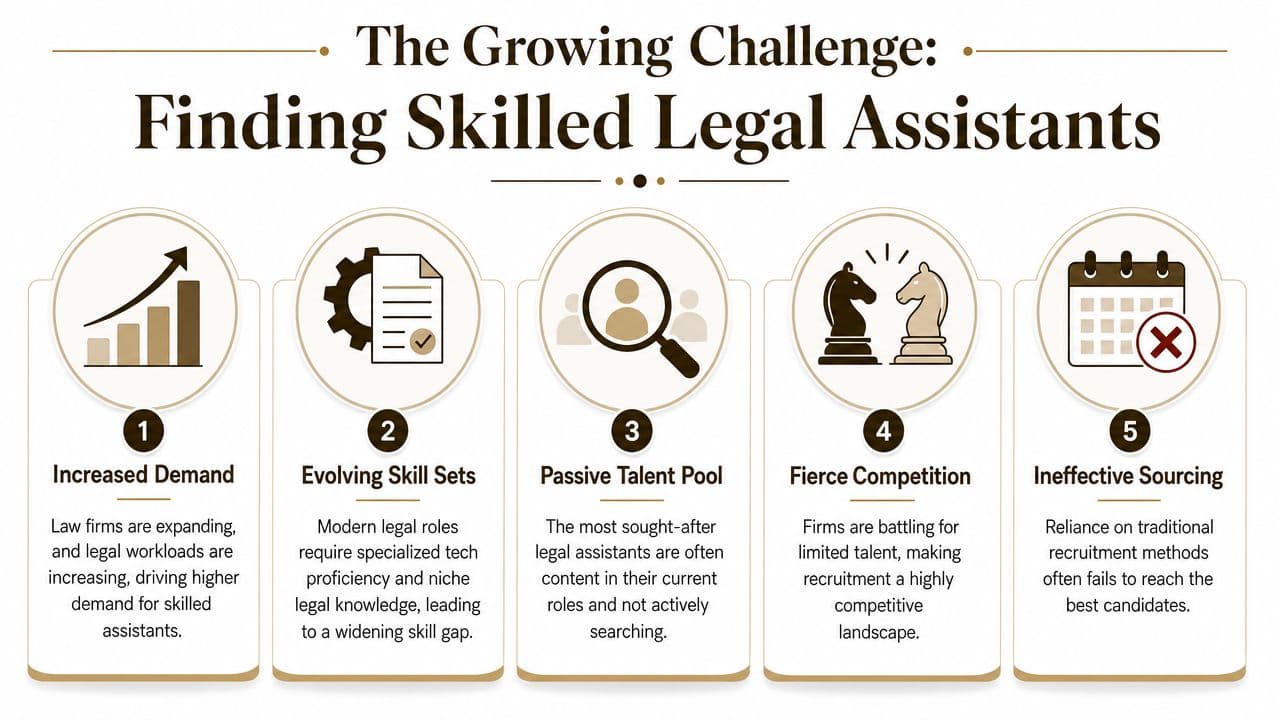
Legal assistant hiring stays active even in slower growth periods, because firms still have to replace people who retire, move to another employer, or leave the field. That replacement pressure is one reason so many searches feel harder than they did a few years ago. The problem is not getting applicants. The problem is getting applicants who can step into a live practice, protect attorney time, and stay long enough to justify the hire.
A strong legal assistant improves output fast. Deadlines get tracked correctly. Filings go out on time. Clients get answers without attorneys chasing status updates. Formatting errors, missed follow-ups, and calendar gaps drop. A weak hire creates the opposite pattern, and the cost shows up in billable leakage, partner frustration, and preventable service mistakes.
Demand is active, but day-one-ready talent is narrower
The applicant pool often looks healthy on paper. Resume volume can be misleading.
What firms need is narrower than the title suggests. They need someone who can manage legal documents with precision, communicate with clients and attorneys in the right tone, use the practice's software without a long runway, and exercise judgment under deadline pressure. That combination is harder to find, especially when competing employers are hiring for the same blend of reliability and discretion.
Many firms also create their own hiring drag. They write broad job ads, screen too late for the work that matters, and treat culture fit as a soft issue instead of a retention issue. We see the opposite work better at Five Star Placements. Firms that define the operating style of the team early, and explain what success looks like after hire, usually attract stronger candidates and lose fewer good ones during the process. That approach is part of how we frame our legal recruiting team and hiring methodology.
Replacement hiring changes the economics
Replacement hiring has a different math than growth hiring. If a legal assistant leaves, the firm is not merely filling a seat. It is repairing workflow, restoring attorney effectiveness, and protecting client experience before standards slip.
That shift matters because the true cost of a miss is rarely limited to salary. It includes slower turnaround, extra supervision from senior staff, rework, and the risk that the next hire leaves for the same reasons as the last one. Firms that ignore retention until onboarding usually repeat the cycle. Firms that build retention into the process earlier tend to hire with more discipline. They define the environment clearly, test for fit with the attorneys and workflow the person will support, and avoid selling a version of the job that does not match reality.
Candidates notice all of this. They can tell when expectations are unclear, when interviewers disagree, or when the role has not been scoped well enough to support long-term success. The firms that hire better are usually the firms that present a clearer business case for joining and staying.
Defining the Role and Writing a Magnetic Job Description
Most legal assistant searches go off track before sourcing even begins. The job description is often too generic, too inflated, or too vague to help anyone. It reads like a recycled HR document instead of a useful hiring tool.
The better approach starts with the role as it exists inside your practice, not the role title on an old posting.
Start with workload not assumptions
Before writing anything, answer a few operational questions:
- What work is backing up: Is the pressure around e-filing, client intake, scheduling, records management, billing support, trial prep, or document production?
- Which lawyers will lean on this person most: A litigation partner needs different support than a trusts and estates attorney or an in-house legal ops team.
- What software is essential: If the desk runs on Clio, Relativity, NetDocuments, iManage, or court e-filing platforms, say so plainly.
- What pace defines success: Some environments need calm, high-volume execution. Others need white-glove client handling and flawless follow-through.
That internal assessment lines up with the recruiting methodology outlined by Scion Staffing's guidance on successful paralegal recruiting, which emphasizes evaluating workload, growth, practice area needs, technical skills, and stakeholder input before drafting the role.
A useful role definition also separates what can be trained from what can't. You can train a new docketing workflow. You can't easily train urgency, attention to detail, or judgment around confidential communication.
Write the description for the candidate you actually want
Generic job descriptions attract generic applications. Strong ones narrow the field on purpose.
Here's the difference in practice:
“Seeking legal assistant to support attorneys with administrative and legal tasks in a fast-paced environment.”
That tells a qualified candidate almost nothing. Compare it with a sharper version:
“Seeking a legal assistant to support a litigation team with document preparation, court filings, deadline tracking, attorney calendar management, and client communication. Candidates should be comfortable working inside a deadline-driven practice, coordinating across attorneys and paralegals, and using the firm's core systems with minimal supervision.”
The second version creates a picture of the job. It helps qualified people self-select in, and helps mismatched applicants self-select out.
A magnetic description usually includes these elements:
-
Scope Name the practice area, reporting line, and daily outputs. “Support two partners in commercial litigation” is better than “assist attorneys as needed.”
-
The tools that matter
Spell out the tech stack or workflow requirements. If the role depends on e-filing fluency or document management systems, don't hide that in line twelve. -
The behavior profile
State how the person needs to work. Organized under pressure. Clear in client communication. Careful with confidential information. Comfortable following through without repeated prompting. -
The culture signals
Don't write “must be a team player” and leave it there. Explain what teamwork looks like in your office. Does the team share deadlines openly? Does the role require direct contact with demanding clients? Does the firm value autonomy or frequent check-ins?
The retention filter belongs in the job description
Many firms miss a substantial opportunity. They treat retention as something to fix after the hire. It should show up in the posting itself.
If the role has heavy peaks around trial calendars, say that. If lawyers expect same-day responsiveness, say that too. If the office is collaborative and people jump in outside formal job boundaries, include it. Clear expectations improve fit before interviews begin.
A strong job description doesn't try to appeal to everyone. It attracts the legal assistant who will succeed in your environment for more than a few months.
Sourcing Talent Where Your Competitors Arent Looking
Most firms overestimate how much the open market will solve for them. They post a role, wait for applicants, and wonder why the shortlist feels thin.
That approach misses where many good legal assistants move.

Job boards are a tool not a strategy
According to Prime Legal's 2026 guide to finding legal assistant jobs, 60% of legal assistant roles are filled via internal networks, and connecting with law firm administrators is described as the highest-yield strategy because they often hear about openings before they're public. That single point changes how smart legal assistant recruitment should work.
If most movement happens through networks, then public ads should support your search, not define it.
The highest-yield sourcing channels usually look like this:
-
Law firm administrators and office leaders
They often know when someone is planning to leave, when a team is stretched, or when a role will open after budget approval. These conversations surface timing before the market sees it. -
Former colleagues and referral loops
Legal assistants who perform well often know other legal assistants who perform well. One trusted introduction can save weeks of poor-fit screening. -
Local bar association events
Not because everyone there is job hunting, but because legal support professionals, administrators, and attorneys gather in the same room. That's where quiet market intelligence travels. -
LinkedIn with a narrow brief
Search by practice area, software exposure, title progression, and tenure patterns. Don't just search “legal assistant.” Search for clues that the person can handle your actual desk.
The best candidates are often not inactive. They're selective. They'll talk when the role is clearly better than what they have.
A broader recruiting content stream can support this kind of proactive outreach, but it only works if the sourcing strategy is specific. That's why firms that study legal hiring insights and recruiting advice often shift from ad-driven searching to relationship-driven pipelines.
How to approach passive candidates without sounding scripted
Most outreach fails because it sounds like mass outreach. Legal assistants can tell when the sender hasn't read their background.
A stronger note is short and role-specific:
- Open with relevance: Mention the practice setting, software, or support scope that matches their background.
- Name the reason for contact: “Your background supporting litigation calendars and filings stood out.”
- Give enough context to earn a reply: In-office, hybrid, team structure, and the nature of attorney support all matter.
- Avoid hard selling: Invite a conversation. Don't push for a resume in the first message.
Here's a simple structure that works better than generic recruiting copy:
I came across your background and noticed your experience supporting litigation workflows and managing filing deadlines. I'm working on a legal assistant search where those skills matter day to day. If you'd be open to a brief confidential conversation, I'd be glad to share the scope and see whether it's worth discussing.
That kind of message respects the candidate's position. It also avoids one of the most common mistakes in legal assistant recruitment, which is assuming every qualified person is actively applying.
For teams that need a quick reset on passive candidate outreach and legal support sourcing, this short video is worth a look.
Screening for Skill and Assessing for Culture Fit
A weak screen creates two expensive problems at once. Firms waste attorney time on candidates who cannot handle the work, and they miss candidates who could have stayed for years because nobody tested for the actual environment.
The fix is to screen for performance and retention at the same time.
In legal assistant recruitment, culture fit should never sit in a separate box at the end of the process. It starts in the screen. If the role requires calm communication, tight deadline control, and comfort with direct feedback, those conditions need to show up before the interview panel gets involved. That approach improves hiring accuracy, and it reduces avoidable turnover in the first 90 days.
Verify the work before the interview loop gets expensive
Too many firms wait until the second or third conversation to find out whether a candidate can format pleadings correctly, catch a date error, or manage competing requests from two attorneys. By then, the team has already spent real time on a candidate who should have been filtered out early.
A better process uses a short front-end screen built around the desk the person will inherit. Keep it practical. Keep it brief. Make it relevant to the practice.
Useful screening exercises include:
- A proofreading task with formatting errors, deadline issues, inconsistent party names, or citation mistakes
- A prioritization scenario that forces the candidate to explain how they would respond to conflicting attorney requests
- A document production exercise tied to the materials your team handles every week
- A short recorded response that shows whether the candidate communicates with clarity, judgment, and professional tone
The point is not to create homework. The point is to see whether the candidate can do the kind of work that affects attorney efficiency, client confidence, and filing accuracy.
Hiring shortcut: If the job requires precision under pressure, the screening process should test precision under pressure.
That standard also supports retention. Candidates stay longer when the hiring process reflects the actual role, not a polished version of it. A realistic screen gives them a fair preview of the pace, expectations, and communication style they are signing up for.
Use a culture screen that measures behavior, not likability
Culture fit gets mishandled when firms treat it as chemistry. Chemistry is unreliable. Behavior is measurable.
For legal assistants, culture fit usually comes down to a few practical questions. Does this person clarify vague instructions or make risky assumptions? Can they stay composed when a lawyer changes direction late in the day? Do they protect confidential information without becoming rigid or defensive? Can they work inside the firm's feedback style without creating daily friction?
Those are retention questions as much as hiring questions.
Ask for examples that show how the candidate works:
- When an attorney gives incomplete instructions, what did you do?
- Tell me about a time two urgent requests hit at once. How did you decide what moved first?
- Describe a situation where you found an error close to a filing deadline. What happened next?
- How have you handled confidential or emotionally charged client communication?
- Tell me about a manager whose style was very direct. How did you adapt?
Strong answers are specific. Weak answers stay abstract, blame other people, or skip the decision-making process entirely.
Score against a shared standard
A screening rubric helps firms avoid two common mistakes. One interviewer overvalues polish. Another overvalues technical experience from a familiar practice area. The result is inconsistent hiring.
Use a simple scorecard that combines skill, work habits, and team fit.
| Competency Area | Indicator of Success (1-5 Scale) | Evaluation Method |
|---|---|---|
| Attention to detail | Produces accurate work with minimal corrections | Proofreading or formatting exercise |
| Legal workflow readiness | Understands filing, calendaring, and document flow in the relevant practice | Resume screen plus technical review |
| Communication | Speaks and writes clearly, professionally, and concisely | Recorded response plus live screening call |
| Prioritization | Handles competing deadlines with sound judgment | Scenario-based questions |
| Initiative | Identifies issues early and follows through without repeated prompting | Behavioral screening |
| Confidentiality and professionalism | Shows discretion and maturity in sensitive situations | Situational prompts and references |
| Team alignment | Fits the firm's pace, feedback style, and collaboration norms | Structured screening and panel feedback |
This keeps the process grounded in evidence. It also makes it easier to compare candidates fairly across different backgrounds.
A candidate can come across as personable and still be a poor hire. The standard is reliability. Can this person step into the team, support the attorneys effectively, and work in a way that the firm will want to retain? That question should shape the screen long before onboarding begins.
Conducting Effective Interviews and Setting Compensation
Firms lose strong legal assistant candidates in the interview stage for two predictable reasons. The process is too loose to surface how the person will perform in practice, or the offer ignores what makes someone stay.
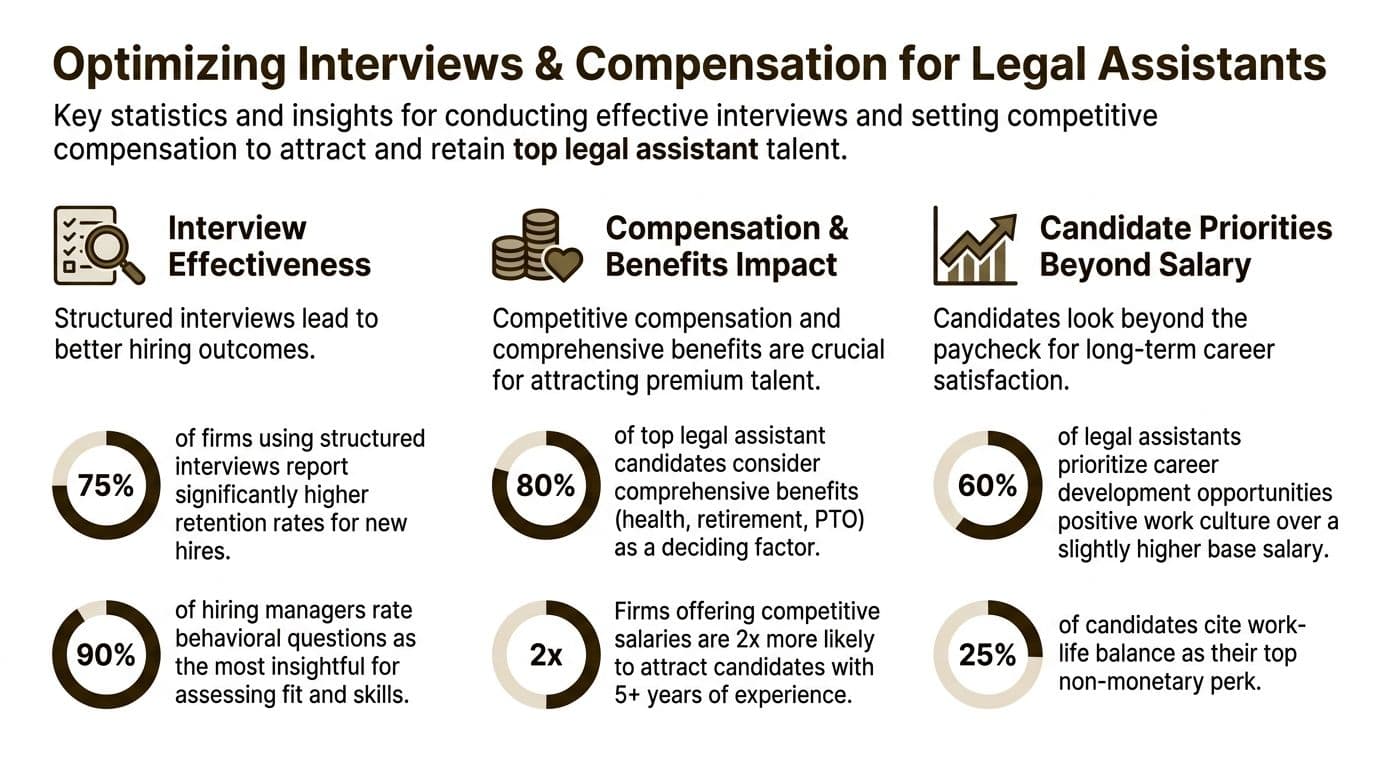
By this point, baseline capability should already be established. Interviews should test judgment, communication under pressure, and whether the candidate can work in the firm's actual environment without creating friction six months later. That means every interviewer needs a defined job, and every question should connect to retention as much as selection.
Who should interview and what each person should test
A good interview panel is small, deliberate, and aligned. Three interviewers is usually enough. More than that often slows the process and produces conflicting feedback that has nothing to do with performance.
Use the panel to test different risk areas.
-
Hiring attorney or partner
Assess responsiveness, prioritization, and fit with the attorney's working style. If the attorney gives fast, incomplete directions, ask how the candidate handles ambiguity and deadline shifts. -
Senior paralegal or lead legal assistant
Assess workflow judgment and practical readiness. This person can usually tell within a few answers whether the candidate really understands document handling, filing pressure, and support expectations. -
Administrator or office leader
Assess reliability, professionalism, and fit with the office culture. This matters more than firms admit. A legal assistant who can do the work but resists feedback or disrupts communication is still an expensive miss.
Behavioral questions work best when they are specific and tied to the role you are filling. Ask for examples with context, action, and result. Then listen for how the candidate made decisions, not just whether the story sounds polished.
Useful prompts include:
- Tell me about a time you caught an error close to a filing or deadline. What did you do next?
- Describe a situation where two attorneys needed help at the same time. How did you set priorities?
- Give an example of a difficult client or opposing counsel interaction. How did you handle it professionally?
- Tell me about a process problem you fixed, or a recurring mistake you helped prevent.
A strong answer shows more than competence. It shows work habits the firm can keep.
Compensation has to match the move you are asking someone to make
Compensation decisions break down when firms anchor to old internal pay ranges and ignore market reality, switching risk, and retention. A legal assistant is not only comparing salary. They are judging schedule stability, commute, attorney temperament, training, and whether the role will still make sense after the first ninety days.
That is why offer strategy starts before the offer. If the role is fully in office, say so early. If overtime spikes around trial prep, closings, or heavy filings, explain that plainly. If the legal assistant will support a demanding rainmaker with little structure, that should not be a surprise on acceptance day. Clarity protects acceptance rates and long-term retention.
A competitive offer usually includes more than base pay:
- Clear reporting lines: who the legal assistant supports and who gives day-to-day direction
- Defined success measures: accuracy, turnaround time, communication standards, and workload expectations
- Realistic schedule expectations: in-office requirements, hybrid flexibility, and peak workload periods
- Growth potential: training on systems, exposure to higher-level work, and room to advance
- Benefits that hold up in practice: time off, health coverage, bonus structure, and any flexibility the firm can honor
I have seen firms lose good candidates over relatively small salary gaps because the broader offer felt uncertain. I have also seen candidates accept a lateral move at similar pay because the role was better defined, the supervision was stronger, and the culture felt sustainable.
That trade-off matters. Retention starts in the interview room and gets reinforced in the offer. If you want a legal assistant who stays, pay for the level of responsibility, describe the job accurately, and make sure the candidate can see a workable future with your team. Firms that need help calibrating interviews, offers, and hiring process can talk with our legal recruiting team.
Onboarding for Success and Driving Long-Term Retention
Early attrition is expensive. In legal support hiring, the cost is not just another search fee. It shows up in missed deadlines, attorney frustration, retraining time, and client service that slips while a team covers the gap.
That is why I treat onboarding as part of legal assistant recruitment. If a firm wants a hire who lasts, retention has to be built into the process before day one and tested during the first ninety days.
A good legal assistant can still fail in a poorly run start. I have seen strong hires walk into offices with no system access, no template library, no clear supervisor, and three people giving conflicting instructions by lunch. That is not a recruiting problem. It is an execution problem, and it drives preventable turnover.
What a strong first ninety days looks like
The first ninety days should answer three questions quickly:
- What does good work look like here
- Who do I go to when I need an answer
- How will performance be measured
Firms that answer those questions early keep more of the people they worked hard to hire.
The setup starts before the person arrives. Technology, workspace, billing access, document management permissions, filing credentials, sample work product, and attorney preference notes should be ready in advance. If the role supports multiple attorneys, the firm should decide who sets priorities when requests conflict. That single decision prevents a surprising amount of friction.
The first week should focus on how work moves through the office. Introductions matter, but practical training matters more. Show the new hire where forms live, how deadlines are tracked, what a finished assignment should look like, when to escalate a problem, and how each attorney wants updates handled.
By the first month, the legal assistant should have a clear support structure. Assigning a reliable point person helps far more than giving broad encouragement to “ask questions.” In practice, new hires stay longer when they know exactly who can help with court filing quirks, document naming rules, billing entries, and the unwritten rules that shape daily work.
Supervisors also need scheduled check-ins. Not casual drive-bys. Real meetings with enough structure to catch problems early, adjust workload, and confirm whether the job matches what was described during recruiting.
Early turnover usually shows up in small signals first. Confusion about priorities. Silence instead of questions. Repeated avoidable errors. Delays that point to hesitation, not lack of effort.
Retention gets won in the handoff between recruiting and management
Culture fit is not proven in the interview alone. It gets confirmed when the firm trains, manages, and communicates the way it said it would.
If responsiveness was part of the hiring profile, define response-time expectations in onboarding. If attention to detail mattered in the interview process, show the new hire the quality-control steps the firm expects on every filing, draft, and calendar entry. If the office says it values calm communication under pressure, supervisors need to model that standard when deadlines tighten.
This is the trade-off firms often miss. They spend time screening carefully, then hand the hire to a manager with no onboarding plan and hope competence fills the gap. Top legal assistants rarely stay in that environment for long, especially if they have other options.
Retention improves when the job description, interview process, offer, and onboarding all tell the same story. That consistency builds trust. It also gives managers a fair basis for accountability because expectations were clear from the start.
Firms that want better retention should audit onboarding with the same discipline they use to review candidate resumes. Where do new hires get stuck? Who owns training? Which attorney preferences are documented, and which still live in someone's head? Those details decide whether a promising hire becomes a stable long-term contributor or an expensive replacement search.
If your team needs help tightening that process, speak with our legal recruiting team about legal assistant hiring and retention.
Need help filling a legal role?
Five Star Placements partners with law firms and legal departments nationwide.
Schedule a Call