
Legal Recruiter vs Job Posting: Your 2026 Hiring Guide
June 26, 2026 · 16 min read · Five Star Placements

Table of Contents
Your hiring committee is staring at the same problem many firms and legal departments face right now. A critical role opens, client work doesn't slow down, and your options look deceptively simple. Post the job and wait. Or hire a legal recruiter and pay a fee.
That's the wrong way to frame it.
The core question in the legal recruiter vs job posting decision is this: do you want broad visibility, or do you want controlled access to qualified, interested, and properly vetted talent? Those are not the same thing. In legal hiring, they rarely lead to the same outcome.
The market has made this choice more consequential. In late 2024, new legal job openings fell sharply year over year, yet the total number of open legal positions still rose, signaling backlog and sustained demand rather than a cooling market, as reported by Leopard Solutions on November 2024 legal job market trends. That means delay is expensive, noise is dangerous, and a public posting can give you a false sense of market coverage.
Table of Contents
- The Modern Legal Hiring Dilemma
- A Framework for Your Hiring Decision
- Analyzing Cost Time and True ROI
- Candidate Quality and The Hidden Job Market
- Screening Depth Confidentiality and Cultural Fit
- Matching The Method to The Mandate
- Your Decision Checklist and FAQs
The Modern Legal Hiring Dilemma
A partner resigns on Friday. By Monday, key clients are asking who will cover the work. A senior associate is already stretched. Your internal team posts the role, resumes start coming in, and everyone feels progress. In reality, the risk has already shifted to service quality, retention, and revenue.
That scenario makes the legal recruiter vs job posting question strategic, not administrative.
A public posting creates visibility. It does not create control. You get applicants, but you also get noise, delay, and a false sense that the market has spoken. In legal hiring, the visible market is only part of the market. Many of the strongest candidates are not applying at all. They are employed, discreet, and willing to listen only if the approach is targeted and credible.
The public market is also less honest than many hiring teams admit. Some listings are real searches. Some are stale. Some are posted to test compensation, collect resumes, or signal growth internally. Ghost posts distort your read on supply and demand, and they distort candidate behavior too. If you rely only on what is posted publicly, you are making a hiring decision based on an incomplete and sometimes misleading picture of available talent.
That matters because legal vacancies rarely stay contained.
When a revenue-producing partner leaves, the cost shows up in client uncertainty and missed expansion opportunities. When an in-house lawyer exits during a major contract cycle, business teams slow down or take risks without enough legal coverage. When the role remains open, your best people absorb the extra load, and that creates the next retention problem.
Why the default choice often fails
Managing partners and GCs often default to a job posting because the upfront cost looks lower and the process looks easy to defend. Post the role. Route applicants to HR. Wait for the market to respond.
That approach breaks down fast for legal hiring because the problem is not getting resumes. It is getting the right resumes, under the right conditions, with the right level of discretion.
Three issues usually get ignored:
- Postings attract inbound interest, not the full candidate market. The strongest lawyers are often selective, passive, and absent from public applicant flow.
- Public ads weaken confidentiality. If you are replacing a partner, a senior in-house lawyer, or a function tied to a sensitive initiative, the market can read the signal before you have a plan.
- Uncontrolled candidate submissions create risk. Multiple recruiters, referral sources, and direct applicants can send the same lawyer into your process with different compensation expectations, ownership disputes, and a poor candidate experience.
That last point is expensive. Once submissions are uncontrolled, your hiring team spends time sorting out who introduced whom, whether a fee is owed, and which conversation reached the candidate first. Good candidates notice the disorder. Some withdraw. Others question whether your organization runs important decisions the same way.
A job posting has a place. It works for straightforward, lower-sensitivity roles where broad visibility is useful and time pressure is manageable. But for business-critical legal hires, posting first and hoping the right person appears is usually weak strategy. You need a process that reaches the hidden market, protects confidentiality, and keeps candidate flow disciplined from the start.
A Framework for Your Hiring Decision
You don't need a philosophical debate. You need a practical framework that tells you which channel fits the mandate.
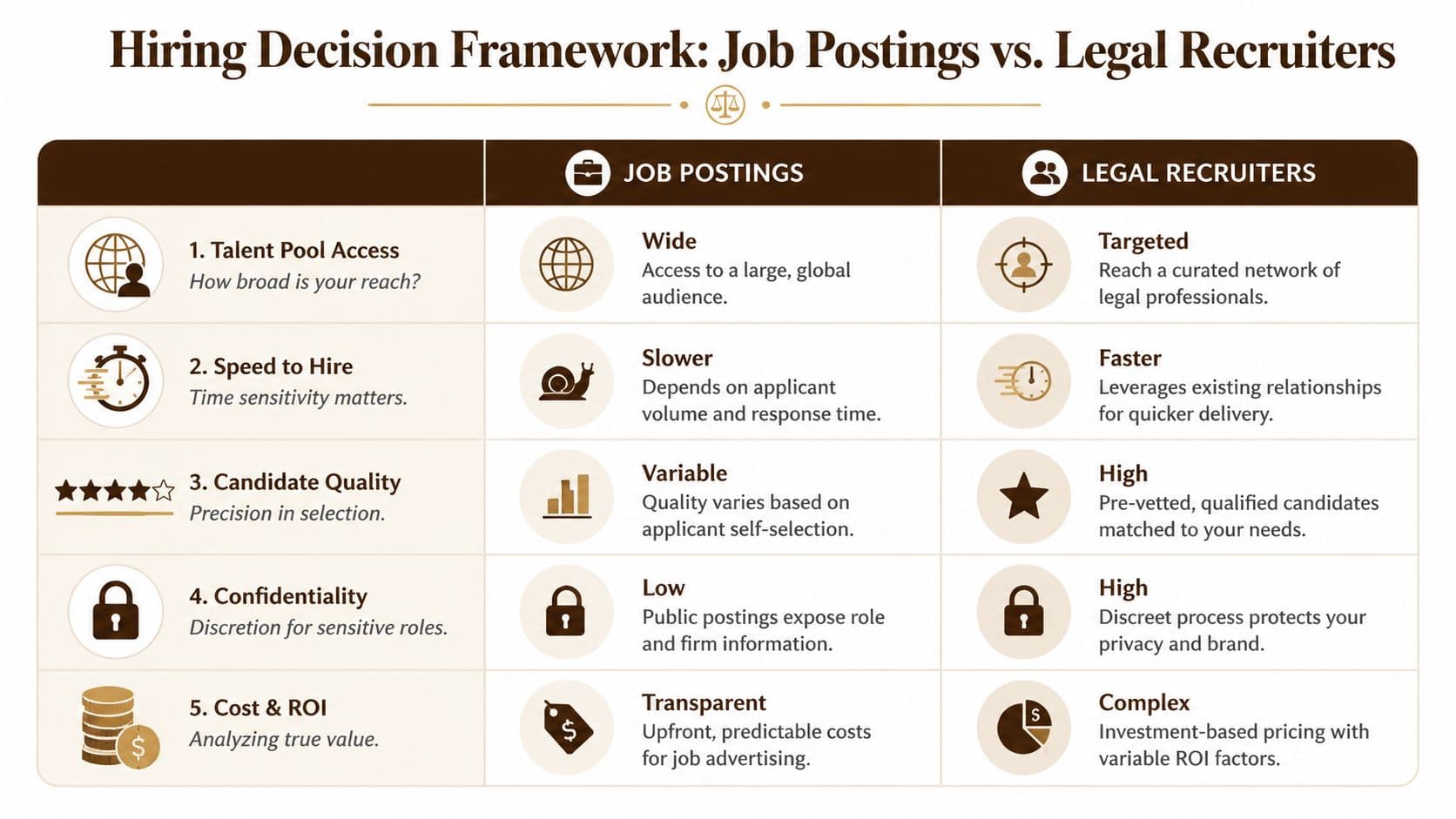
The Fast Comparison
| Decision factor | Job postings | Legal recruiters |
|---|---|---|
| Talent pool access | Broad but mostly public and self-selecting | Targeted and relationship-driven |
| Screening | Resume-led and internal-team dependent | Curated before presentation |
| Speed | Often slower because volume creates drag | Faster when urgency matters |
| Confidentiality | Weak for sensitive searches | Stronger for discreet outreach |
| Cost structure | Looks cheaper upfront but adds internal burden | Contingency-based and outcome-tied |
The key difference is not reach. It's control.
A posting casts a wide net into the visible market. A recruiter goes directly into the relevant market. Those aren't competing tactics so much as different instruments. If you need a niche healthcare regulatory associate in a specific city, broad visibility isn't your main issue. Precision is.
What the Numbers Actually Mean
The strongest argument for recruiters is not style. It's conversion quality. Legal recruiters achieve a 27% interview-to-hire conversion rate, while job postings typically produce a 3% applicant-to-interview ratio and an average of 180 applicants per hire, according to CareerPlug recruiting metrics.
That gap matters because each low-quality application creates work for someone on your side. HR spends time triaging. Partners review weak resumes. Interview slots go to candidates who never should have reached that stage. The posting may be cheap to publish, but the screening burden is paid in executive time.
Practical rule: If your partners are screening resumes themselves, your hiring system is already too expensive.
Use this framework to make the initial call:
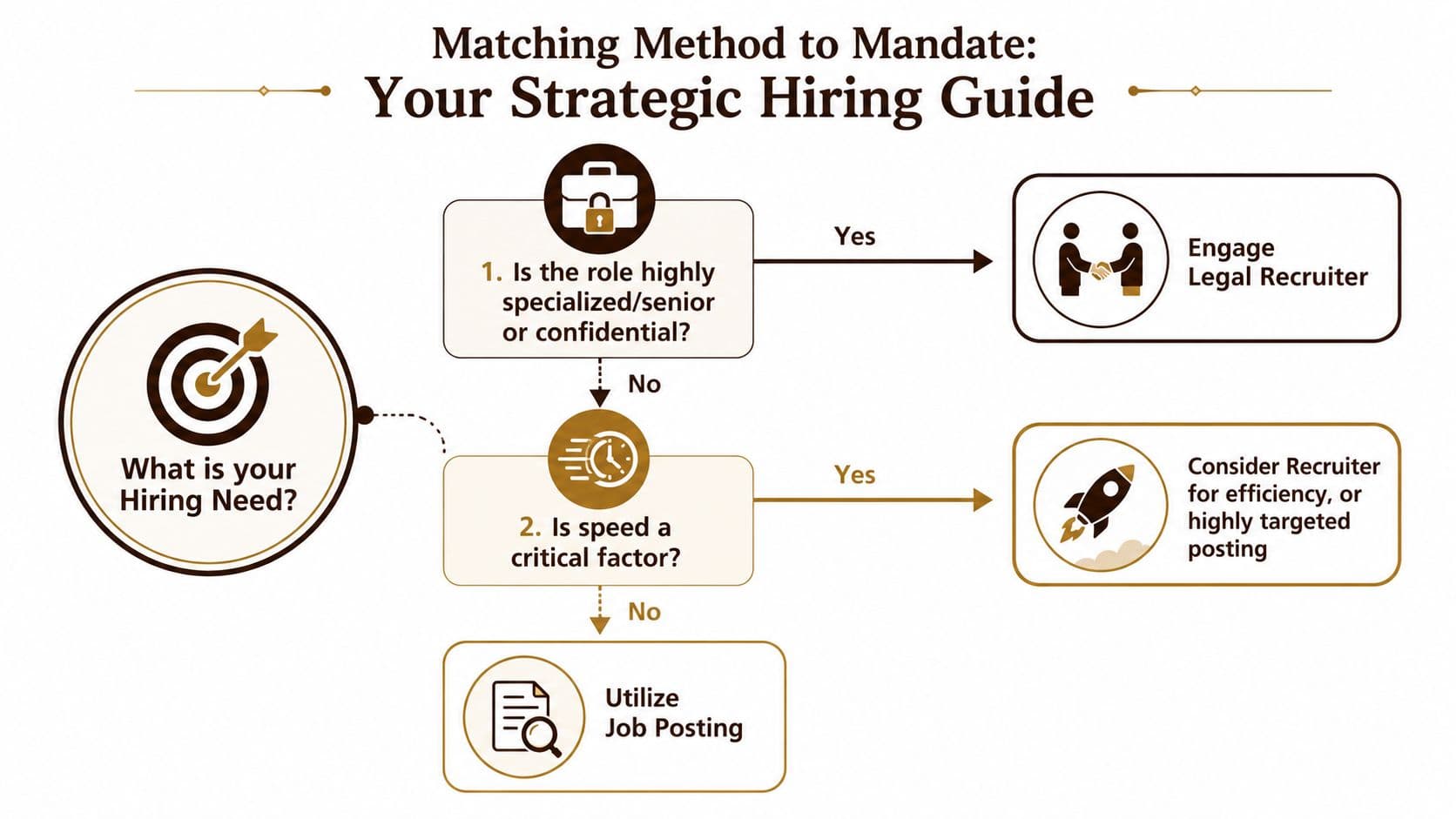
- Choose a posting first when the role is common, the applicant pool is likely to be active, and confidentiality is irrelevant.
- Choose a recruiter first when the role is senior, specialized, urgent, or politically sensitive.
- Use both carefully when you want public market coverage but still need direct access to passive talent.
The mistake is treating these channels as equivalent. They aren't. One is a marketplace listing. The other is active search.
Analyzing Cost Time and True ROI
A partner resigns on Friday. By Monday, your team posts the role. Two weeks later, you have a full inbox, no serious shortlist, and no clear read on whether the best candidates ever saw the opening. That is how firms confuse activity with progress.

The Recruiter Fee Is Not the Full Cost Story
Contingency legal recruiter fees usually run 15% to 25% of first-year salary, paid only if you hire, as noted in Right Fit Advisors' guide to legal recruiters. That number is visible, so leadership fixates on it.
The larger cost usually sits off the invoice. Job ads, recruiter seat licenses, ATS administration, scheduling, interview coordination, partner review time, compensation calibration, and the revenue loss from an open seat all belong in the same calculation. So does the cost of market confusion. Many legal employers post roles they are not ready to fill, keep stale listings live, or collect resumes for future use. Those ghost posts distort your view of supply and waste time on both sides.
That matters because a posting does not just attract candidates. It also creates work. If your hiring process produces 120 resumes and only four are worth a serious look, the other 116 still cost you money.
For a managing partner or GC, the right comparison is simple. Measure external recruiter fee against internal labor, vacancy cost, lost billings or delayed legal work, and the risk of missing candidates who will never apply to a public post.
Time Is a Financial Variable
Response speed changes the economics of a search. Recruiter-led text outreach gets an 8x higher response rate than job board email applications, according to Right Fit Advisors, as noted earlier. That difference shows up in time-to-slate, not just vanity metrics.
Time is where postings often look cheaper than they are.
A public post can sit live for weeks while your team screens applicants who were never close to the mark. Meanwhile, strong candidates move through private channels, respond to trusted recruiters, or avoid public application portals altogether because they do not want their interest exposed. By the time your team decides the posting “didn't work,” the market has already moved.
Uncontrolled candidate submissions create another cost center that firms rarely price correctly. Multiple agency introductions, unsolicited resumes, and unclear ownership can trigger fee disputes, duplicate outreach to the same candidate, and reputation damage with the lawyers you want to hire. If your process lets resumes arrive from every direction, you do not have broad market coverage. You have channel conflict.
Use a hard standard:
- Who owns first-round screening? If the answer is a billing partner or senior in-house lawyer, your cost model is upside down.
- What is one month of vacancy worth? Put a number on lost revenue, slower matter flow, missed client deadlines, or pressure on the rest of the team.
- How many applicants are real contenders? Volume without selectivity is administrative drag.
- Are you controlling submissions? If not, expect confusion, duplicate candidate contact, and avoidable fee arguments.
For a practical look at how firms assess hiring channels and search efficiency, review the guidance in the legal recruiting insights on the Five Star Placements blog.
A short explainer on hiring economics is worth your time here:
Recruiter fees make business sense when the role affects revenue, client retention, leadership stability, or confidentiality. In those searches, you are buying speed, market access, and process control.
True ROI is not the cheapest posting option. It is the hiring method that gets the right lawyer into the role with the least wasted leadership time, the lowest process risk, and the fewest false signals about what the market offers.
Candidate Quality and The Hidden Job Market
The visible legal market is not the whole market. That is the first point many firms get wrong.

Public Listings Show Only Part of the Market
An estimated 60% to 70% of lateral associate roles are never publicly posted and are filled through recruiter networks, according to BCG Search on using a legal recruiter. If you rely only on postings, you're not surveying the legal talent market. You're surveying the slice of it that is public, active, and willing to apply cold.
That distinction matters most for strong midlevel and senior candidates. They're usually employed. They may be open to moving. But they are not spending evenings searching job boards and submitting resumes into applicant tracking systems.
The legal recruiter vs job posting comparison demonstrates a significant disparity. A posting primarily attracts active seekers. A recruiter reaches passive candidates with the exact profile you want.
For hiring leaders, that means:
- Your posting is not a market map. It's one channel.
- Silence from top candidates doesn't mean disinterest. It often means they never engage publicly.
- A recruiter can validate whether a role is real and worth pursuing. That matters in a crowded market.
For a broader view on legal hiring patterns and search strategy, many leaders follow commentary on the Five Star Placements blog.
Ghost Posts Distort Decision Making
The other problem with public listings is that not every listing represents a concrete, approved, immediate hiring process. Firms sometimes post vague openings to test interest, benchmark compensation assumptions, or create optionality before fully committing. Candidates notice this. So do recruiters.
That creates what many attorneys now describe as ghost posts. Listings that signal possibility, but not necessarily action.
A ghost post wastes time on both sides. The employer gets noise. The candidate gets uncertainty. Neither gets a real hiring process.
This has two direct business consequences.
First, your own posting may compete with other vague listings that confuse the market and lower response quality. Candidates become skeptical. Strong attorneys may avoid applying because they don't want to expose themselves for a role that isn't moving.
Second, if you're hiring through a recruiter, you can keep the search confidential and credible. The recruiter can tell a candidate whether the role is active, qualified, and backed by a real process. That assurance is often what gets a strong passive candidate into the conversation.
If you want access to the hidden market, public posting alone won't get you there.
Screening Depth Confidentiality and Cultural Fit
A legal resume tells you what a candidate wants you to see. It doesn't tell you how they perform under pressure, how they manage a book, whether they collect on what they bill, or whether they'll fit your compensation structure and client expectations.
A Resume Won't Tell You Enough
The strongest recruiters screen beyond titles and pedigree. They look at the benchmarks that matter in lateral legal hiring: responsible billable hours, effective rate, cash collections, profitability margin, and business development time. Those are the operating indicators behind the hire, and they don't show up cleanly in a posting response.
A posting, by design, relies on self-reporting. Candidates decide what to disclose, how to frame it, and what to leave out. Your team then has to uncover the truth through interviews, references, and pattern recognition. Sometimes that works. Sometimes it produces a polished candidate who interviews well and underperforms after joining.
For a firm or legal department, deep screening should answer questions like these:
- Can this person carry the workload claimed on paper?
- Will they fit the economics of the role?
- Can they build trust with your clients or internal stakeholders?
- Are they moving for the right reason, or just moving away from a problem?
The best hires usually look obvious in hindsight. They rarely look obvious from a resume alone.
Confidentiality Requires Process Not Hope
Confidential hiring is where public postings break down fastest. If you're replacing a partner, restructuring a practice group, or adding senior legal leadership before an announcement, a public ad can create speculation internally and externally before you've even built a shortlist.
The candidate side has its own confidentiality problem. 40% of associates report being submitted for roles without explicit consent, according to a discussion of recruiter submission controls on LinkedIn. That is not a minor process issue. It can expose a candidate to the market, strain trust, and damage your own reputation if firms think your search is creating uncontrolled circulation.
Best-in-class recruiters solve this with written authorization before each submission. That protects the candidate. It protects the employer. It also preserves search integrity, because everyone knows who has been presented, where, and under what terms.
If you engage a recruiter, require discipline:
- Demand written submission approval for every candidate.
- Insist on no-recirculation language where appropriate.
- Ask how the recruiter tracks exclusivity and prior contact.
- Require clear communication before any profile reaches your desk.
That level of control doesn't exist in a public posting model. Applicants can apply through multiple channels. Internal teams can lose visibility. Duplicate activity can start before anyone notices.
In sensitive legal hiring, discretion is not a preference. It's part of risk management.
Matching The Method to The Mandate
The right answer depends on the role. Treating all legal hiring the same is lazy management.
Hiring demand is still strong in the profession. Robert Half's 2026 report says 58% of legal leaders plan to add permanent staff, law firms posted 45,300 lawyer jobs, and corporate sectors such as financial services and healthcare posted 6,100 and 5,100 legal jobs respectively, while salary ranges run from $98,500 to $151,500 for lawyers with 2 to 3 years of experience up to $222,750 to $270,500 for general counsel roles, as shown in Robert Half's legal hiring demand data. That range alone tells you one thing: one hiring method won't fit every search.
When a Job Posting Makes Sense
Use a posting when the role is easier to describe than to sell.
That usually means positions with a broad active market, standardized requirements, and low confidentiality concerns. Think legal support roles, some junior attorney openings, or operational hires in markets where applicants are actively searching.
A posting is reasonable if:
- The role is not confidential.
- You can absorb screening volume internally.
- The qualification criteria are clear and measurable.
- You're comfortable hiring from the active market.
When a Recruiter Is the Better Choice
Use a recruiter when the role is hard, sensitive, or expensive to miss on.
That includes partner searches, niche practice specialists, confidential replacements, in-house counsel hires, and positions where the strongest candidates are unlikely to apply publicly. It also applies when urgency is real and your internal team doesn't have bandwidth to run a disciplined search.
A recruiter is the better instrument when:
- The role requires market mapping, not applicant management.
- You need passive candidates.
- The hire affects clients, leadership, or revenue.
- The search must stay controlled and discreet.
If you're weighing options for a specialized legal hire, the team background on the Five Star Placements about page reflects the type of niche search coverage many employers look for in a recruiting partner.
When to Use Both
A hybrid model works when you want market visibility without relying on market visibility.
Post publicly to capture active applicants. Run a recruiter-led search at the same time to reach passive candidates and benchmark the market. But only do this if someone owns channel management. Without that, you get duplicate submissions, messy communication, and a diluted candidate experience.
The best hybrid searches are tightly coordinated. The worst ones create confusion and make the employer look disorganized.
For most senior legal hiring, don't overcomplicate it. If the role is important enough to hurt when vacant, it's important enough to search properly.
Your Decision Checklist and FAQs
A hiring method should match the business risk of the role. That's the cleanest way to decide.
Decision Checklist
Run through these questions before you approve the search plan:
- Is the role confidential? If yes, don't lead with a posting.
- Is the hire senior, specialized, or market-sensitive? If yes, use a recruiter.
- Do you need the person quickly because work, clients, or leadership are exposed? If yes, prioritize direct outreach over passive inbound.
- Can your internal team screen at a high level without disrupting higher-value work? If not, external search support is the better business choice.
- Will the best candidates apply publicly? For many legal roles, the honest answer is no.
- Do you need submission control and candidate consent protocols? If yes, insist on recruiter discipline from the start.
Here's the short version.
Use a job posting for broad-market, lower-risk roles. Use a legal recruiter for difficult, confidential, urgent, or high-impact hires. Use both only when you have clear ownership and strict process.
FAQs
Can I use both methods at the same time?
Yes, but only if one person controls channel conflict. Otherwise you'll get duplicate candidate activity and mixed messaging.
How should I vet a legal recruiter?
Ask how they source, how they screen, how they handle written authorization, and how they prevent uncontrolled submissions. Ask for their process, not just their network.
What if my internal team says they can handle a senior search alone?
They might be right. The better question is whether they should. If the role is strategic and time-sensitive, senior internal attention spent sourcing and triaging candidates may be the wrong use of that team's time.
What's the biggest mistake employers make in the legal recruiter vs job posting decision?
They assume a posting shows them the market. It doesn't. It shows them the public slice of the market, filtered by who is willing to apply openly.
If you want to pressure-test your next legal search strategy or discuss a confidential opening, use the Five Star Placements contact page to start the conversation.
Five Star Placements helps law firms and corporate legal departments hire attorneys, partners, in-house counsel, legal support staff, and legal operations leaders through contingency-based permanent placement. If you need a search partner that can move quickly, protect confidentiality, and deliver screened legal talent nationwide, connect with Five Star Placements.
Need help filling a legal role?
Five Star Placements partners with law firms and legal departments nationwide.
Schedule a Call