
Personal Injury Paralegal Role, Skills, and Career Path
October 1, 2026 · 15 min read · Five Star Placements

Table of contents
A managing partner calls at 8:15 a.m. because three new matters need intake, two demand packages are waiting on medical records, and a deposition notice just arrived. The firm already has legal support staff, but the work keeps stalling between the first client call and attorney review. The hiring question isn't whether to add a personal injury paralegal. It's whether you need someone who converts intake, builds reliable medical chronologies, prepares settlement demands, supports litigation, or owns a defined combination of those functions.
That distinction drives hiring quality, compensation, and case velocity. Generic legal experience can help a candidate get noticed, but firms usually need evidence of a specific deliverable, such as a signed retainer packet, an indexed treatment timeline, a settlement-ready demand, or a complete trial binder. The strongest candidates don't describe themselves as merely organized. They show exactly which bottleneck they can remove.
Table of Contents
- What a Personal Injury Paralegal Actually Does Day to Day
- The Labor Market and Demand for Personal Injury Paralegals
- Core Skills That Make a Personal Injury Paralegal Valuable
- Career Paths From Intake to Senior Litigation Support
- Salary Benchmarks by State and Experience Level
- Why Specialized Skills Justify Premium Pay
- Hiring Playbook for Firms and Corporate Legal Teams
What a Personal Injury Paralegal Actually Does Day to Day
A personal injury paralegal keeps a file moving from first contact through settlement or trial. The work starts with disciplined intake, not paperwork for its own sake. The paralegal gathers accident facts, identifies potential parties and witnesses, captures insurance information, checks conflicts, and prepares the retainer and authorization packet for signature.
A typical morning may include returning prospective-client calls, confirming the incident date and treatment status, opening a matter in the firm's case management system, and sending the representation letter to the relevant carrier. The paralegal may request a police report, insurance disclosures, photographs, wage-loss documentation, and the first set of medical records. Each action creates a usable case record and prevents the attorney from having to reconstruct the file later.
The intake zone
Intake support is a conversion and triage function. A capable paralegal knows which facts affect liability, damages, collectability, and urgency. They also know when a matter needs attorney review before the firm promises anything to the prospective client.
The deliverable is a complete, signed intake file. It should include the retainer, medical authorization, contact details, accident summary, insurance information, witness information, and a clear list of outstanding items. A candidate who can explain how they move a lead from inquiry to opened matter is more valuable than one who only lists “client communication” on a résumé.
The records and chronology zone
Once the client is represented, the paralegal tracks providers, requests records, follows up on incomplete productions, and organizes bills and clinical notes. The goal isn't to create a pile of documents. It's to build an accurate chronology that connects the incident to treatment, diagnoses, procedures, recovery, gaps, and claimed damages.
A useful chronology lets an attorney answer practical questions quickly. When did symptoms begin? Which provider documented the diagnosis? Was there a treatment gap? What bills support the damages calculation? Records analysis is often where an otherwise active file loses momentum, so firms should test this skill directly.
Pre-litigation and litigation are different jobs
Before filing, the paralegal often focuses on investigation, medical documentation, insurer communication, demand preparation, and settlement support. The personal injury paralegal checklist from Clio similarly emphasizes assembling records, bills, imaging, wage-loss documents, police reports, photographs, witness statements, and insurance data into a coherent case file.
Litigation support requires a different operating rhythm. The paralegal monitors discovery, deposition scheduling, hearings, expert evaluations, filing requirements, and evidence preservation. Once litigation is filed or reasonably anticipated, preservation duties may attach, requiring preservation notices, evidence inventories, and chain-of-custody documentation. A firm can hire one person for both pipelines, but it must define priorities clearly. Otherwise, urgent intake work will compete with deadlines that carry far greater procedural consequences.
The Labor Market and Demand for Personal Injury Paralegals
A firm can have steady case intake and still struggle to hire. The problem is usually not the title. It is finding someone who can take ownership of a specific workflow, reduce attorney review, and keep files progressing without repeated reminders.
The U.S. Bureau of Labor Statistics outlook for paralegals and legal assistants reports about 404,900 jobs in 2025 and projects little or no occupational change from 2024 to 2034. The occupation should still produce about 39,300 openings per year on average during that period as employers replace departing staff and fill roles created by turnover.
That market favors specialized candidates. A résumé that lists “case management” and “client communication” describes a general legal assistant. A résumé that shows ownership of intake support, medical-record chronology, demand packages, or litigation support shows where the candidate can create value.
The underlying market is large. A 2026 personal injury industry summary from CasePulse reported $61.3 billion in U.S. personal injury law market revenue in 2024. The same source cites a resolution pattern in which 4% of personal injury cases go to trial, with roughly 96% resolving before trial through negotiation or settlement. Hiring decisions should therefore give serious weight to pre-litigation execution. Intake accuracy, records control, chronology quality, demand-package preparation, and settlement support affect the path followed by most matters.
Where hiring demand concentrates
High-volume plaintiff firms need paralegals who can qualify leads, organize medical records, and keep demand work moving at volume. Defense practices need staff who can control claims documentation, discovery, deposition coordination, and evidence. Corporate legal teams managing third-party claims need disciplined file control and clear communication with insurers, outside counsel, and business stakeholders.
Hire against the bottleneck. A firm with weak intake needs a different candidate from one buried in medical records or approaching a heavy deposition calendar.
| Indicator | Value | Implication for Hiring |
|---|---|---|
| Paralegal and legal assistant employment | About 404,900 jobs in 2025 | Specialization helps a résumé stand out within a large support profession. |
| Occupational projection | Little or no change from 2024 to 2034 | Firms should not expect broad market growth to solve a skills shortage. |
| Average annual openings | About 39,300 | Replacement demand keeps recruiting active in a stable occupation. |
| U.S. personal injury law market revenue | $61.3 billion in 2024 | PI support roles serve a large, settlement-driven legal services market. |
| Cases reaching trial | 4% | Pre-litigation and settlement skills deserve substantial weight in hiring. |
Recruiting rule: Hire the person who can own the next bottleneck, not the person whose résumé contains the most general legal vocabulary.
Core Skills That Make a Personal Injury Paralegal Valuable
A strong personal injury paralegal isn't defined by one broad list of duties. Firms should assess four separate skill zones because each produces a different business deliverable.
Intake conversion
The first zone is intake conversion. The paralegal gathers the facts needed to evaluate the claim, communicates clearly with an injured person, identifies missing information, and moves qualified matters toward a signed retainer. The proof isn't “handled phones.” Ask for evidence of a complete retainer packet, accurate matter setup, conflict-check coordination, and documented follow-up.
The right tools include a case management platform, intake forms, e-signature workflows, conflict procedures, and a reliable task queue. The candidate should explain how they separate a viable lead from a matter that needs attorney review.
Medical records and chronology
The second zone is medical documentation. The deliverable is an indexed medical binder with a treatment timeline, not a folder full of provider PDFs. The paralegal should be able to identify clinical dates, diagnoses, treatment descriptions, bills, imaging, referrals, gaps, and inconsistencies without making unsupported medical conclusions.
Chronology work rewards careful reading and structured extraction. Candidates should be comfortable with document management, searchable PDFs, spreadsheet controls, and tools that help organize unstructured records. Ask them to describe how they verify dates and reconcile bills against treatment.
Demand package drafting
The third zone is demand package support. The deliverable is a redlined demand containing organized liability and damages sections, a treatment narrative, supporting records, bills, wage-loss materials, and a clear attorney-review trail. The paralegal doesn't decide legal strategy independently, but they should make it easy for counsel to evaluate the evidence and approve a persuasive package.
A candidate who has assembled demands can explain how they identify missing support, update damages, and tailor the narrative to the available liability evidence. That capability is distinct from formatting a letter.
Litigation support
The fourth zone is litigation. The deliverable may be a trial binder with deposition summaries, exhibit lists, pleadings, discovery materials, witness information, and hearing deadlines. Preservation, production, deposition preparation, and exhibit control require stronger procedural discipline than ordinary file administration.
For candidates whose work centers on discovery and trial preparation, compare their experience with the responsibilities described for a litigation support specialist. The title matters less than the evidence. Score the résumé against these four questions:
- Intake: Has the candidate produced signed, complete new-matter files?
- Records: Have they built chronologies from medical documentation?
- Demands: Have they assembled settlement packages for attorney approval?
- Litigation: Have they supported discovery, depositions, hearings, or trial exhibits?
A résumé that answers all four questions with concrete examples deserves a different interview track from one that only says “managed cases.”
Career Paths From Intake to Senior Litigation Support
A junior generalist and a senior specialist may carry similar titles while creating very different value. The junior paralegal touches every stage, switches frequently between client calls, records requests, correspondence, pleadings, and calendars, and often needs an attorney or senior paralegal to check the work. The senior specialist owns a defined output and protects the team from avoidable rework.
A first-year employee may support a broad premises-liability caseload and spend the day switching between intake, records, and draft pleadings. A senior chronology paralegal working within the same type of practice may focus on treatment timelines, expert coordination, damages support, and attorney-ready analysis. The difference is not busyness. It's ownership.
Three practical tracks
The intake-led track suits people who communicate well, qualify matters, gather facts, and keep prospective clients engaged. It can lead toward intake management, settlement coordination, or client-service leadership.
The records-led track suits detail-oriented paralegals who enjoy provider follow-up, medical terminology, chronology construction, damages organization, and demand support. This track often creates a clear premium because the work directly affects settlement readiness.
The litigation-led track moves toward discovery, deposition preparation, motion support, expert coordination, hearing logistics, and trial exhibits. It rewards procedural knowledge, deadline control, and comfort with e-discovery review.
The law-firm intake specialist role guide is useful for separating client-facing intake work from broader case-support responsibilities. Candidates should choose a direction rather than remain indefinitely “open to anything.”
Career advice: Generalist experience is a foundation. It becomes a plateau when the paralegal can't identify one case-stage deliverable they can own without close supervision.
The inflection point usually comes when a paralegal can show repeatable results through work product, not just tenure. Useful signals include a completed chronology, a demand package prepared for attorney review, discovery production managed to deadline, or a trial binder built from a defined checklist. Software fluency helps, but it must serve the workflow. Case management, document review, calendaring, and litigation tools matter because they support accountable output.
Salary Benchmarks by State and Experience Level
A personal injury paralegal's salary reflects four factors: location, experience, case mix, and the work the employee can own. A 2026 salary source cited in the CasePulse industry overview places the U.S. average at $67,704 per year, with a typical range of $61,059 to $74,628 and a 90th percentile near $80,932. The same source reports a California average of $74,678 and a Florida average of $64,062.
Experience creates a wider spread. The cited data place senior-level compensation at $113,869 for five to eight years of experience and $145,974 for more than eight years. Treat those figures as market reference points, not automatic offers. Firms should define the case-stage responsibilities first, then set pay against the expected ownership.
Match pay to ownership
An entry-level position may focus on intake, authorizations, provider follow-up, and records indexing. A mid-level paralegal may own medical-record chronologies, damages summaries, and demand packages. A senior hire may manage complex litigation support, discovery, experts, depositions, motions, and trial preparation.
| State | Entry-Level, Intake and Records | Mid-Level, Chronology and Demand | Senior, Litigation Support |
|---|---|---|---|
| California | Benchmark locally | Benchmark against chronology ownership | Use senior scope and complex litigation experience |
| Florida | Benchmark locally | Benchmark against demand-package ownership | Use litigation and trial-preparation scope |
| United States | $61,059 to $74,628 typical range | $67,704 average reference point | $113,869 at five to eight years, and $145,974 above eight years |
The table provides national and state reference points, not invented state ranges. For New York, Texas, Midwest markets, and Mountain markets, firms should obtain current local comparisons instead of applying an unsupported national adjustment.
Robert Half's 2026 legal salary outlook says specialized litigation, corporate law, and contract-management roles are expected to see salary growth above the projected +2.2% average for legal positions. The same verified brief reports 2026 legal assistant datasets ranging from about $48,215 to $71,080 annually, depending on source, market, and role definition.
Remote hiring can reduce geographic differences, but local market knowledge, jurisdiction familiarity, and dependable ownership still affect an offer. Tie bonuses to defined milestones, such as completed demand packages or discovery deadlines. Avoid vague incentives based only on overall firm results. A candidate who can independently produce a usable chronology or demand package should be priced above one who only performs intake and administrative follow-up.
Why Specialized Skills Justify Premium Pay
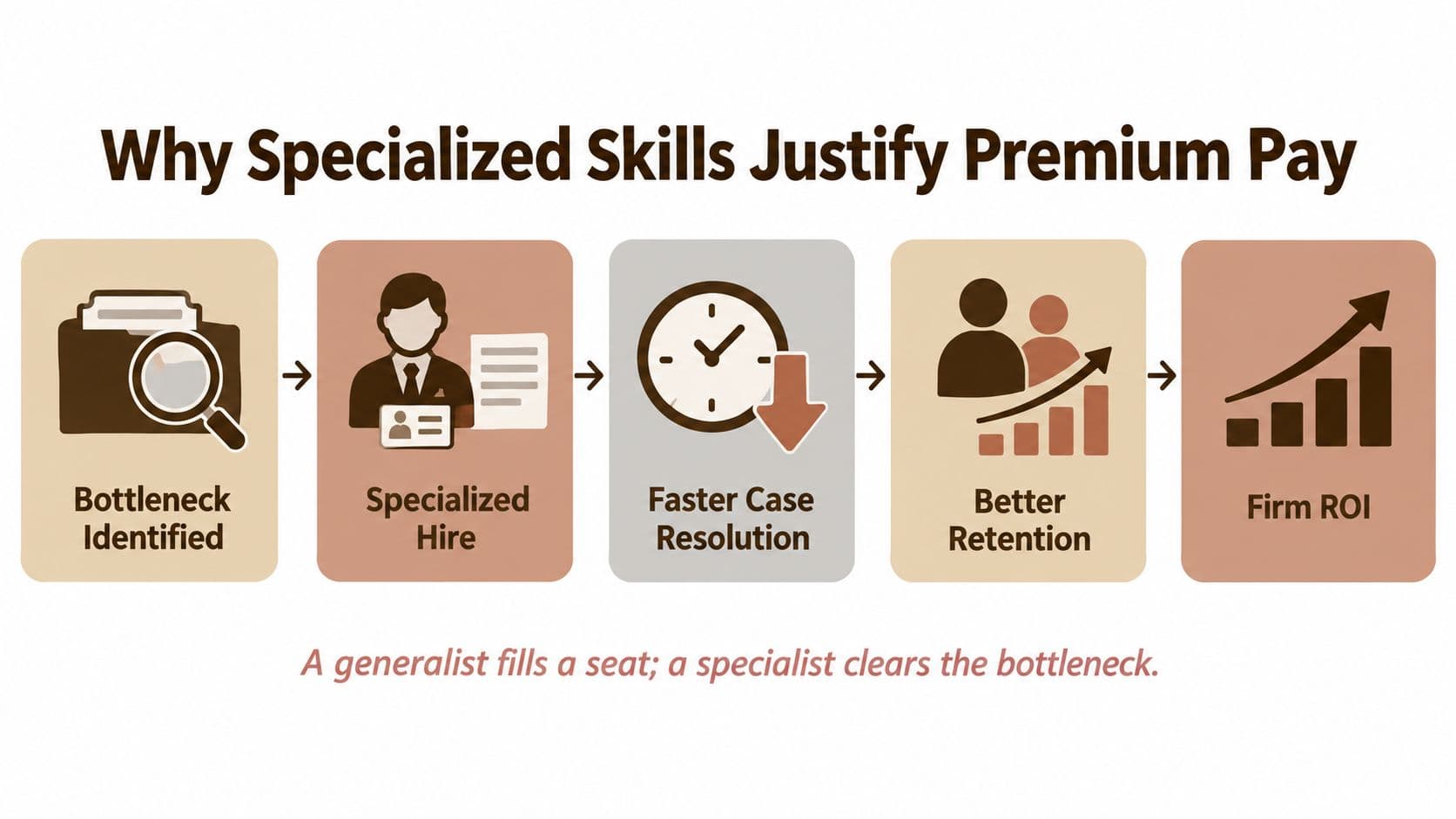
A firm doesn't build momentum by adding another person to a crowded workflow. It builds momentum by assigning the right person to the point where files stop moving.
Consider medical records. The relevant capability isn't merely requesting documents. It's extracting clinical dates, diagnoses, treatment descriptions, bills, and gaps into a chronology that an attorney can use. Industry commentary from NexLaw on personal injury case-preparation bottlenecks describes firms using structured extraction from unstructured medical documentation so timelines can be built in hours instead of days. The operational lesson is clear, even without turning that workflow observation into an invented performance statistic.
Four bottlenecks, four types of value
An intake specialist improves the quality and speed of first-contact handling. They ask better questions, identify missing facts, protect attorney time, and move appropriate prospects toward a signed retainer.
A chronology specialist reduces the delay between records receipt and attorney evaluation. They identify missing providers, flag gaps, organize bills, and give counsel a reliable factual spine for the demand.
A demand specialist turns that organized evidence into an attorney-ready package. Their value comes from completeness, clarity, version control, and the ability to expose missing support before the package reaches the insurer.
A litigation paralegal protects deadlines and reduces attorney involvement in repetitive procedural work. They coordinate discovery, organize productions, prepare deposition materials, manage exhibits, and maintain a usable case calendar.
Hiring principle: A generalist fills a seat. A specialist clears the bottleneck.
Premium pay makes sense when the employee's work reduces supervision, prevents rework, and moves a file toward its next decision. It doesn't make sense merely because a candidate has held a legal title for several years. Test the deliverable and pay for demonstrated ownership.
Specialists also preserve institutional knowledge. They learn how recurring defense counsel, adjusters, providers, experts, and opposing teams operate. That knowledge improves handoffs and makes the employee harder to replace than someone whose contribution remains limited to interchangeable administrative tasks.
Retention starts with recognition of that value. Give specialists ownership milestones, access to personal injury continuing education, and a visible path from records or intake work into demand, discovery, or trial support. A firm that keeps raising responsibility without clarifying progression will eventually lose the person it trained.
Hiring Playbook for Firms and Corporate Legal Teams
Start with the vacancy, not the résumé. Decide whether the firm needs intake capacity, records throughput, demand support, litigation coverage, or a hybrid role with explicit priorities. A vague posting attracts vague applications and forces the hiring team to diagnose the job after interviews have already begun.
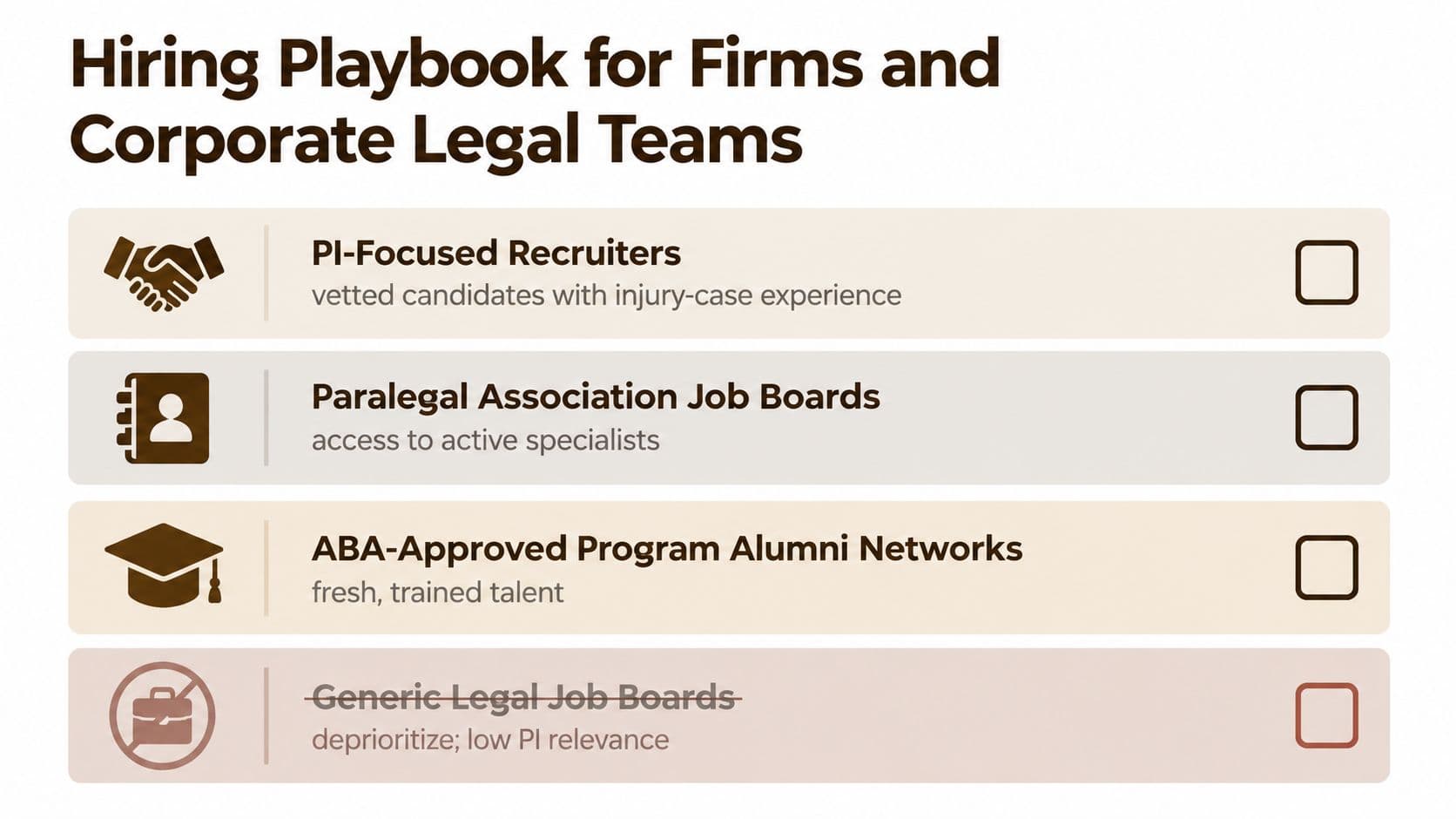
Use targeted channels first. PI-focused recruiters, paralegal association job boards, and alumni networks from ABA-approved programs can reach candidates with more relevant exposure than broad legal listings. Generic legal job boards can still produce applicants, but they shouldn't be the primary filter for a role that requires medical chronology or litigation-specific work.
Screen for work product
Review each résumé against the four skill zones. “Managed files” is weak evidence. “Prepared medical chronologies, tracked provider requests, and assembled demand packages for attorney review” is much stronger because it identifies ownership.
In interviews, use practical tests:
- Intake test: Ask the candidate to explain how they would organize the first call, retainer, authorizations, insurance information, and outstanding documents.
- Chronology test: Provide a redacted sample and ask the candidate to identify dates, providers, treatment gaps, and missing records.
- Demand discussion: Ask them to walk through a demand package they assembled, including how they organized liability, treatment, bills, and wage loss.
- Litigation verification: Ask for specific examples of discovery production, deposition preparation, exhibit management, calendaring, and trial support.
- Technology check: Confirm experience with case management platforms such as Needles or SmartAdvocate, document systems, chronological summation tools, and e-discovery review.
Don't rely on software names alone. A candidate may have opened a platform without owning the workflow inside it. Ask what they entered, what they monitored, what they escalated, and what the attorney received.
Close around measurable ownership
Before making an offer, define the expected first-stage outputs. For intake, that might be complete matter setup and consistent follow-up. For records, it might be organized provider requests and accurate chronologies. For litigation, it might be discovery tracking, deposition support, or exhibit preparation.
A personal injury paralegal recruiting resource from Five Star Placements can be one sourcing option for firms that need customized screening for legal support roles. Whether you recruit internally or use an outside partner, keep the evaluation tied to practice needs, work product, and culture fit.
Retention improves when the paralegal sees a path forward. Offer paid continuing legal education aligned with the practice, assign meaningful case ownership, and make the transition from intake to records, demand, or litigation support deliberate rather than accidental.
Five Star Placements provides permanent placement for paralegals and other legal support professionals, including candidates for personal injury and litigation teams, with screening aligned to role requirements and firm culture. If your firm needs a personal injury paralegal who can own intake, medical chronologies, demand packages, or litigation support, visit Five Star Placements to discuss the search.
Need help filling a legal role?
Five Star Placements partners with law firms and legal departments nationwide.
Schedule a Call