
When Should a Law Firm Use a Recruiter: Key Signals
July 25, 2026 · 14 min read · Five Star Placements
Table of contents
The call comes in after lunch. The partner who owns the matter is irritated, the inbox has 14 resumes, and none of them look like someone who can step into the seat without slowing the team down. HR is already juggling other searches, the practice group needs coverage now, and everyone in the room knows the core problem isn't the job title, it's the cost of leaving the role open another month.
That's the point where a managing partner should stop asking, “Is this hard to fill?” and start asking, “What is this vacancy costing us, and is that cost already bigger than the recruiter fee?” That's the cleaner way to decide when should a law firm use a recruiter, because the right answer depends on vacancy cost, market access, confidentiality, and timing, not just on whether the search feels annoying.
Table of Contents
- The Moment Every Managing Partner Recognizes
- Why the Recruiter Question Is Really a Vacancy Cost Question
- Signals That a Recruiter Belongs in the Search
- Contingency Versus Retained Recruiting Models
- What the Legal Search Timeline Looks Like
- The Decision Checklist for Engaging a Recruiter
- Two Real Scenarios That Test the Framework
- Interview Questions, Alternatives, and Next Steps
The Moment Every Managing Partner Recognizes
The search looks manageable at first. The practice leader says the opening matters, but it can wait. The internal team posts the role, waits for the right resumes, and assumes the market will cooperate. Then a week slips by, the first round of candidates disappoints, and the partners covering the work start asking why a search that sounded simple is still open.
That is usually the point where the room changes. Billable attorneys are spending time triaging coverage, the HR generalist is screening people who will not fit, and the matter load keeps moving whether the requisition is filled or not. If you have sat in that meeting, you already know what is happening. The vacancy is no longer a hiring issue, it is operational drag.
A recruiter belongs in that room when the firm needs outside market access before the internal process can produce it. The market now rewards early action and broad outreach, not a slow, campus-first wait. NALP recruiting trend data shows how wide the funnel has become, with 93% of law offices accepting direct applications, only 71% participating in OCI programs, and 56% of 2L summer offers made before June of students' 1L year. That is a market that moves earlier and leaves less room for delay, so waiting to “see how the search goes” is a costly habit.
The primary question is not whether the role is difficult. The primary question is whether the firm can afford to keep coverage, client service, and partner time tied up while it waits. If the answer is no, the recruiter decision belongs at the start of the search, not after the process has already started slipping.
Practical rule: if the vacancy is already consuming partner attention, the search has become a business issue, not a staffing task.
For firms that want a recruiter relationship before the next crisis hits, Five Star Placements is one example of a legal recruiting firm built around permanent placement across attorneys, legal support staff, partners, in-house counsel, and legal operations roles.
Why the Recruiter Question Is Really a Vacancy Cost Question
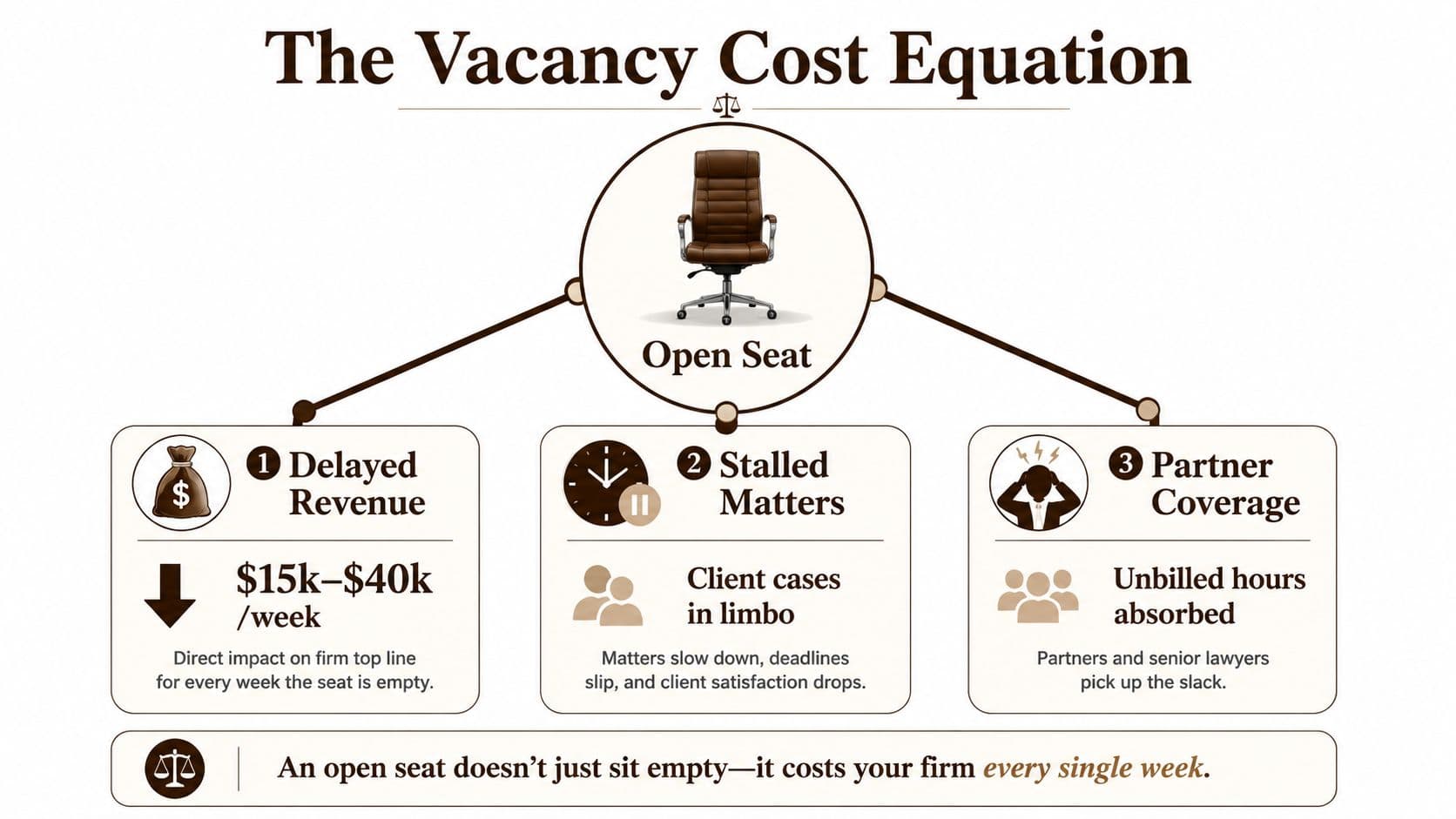
A managing partner should not treat a recruiter as a convenience purchase. The key decision is whether the firm can afford the cost of an open seat. In a law firm, every vacant role creates immediate drag, lost revenue, disrupted matters, and partner time pulled away from billable work.
Start with the cost of delay
If the role touches client coverage, the vacancy starts costing money the moment the seat opens. The work does not pause. Senior lawyers absorb tasks they should not be carrying, deadlines move more slowly, and the eventual hire starts from behind because the team has already spent weeks patching the gap. In a legal practice, that lost time is gone for good.
The hidden cost is just as serious. A delayed or weak search can push partners to turn away work, decline staffing opportunities, or overload the people already in place. That may never appear as a recruiter line item, but it shows up in missed revenue, strained morale, and a team that is running hotter than it should.
Compare vacancy cost to recruiter cost
The recruiter fee only makes sense in relation to what the firm loses while the seat stays empty. A recruiter pays for itself if it shortens the vacancy window or improves the quality of the hire enough to reduce the cost of a miss. That is the calculation. If the firm can fill the role quickly and accurately on its own, keep the search internal. If the internal process is likely to slow the search, narrow the field, or produce a weak shortlist, outside help starts to make financial sense.
The Stanford BCG guidance on legal recruiting makes the same point in practice, controlled submission and disciplined process matter, especially in confidential or highly selective searches. BCG Rules of Engagement
Bottom line: do not ask whether recruiters are worth it in the abstract. Ask whether the firm can afford the vacancy longer than it can afford the fee.
That is the cleaner test. It forces the partner group to face internal capacity, market access, and opportunity cost in plain terms. Once the vacancy is treated as a cost center, the recruiter decision becomes a management call, not a preference. For firms that want a recruiting perspective on timing and search strategy, the Five Star Placements blog is a useful reference point.
Signals That a Recruiter Belongs in the Search
The first mistake firms make is treating recruiter use as a prestige decision. It is not. The question is whether the vacancy is costing more than outside help would, because the longer a seat stays open, the more it eats into revenue, client coverage, and partner time.
The role supports live work or client coverage
If the opening touches active matters, client deadlines, or a seat that produces revenue, the firm should treat the search as a business issue, not a staffing convenience. Waiting to see whether the team can absorb the strain is the wrong move. By the time the strain is obvious, the vacancy has already started to hurt.
The internal team is already stretched
When HR is juggling multiple searches, or partners are screening candidates themselves, the firm has run past its own recruiting capacity. That is the moment external help makes sense. A recruiter does not just add resumes, it buys back bandwidth and keeps the search moving before the process slows to a crawl.
The market is specialized or hidden
Specialty practice areas, first-of-kind leadership hires, and partner moves are not filled by posting a job and hoping for the right response. A recruiter can map passive candidates, build a credible shortlist, and handle outreach the internal team often cannot sustain alongside its day job. That matters most in confidential lateral partner searches, general counsel searches, and leadership roles where the firm needs reach, discretion, and a filtered field, not a stack of unvetted resumes.
Timing matters even outside campus recruiting. The market tends to move before firms are ready for it, and firms that wait for the search to look difficult usually arrive late. That is the lesson from the recent recruiting cycle, and it is why early engagement beats rescue mode. NALP recruiting trend data
For firms that want a practical lens on active searches, Five Star Placements' blog is one place to see how recruiters frame candidate access and search timing.
A recruiter is not just a fast way to get applicants. A recruiter is a way to reach people who were never going to respond to a posting.
That is the dividing line. If the role depends on passive candidates, market intelligence, or confidentiality, the recruiter belongs in the search early, before the vacancy starts draining value. If the role is straightforward and the internal team has room to run it well, keep it in-house and keep the process tight.
Contingency Versus Retained Recruiting Models
Choosing a recruiter is only half the decision. The other half is choosing the right model for the role. Firms confuse this all the time, then wonder why the process feels misaligned.
Use the model to match the need
Contingency recruiting fits searches where the firm wants market reach without upfront commitment. It's the natural fit for many associate, lateral, paralegal, and in-house support searches, especially when the firm wants multiple options and doesn't need exclusive attention from one search partner.
Retained recruiting fits roles where confidentiality, market mapping, and deliberate outreach matter more than raw volume. Think partner searches, general counsel roles, and first-of-kind leadership hires. In those searches, the recruiter is not just filling a seat, they're building a market map, controlling access, and helping the firm approach candidates who are not actively applying.
Contingency vs Retained Recruiting at a Glance
| Dimension | Contingency | Retained |
|---|---|---|
| Fee structure | Payment only on successful hire | Upfront engagement with dedicated search work |
| Risk | Lower upfront risk for the firm | Higher commitment, more exclusive process |
| Best use | Associate, lateral, paralegal, many in-house roles | Partner, general counsel, confidential leadership hires |
| Candidate reach | Broad, competitive market coverage | Targeted market mapping and passive outreach |
| Confidentiality | Useful, but less inherently controlled | Strong fit when discretion matters |
| Process style | Faster market response, more parallel activity | Deeper search design and shortlist building |
Hybrid and container models exist, but don't get distracted
Some firms use hybrid arrangements or container models to blend access and control. Those can work, but they don't change the core logic. The role type should drive the model, not the other way around.
BCG's legal hiring trends also show why this distinction matters, because in 2024 U.S. law firms recorded a median of just six summer associate offers per office, the lowest level since 1993, while overall lateral placements rose 14% and lateral-associate hires rose nearly 25%. The market is leaning into smaller, more flexible talent pools, which makes precision more valuable than volume. BCG legal recruiting trends
If the search is broad and the hire is operational, contingency usually makes sense. If the search is sensitive, high-stakes, or practice-defining, retained is the cleaner fit.
What the Legal Search Timeline Looks Like
A legal search is a chain of handoffs, and each handoff can slow the process if the firm is not disciplined. That is why a recruiter earns a fee. The recruiter handles the parts most likely to stall, sourcing, candidate coordination, and shortlist control, while the firm keeps responsibility for the hire itself.
Weeks 1 through 3 are about market access
The opening phase is intake, calibration, sourcing, and market mapping. The recruiter learns what the firm needs, not just what was written into the job description. In contingency searches, the advantage shows up in faster candidate delivery. In retained searches, the value shows up in deeper mapping and confidential outreach to people who were not expecting a call.
Weeks 4 through 8 are about discipline, not magic
Once the shortlist is moving, the process depends on the client side as much as it depends on the recruiter. Interview scheduling, compensation alignment, reference checks, and counteroffer pressure still sit with the firm. A recruiter can keep the process moving, prepare the candidate, and keep communication clean, but they cannot force partners to decide on time.
The Stanford guidance makes the same point in a different way. Legal searches require coordination, authorization discipline, and process control, which is why submissions and outreach need to be handled carefully in this market.
The recruiter removes friction, not responsibility
That is the honest view. A recruiter compresses the parts of the search that are easiest to bottleneck, sourcing, screening, coordination, and negotiation support. The firm still has to show up, move fast, and decide quickly.
If the firm cannot do that internally, outside help is worth paying for. If it can, the recruiter should still be used to widen access and keep the process honest.
The Decision Checklist for Engaging a Recruiter
Use this against any opening before the search drifts. If the answer is yes to two or more, the firm should seriously consider outside help.
Run the role through these questions
- Is the role tied to revenue or client coverage in the next two quarters? If yes, vacancy cost is already real, not theoretical.
- Is your internal team at capacity? If yes, the search will slow unless someone else takes over sourcing and screening.
- Is the candidate pool specialized or niche? If yes, market mapping matters more than posting volume.
- Does the search require confidentiality? If yes, the firm needs controlled outreach, not public visibility.
- Has the vacancy already outlasted the internal team's normal pace? If yes, the process is telling you it needs help.
- Would a bad hire cost more than the recruiter fee? If yes, external screening is cheaper than cleaning up a miss.
- Does the role require passive candidates? If yes, direct applications will not be enough.
- Is the hiring decision tied to partner bandwidth? If yes, outside support buys time as well as access.
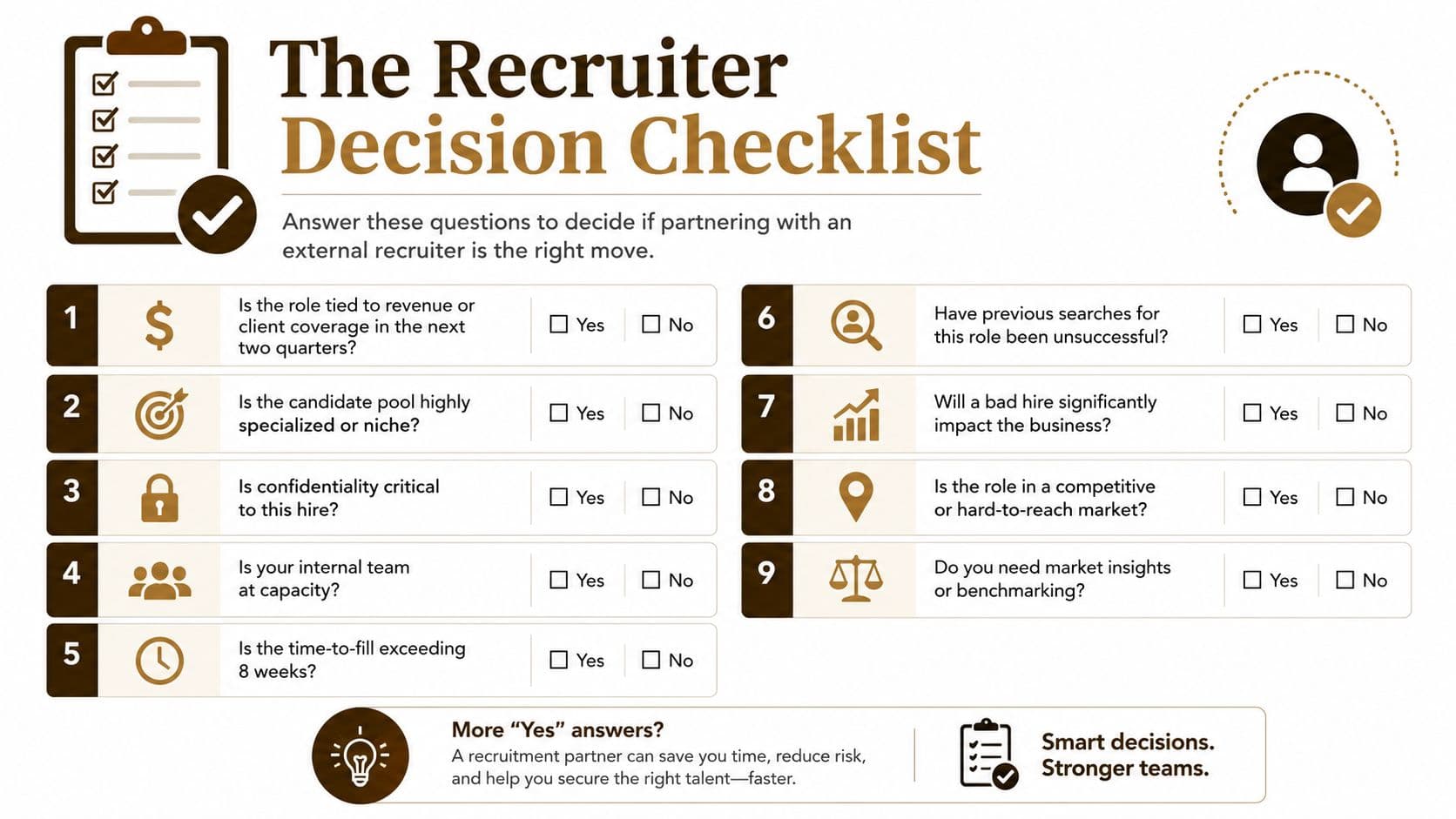
If you can't answer these questions quickly, the search is already drifting into avoidable delay.
The point is not to make every role a recruiter search. The point is to stop pretending that every vacancy can be solved the same way. Some roles deserve in-house handling. Others deserve external market access before the clock starts hurting the firm.
Two Real Scenarios That Test the Framework
The framework is only useful if it produces a clear answer under pressure. These two scenarios show how the same checklist leads to different decisions.
Scenario A, a confidential partner-level hire
A mid-sized firm wants an equity partner to lead a trusts and estates practice. The current partners know the practice, but they can't map the lateral market themselves, and the move can't leak before the announcement. The hire affects client coverage, compensation, and firm positioning.
That's a retained search. The confidentiality issue alone pushes the firm away from a public posting. The leadership level pushes it further. The need for market mapping, passive outreach, and a defensible shortlist makes retained recruiting the clean answer.
Scenario B, a routine backfill with manageable urgency
A regional firm needs a litigation paralegal to backfill a promotion. The role is well-defined, the HR manager has room to handle the search, and there's no confidentiality issue. The firm knows the work, the timeline is manageable, and the risk of a bad hire is lower than in a partner search.
That's internal first. If the first stretch of sourcing doesn't produce workable candidates, a contingency recruiter can step in. There's no reason to pay for outside help before the firm has tested its own capacity.
The retention question matters here too. Recruiter-led screening tends to matter most when the role is hard to assess from a resume alone, or when confidentiality and practice fit are central. For simple, visible roles, the recruiter is usually a speed and reach tool, not a long-term retention fix.
In both scenarios, the answer came from vacancy cost and market access, not from the job title. That's the better way to think about it.
Interview Questions, Alternatives, and Next Steps
If you're considering outside help, don't start with a pitch. Start with a hard interview. A recruiter should be able to answer these questions clearly.
Questions to ask before you engage anyone
- Which practice areas and seniority levels do you cover most often?
- Who pays the fee, and what triggers payment?
- How do you source candidates beyond public applications?
- What does your shortlist process look like?
- How do you protect confidentiality during outreach?
- How do you measure success beyond making a placement?
- How do you screen for culture fit and practice-specific fit?
Those questions tell you whether the recruiter understands legal hiring or just talks about it well. You want market knowledge, disciplined process, and a clean explanation of how they work.
The real alternatives
Internal hiring alone is fine when the role is straightforward and the team has bandwidth. HR consulting can help tighten process, but it won't add market reach. Temporary or contract legal staffing can bridge a gap when demand is uncertain. Direct sourcing tools can help, but they don't replace the network, screening judgment, and candidate management a recruiter brings.
Five Star Placements offers contingency-based permanent placement for law firms and corporate legal departments, along with recruiting for attorneys, legal support staff, partners, in-house counsel, and legal operations leaders. If you need a recruiter, that's the kind of service to evaluate against the specific vacancy you're trying to solve. Five Star Placements contact page
Run the checklist, decide whether the vacancy cost is already too high, and choose the recruiting model that fits the role. If the seat is affecting revenue, client coverage, or partner time now, don't wait for the search to break before you bring in outside help.
If your firm needs a legal recruiter who can handle permanent placements across attorneys, support staff, partners, and in-house roles, Five Star Placements is a practical place to start. They work with law firms and corporate legal departments on contingency-based searches, which makes the decision easier when you're weighing vacancy cost against fee risk.
Need help filling a legal role?
Five Star Placements partners with law firms and legal departments nationwide.
Schedule a Call