
How Law Firms Attract Top Legal Talent: 2026 Playbook
June 29, 2026 · 15 min read · Five Star Placements

Table of Contents
You've likely lived this already. A practice group loses a key associate, the work doesn't slow down, and the partners decide to run a search “quickly.” Three interview rounds later, the strongest candidate goes dark, a second accepts another offer, and the role sits open while clients keep expecting the same responsiveness.
That isn't a recruiting problem in the narrow HR sense. It's an operating problem. It affects matter staffing, partner utilization, client service, and the firm's ability to grow without burning out the people who stayed.
The firms that win talent consistently don't treat hiring like an occasional administrative task. They treat it like a business-critical process with defined inputs, decision points, timelines, and accountability. That shift is at the center of how law firms attract top legal talent now. Not with slogans. Not with prestige alone. With a repeatable playbook that candidates can feel from the first outreach to the first day on the job.
Table of Contents
- The High Cost of a Revolving Door
- Building a Magnetic Employer Brand
- Sourcing Talent Where Competitors Are Not Looking
- Designing an Irresistible Offer
- Mastering the High-Stakes Interview Process
- Using Specialist Recruiters to Accelerate Hiring
The High Cost of a Revolving Door
A missed hire rarely stays confined to one open seat. In a law firm, one vacancy can force partners to absorb more supervision, associates to stretch beyond capacity, and support teams to work around bottlenecks that shouldn't exist. That pressure shows up in slower turnaround times, uneven client experience, and a culture that starts to feel reactive.
The bigger mistake is thinking the answer is “pay more.” Compensation matters, but it doesn't rescue a messy process, an unclear opportunity, or a firm that can't explain why a strong lawyer should build a career there. Top candidates read those signals fast.
Practical rule: If your firm can describe client service standards in detail but can't describe its hiring standards, you don't have a talent strategy. You have a vacancy response.
Managing partners usually see recruiting as episodic. It feels urgent only when someone leaves or a new book of business arrives. The firms that hire well take the opposite approach. They decide in advance what they're selling, who owns each step, how fast they move, and what kind of lawyer will thrive in their environment.
That's the core operational shift. Hiring becomes less about posting and hoping, and more about managing a pipeline with the same discipline you'd bring to a major matter.
A practical recruiting operation includes a few essential elements:
- Clear role economics. Know whether the hire is expected to protect revenue, create capacity, deepen a specialty, or support expansion into a new client segment.
- Defined interviewer roles. One person tests technical depth. Another evaluates judgment. Another assesses working style and team compatibility.
- Fast decisions. Candidates interpret silence as disinterest or disorganization.
- Retention thinking up front. The best time to reduce regrettable attrition is before you make the hire.
Firms that get this right don't just fill roles. They build a reputation in the market for being decisive, credible, and worth joining.
Building a Magnetic Employer Brand
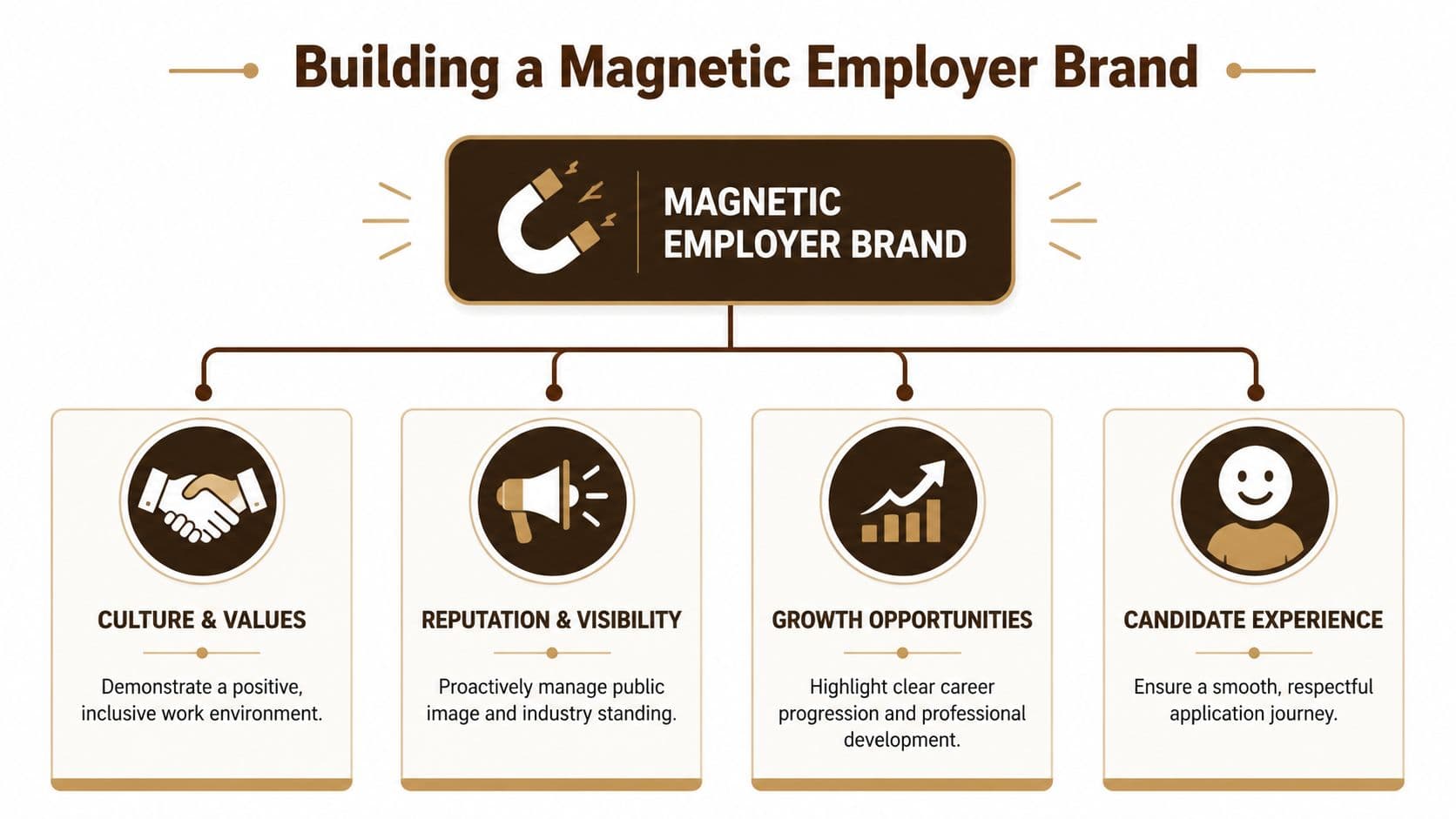
Most firms think they have an employer brand because they have a website careers page and a paragraph about collegiality. That's not enough. Your employer brand is what candidates believe after hearing your name, talking to your lawyers, and moving through your process.
If that message is fuzzy, recruiting gets expensive and slow. If it's specific, the right candidates start pre-qualifying themselves before the first interview.
Define what your firm actually offers
The strongest firms don't try to appeal to everyone. They make a clear case to the lawyers they want most. That usually comes down to a handful of things candidates highly value: quality of work, access to decision-makers, realistic workload expectations, development, and whether the firm's culture feels lived-in or scripted.
Start with a blunt internal audit. Ask partners, associates, and legal support staff the same question: why do good people stay here, and why do good people leave? Then compare those answers with what your job postings and interviewers are saying. The gap between those two is usually where your recruiting problem sits.
A useful benchmark for that message comes from Axiom Law's workload philosophy. Axiom states that 67% of workloads should be comfortable and 33% should challenge employees to learn, giving firms a concrete 2/3 to 1/3 Workload Balance Ratio they can use in recruiting instead of vague promises about flexibility (Axiom Law on attracting and retaining top legal talent).
That kind of specificity changes the conversation. Candidates hear a firm that has thought through workload design, not one that is recycling market language.
Turn vague flexibility into a concrete promise
“Work-life balance” has become so overused that many candidates discount it immediately. They want proof. They want to know what happens on a busy week, who gets protected from unnecessary chaos, and whether leadership behaves the way recruiting materials claim.
A credible employer brand should answer questions like these:
| What candidates ask | What strong firms say |
|---|---|
| How is work assigned? | Matters are staffed deliberately, not dumped on whoever looks available |
| How is growth handled? | Stretch work is intentional and supported |
| What does flexibility mean here? | Expectations are defined by team and practice, not left to guesswork |
| Who gets access to mentors? | Mentorship is built into supervision and feedback, not left to chance |
A lot of firms avoid this level of detail because they worry it limits flexibility. In practice, it does the opposite. It builds trust.
For firms refining that message, it helps to review how legal recruiting specialists present employer value in the market, especially firms that work across attorney, partner, support staff, and legal operations searches such as Five Star Placements.
A short explainer can also help leadership align around what candidates now expect from a legal employer:
Make the candidate experience part of the brand
Candidates don't separate brand from process. If your scheduling is sloppy, if interviewers aren't prepared, or if no one can explain the role consistently, they assume the firm runs that way internally too.
A polished candidate experience doesn't mean being slick. It means being clear, respectful, and prepared.
That means simple things done well:
- Consistent messaging. Every interviewer should describe the role, expectations, and path forward the same way.
- Prompt follow-up. Even a short update preserves trust.
- Real examples. Show how current lawyers have grown, shifted practices, taken on leadership, or built internal credibility.
- Honest trade-offs. If your firm demands intensity during trials, deals, or filing cycles, say so. Discerning candidates respect candor more than spin.
Many firms finally understand how law firms attract top legal talent. The attraction happens long before the offer. It starts when the market believes your firm knows what it is and can prove it.
Sourcing Talent Where Competitors Are Not Looking
Job boards and standard LinkedIn outreach have their place. They're just not where the best legal hiring outcomes usually begin. Strong lawyers, especially the ones you want most, are often busy, selective, and not actively applying.
A better sourcing strategy changes by role. The mistake is using one playbook for every seat in the firm.
Associates require a different pipeline
For junior and midlevel associates, timing matters. So does visibility. You need relationships and touchpoints before a vacancy becomes urgent.
Useful channels include:
- Law school career offices. Strong for building visibility with emerging talent before firms start competing all at once.
- Clerkship networks. Judicial clerks often move through trusted recommendation channels, not broad public searches.
- Practice-specific events. Bar sections, CLE programming, alumni gatherings, and niche legal communities create repeated exposure without transactional outreach.
- Former summer associates and past finalists. Many firms ignore people who nearly joined. That's wasted pipeline.
The firms that source well keep a live bench, not a dead spreadsheet. They revisit strong people, track timing, and stay relevant without pushing too hard.
Partners and senior laterals move through trust
Senior laterals rarely respond to generic opportunity messages. They move when a role solves a real business problem or creates a better platform for clients, compensation, support, or succession.
That requires discretion. It also requires preparation before outreach begins.
Ask these questions first:
- Why would this person move now?
- What client, platform, or leadership story can the firm credibly offer?
- Can the firm support integration after the hire, not just celebrate the announcement?
If you can't answer those questions, you're not ready to recruit a partner. You're just making contact.
A practical way to sharpen your sourcing approach is to study legal hiring patterns and role coverage across practice areas, support functions, and legal operations content such as the guidance available on the Five Star Placements blog.
Senior laterals aren't bought with enthusiasm. They're won with alignment.
Support staff and legal operations hires need local intelligence
Many firms underinvest here, then wonder why attorneys stay bogged down in tasks they shouldn't be touching. Strong paralegals, legal assistants, intake specialists, records staff, and legal operations professionals are force multipliers. They also tend to move through local networks and reputation channels more than broad public postings.
A more effective approach includes a mix of:
| Role type | Better sourcing lane |
|---|---|
| Paralegals | Local association networks, referrals, prior contract talent |
| Legal assistants and secretaries | Office-specific reputation, manager referrals, local legal community contacts |
| Intake and case management staff | Adjacent legal service environments with strong client-facing discipline |
| Legal operations leaders | Cross-functional business networks, specialist search support, discreet referrals |
One more point matters here. Don't source support staff as if they are interchangeable. A litigation support specialist, a trusts and estates paralegal, and a plaintiff intake lead solve very different problems. Firms that hire precisely get better tenure, better workflow, and less attorney frustration.
That precision is a major part of how law firms attract top legal talent across the organization, not just at the attorney level. Lawyers pay attention to whether the firm equips them with capable people around them.
Designing an Irresistible Offer
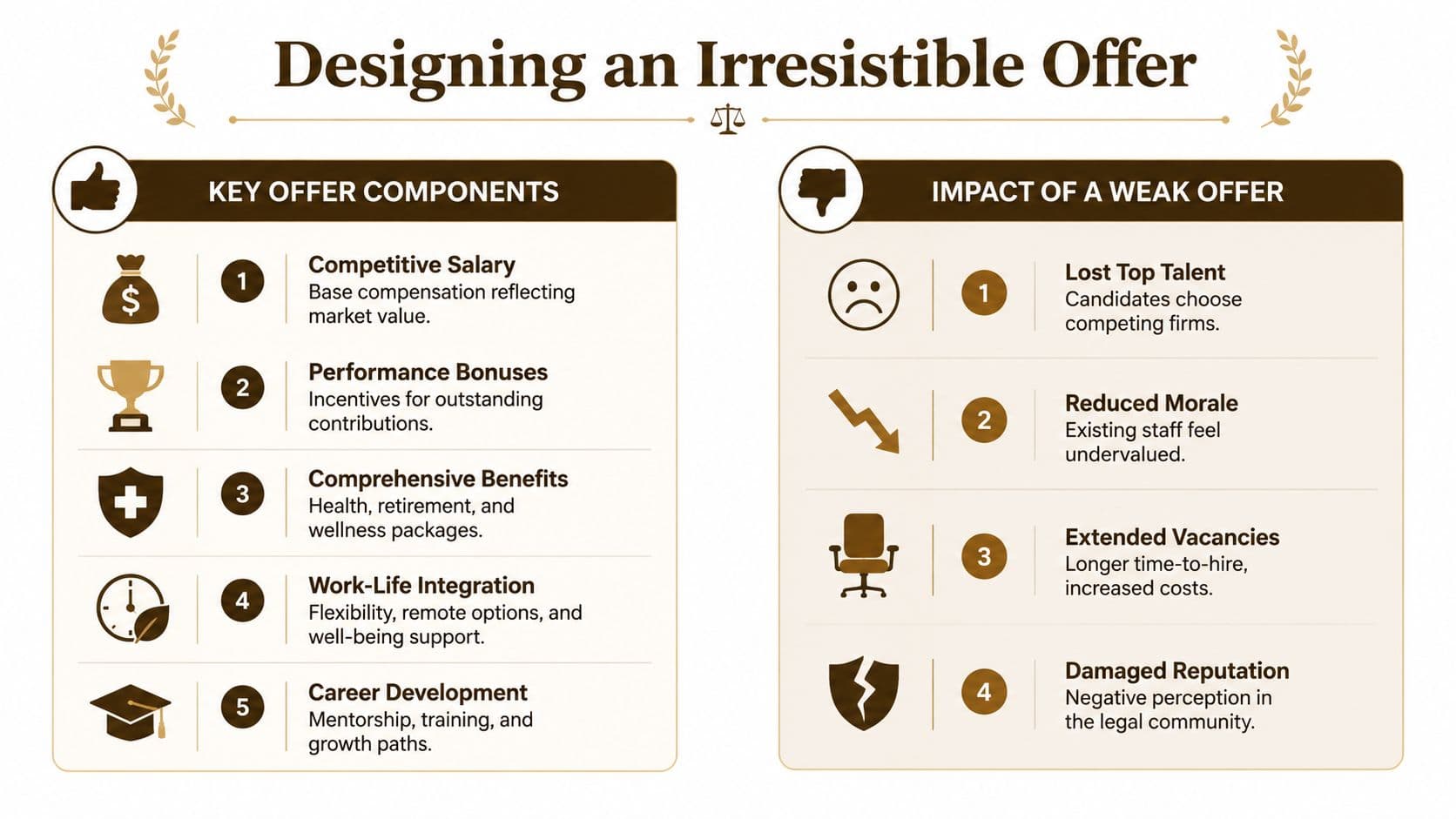
The offer letter closes the process, but the actual offer is broader. It tells the candidate how the firm values time, output, development, and sustainability. If the package is built only around base salary, many strong lawyers will hear an outdated model behind it.
According to Thomson Reuters, firms attracting top legal talent are now offering better benefits and higher salaries while also reducing mandatory billable hour targets to support a more balanced professional lifestyle (Thomson Reuters on retaining legal talent).
Top candidates evaluate the whole deal
A modern legal offer has to work on three levels at once. It must be competitive now, sustainable for the firm, and believable in practice.
That usually means addressing more than pay:
- Compensation structure. Candidates want to understand not only base salary, but what behavior the model rewards.
- Billable expectations. A lower target, if real, can be a serious differentiator.
- Benefits and wellbeing support. Candidates read these as evidence of institutional seriousness, not just perks.
- Flexibility with guardrails. Good candidates don't need unlimited ambiguity. They want clarity.
- Professional development. Training, mentorship, and leadership access make the offer feel like a career decision rather than a job change.
A weak offer often fails because the firm is negotiating against itself. It assumes prestige or practice quality will compensate for unclear advancement, rigid work design, or benefits that lag what the market now expects.
Career architecture matters as much as cash
Another shift is just as important. Not every strong lawyer wants the same destination. The old “partnership or bust” model pushes out people who could become excellent long-term contributors in other forms of leadership.
Circles reports that firms offering diverse, non-traditional career pathways alongside clear partnership tracks report a 28% reduction in mid-level attorney attrition, and that when leadership fails to model balanced professional lifestyles, attrition risk rises by 45% among junior and mid-level attorneys (Circles on attracting and retaining top talent in 2024).
That should change how firms structure offers. A persuasive offer doesn't just answer “what will I make?” It answers “what can I become here?”
Consider offering progression paths such as:
- Practice leadership for lawyers with deep subject matter authority
- Client relationship leadership for lawyers who excel at managing institutional accounts
- Legal operations or process-focused roles for lawyers who improve delivery and systems
- Traditional partnership track for lawyers building books and firm leadership capacity
If those paths exist, spell them out. Show examples. Put time horizons, responsibilities, and support around them.
The most attractive offer is often the one that removes ambiguity. Top candidates don't just want upside. They want a map.
A firm that pairs strong compensation with realistic workload expectations and visible career architecture is far easier to join with confidence.
Mastering the High-Stakes Interview Process
A candidate can like your platform, respect your partners, and still walk away because the interview process felt chaotic. That happens more often than firms admit. In legal hiring, process quality sends a message about management quality.
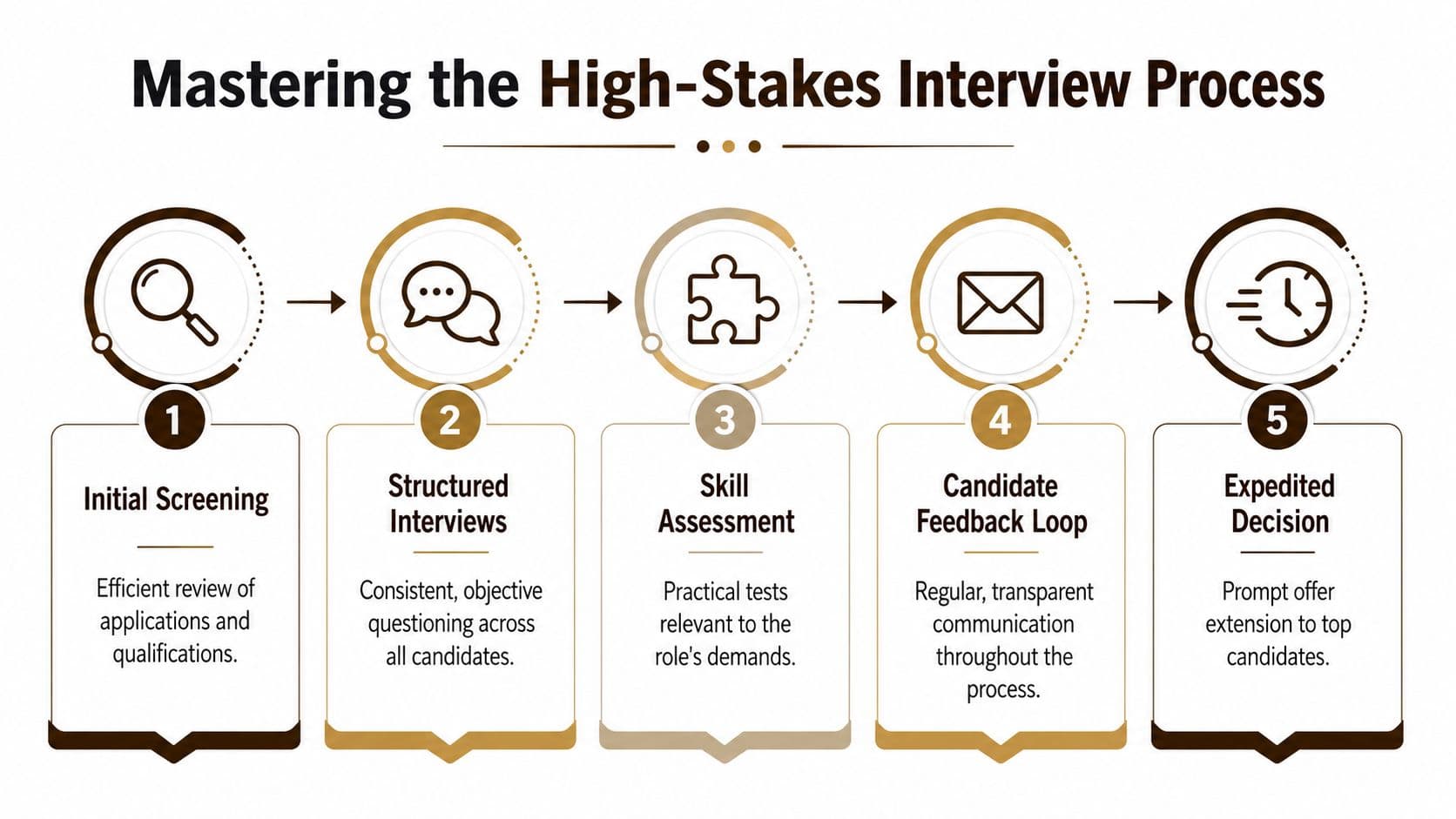
The strongest interview systems are fast, structured, and demanding without being cumbersome.
Structure beats improvisation
Interviewing by instinct creates noise. One partner likes confidence. Another likes caution. A third asks abstract questions and leaves with a vague impression. None of that builds a reliable hiring decision.
A stronger process assigns each stage a job:
| Interview stage | Purpose |
|---|---|
| Initial screen | Confirm baseline fit, motivation, communication, and compensation alignment |
| Hiring partner interview | Test role-specific judgment and practice alignment |
| Peer or cross-functional interview | Assess collaboration style and day-to-day working fit |
| Final decision round | Resolve open concerns and reinforce the firm's value proposition |
This is more than good housekeeping. Firms using a multi-stage evaluation with behavioral and culture-fit assessments see 35–40% higher attorney retention, while skipping the culture-fit assessment leads to a 50% increase in turnover within the first two years (Insource Recruit on hiring lawyers faster).
Speed is part of the assessment
Candidates judge your firm while you're judging them. Delay signals weak coordination, unclear authority, or lack of conviction. None of those help you close top talent.
A clean process usually includes:
- Interview blocks scheduled in advance rather than one meeting at a time
- Fast internal debriefs immediately after each round
- One decision owner who can push the process forward
- A candidate communication plan so no one waits in silence
This doesn't mean rushing people blindly. It means removing preventable lag.
If four people have veto power, one person should still own momentum.
Culture fit should be rigorous, not fuzzy
Culture fit is where many firms make two opposite mistakes. Some skip it entirely and hire only on credentials. Others use it as a vague personal-comfort test, which can introduce inconsistency and bias.
A useful culture-fit interview focuses on observable working realities:
- How does the lawyer handle supervision?
- How do they communicate under pressure?
- What kind of environment helps them produce strong work?
- What frustrates them in team settings?
- How do they respond to feedback?
That's very different from “would I enjoy having coffee with this person?” The first predicts integration. The second often predicts nothing.
The best candidates leave a strong process feeling challenged, respected, and informed. Even if they decline, they should be able to say your firm knows how to make decisions. That reputation compounds over time.
Using Specialist Recruiters to Accelerate Hiring
Some searches should stay internal. Others shouldn't. The difference usually comes down to urgency, confidentiality, role complexity, and whether the firm has the time and market access to run the process properly.
For many high-stakes searches, especially lateral partner, niche practice, in-house counsel, or hard-to-find support and operations roles, a specialist recruiter speeds up access and sharpens selection.

When to build internally and when to bring in help
Internal recruiting works well when the firm has strong market visibility, interviewer discipline, and enough bandwidth to move candidates from first contact to offer without drift.
External help makes more sense when:
- The role is business-critical and vacancy cost is rising
- The talent pool is passive and unlikely to apply directly
- The search needs discretion
- Internal teams are overloaded
- The firm keeps reaching finalist stage and losing candidates
Many small and mid-sized firms fall into a trap. They assume outside help is an extra cost, while ignoring the cost of delay. Yet small and mid-sized firms often lose strong applicants because hiring processes are slow and unresponsive, making efficient timelines and clear career paths essential (LinkedIn guidance on attracting and retaining top legal talent at small firms).
What a good recruiting partnership looks like
Not every recruiter adds equal value. A strong legal recruiting partner does more than forward resumes. They help define the brief, pressure-test the market story, calibrate candidate quality, and keep momentum intact.
The best recruiter relationships usually include:
- A precise intake. Practice area, required experience, business need, reporting lines, compensation philosophy, and culture realities should all be clear.
- Candidate screening beyond the resume. Writing ability, motivation, communication style, and role fit matter.
- Timely feedback loops. If the firm takes too long to respond, even the best recruiter can't save the process.
- Market honesty. A good recruiter will tell you when your expectations and your offer are out of sync.
- Process management. Scheduling, candidate preparation, and closing support all affect outcomes.
For firms evaluating potential search partners, it's worth reviewing how a legal recruiting team positions its process, role coverage, and collaborative model, such as the overview provided on the Five Star Placements team page.
There's also an important distinction between contingency and retained search. Contingency can work well for many direct-hire roles when speed and flexibility matter. Retained search often fits the most sensitive or senior mandates, where deeper market mapping and concentrated attention are required. The right model depends on the stakes, not on habit.
A specialist recruiter should feel like an extension of the firm's judgment, not a separate vendor tossing over candidates. When that partnership is right, the firm gets faster access, better screening, and a tighter path from vacancy to accepted offer.
Five Star Placements helps law firms and legal departments hire attorneys, partners, legal support staff, in-house counsel, and legal operations leaders through customized permanent placement. If your firm needs a faster, more disciplined hiring process with screening aligned to practice needs and culture, explore Five Star Placements.
Need help filling a legal role?
Five Star Placements partners with law firms and legal departments nationwide.
Schedule a Call