
How to Find Qualified Attorneys for Your Law Firm in 2026
June 27, 2026 · 15 min read · Five Star Placements

Table of Contents
A key attorney leaves. Matters don't slow down. Partners start redistributing files, associates absorb work they weren't staffed to handle, and clients notice response times stretching. The immediate instinct is usually the same: post the role, collect resumes, and screen for pedigree, practice area, and years in seat.
That approach feels responsible. It also misses the core issue.
Most advice on hiring lawyers is written for consumers choosing outside counsel, not for law firms or legal departments trying to add a lawyer who performs, fits, and stays as expected. That's why so many hiring teams end up with a technically qualified candidate who turns out to be the wrong hire six months later.
Table of Contents
- Why Your Attorney Hiring Process Is Broken and How to Fix It
- Define the Role for Retention Not Just Resumes
- Source Top Attorneys Who Are Not Looking
- The Four-Question Framework for Effective Interviews
- Craft Offers That Top Candidates Actually Accept
- When to Partner with a Legal Recruiter for Faster Results
Why Your Attorney Hiring Process Is Broken and How to Fix It
If your process starts and ends with credentials, it's broken.
Law firms don't usually miss because they forgot to verify bar admission or because they failed to notice where someone went to law school. They miss because they overvalue what's easy to confirm and underinvest in what predicts a good hire inside their own environment. Hiring partners know this already. 73% of law firm hiring partners report that culture fit and client-service alignment are harder to assess than technical credentials, and 40% of lateral hires exit within the first year due to mismatch, as noted in Cornwell Law's discussion of attorney specialty selection.
That disconnect explains why a polished resume can still produce a weak hire. A candidate may be strong on paper and wrong for your client communication style, pace, supervision model, or economics.
Practical rule: Credentials get a lawyer in the door. Fit determines whether they become profitable, promotable, and durable.
A better process starts by recognizing that attorney hiring is an organizational design problem, not a resume review exercise. You're not filling a chair. You're adding someone to a client-facing system with billing pressure, workflow habits, management realities, and political dynamics inside the firm.
That's also why firms that want a more disciplined search often look at legal recruiting partners such as Five Star Placements. Not because outsourcing is automatically better, but because the right process screens for the things most internal teams rush past when the vacancy is painful.
The fix is straightforward. Define success before you source. Source before the market sees the role. Interview against a framework. Then build an offer around what the candidate values, not what your template letter says.
Define the Role for Retention Not Just Resumes
A weak search usually starts with a weak brief. The hiring partner says, “We need a commercial litigator with seven years of experience,” and HR turns that into a job description. That document may help advertise the opening, but it won't help you make a durable hire.
The better document is a success profile.
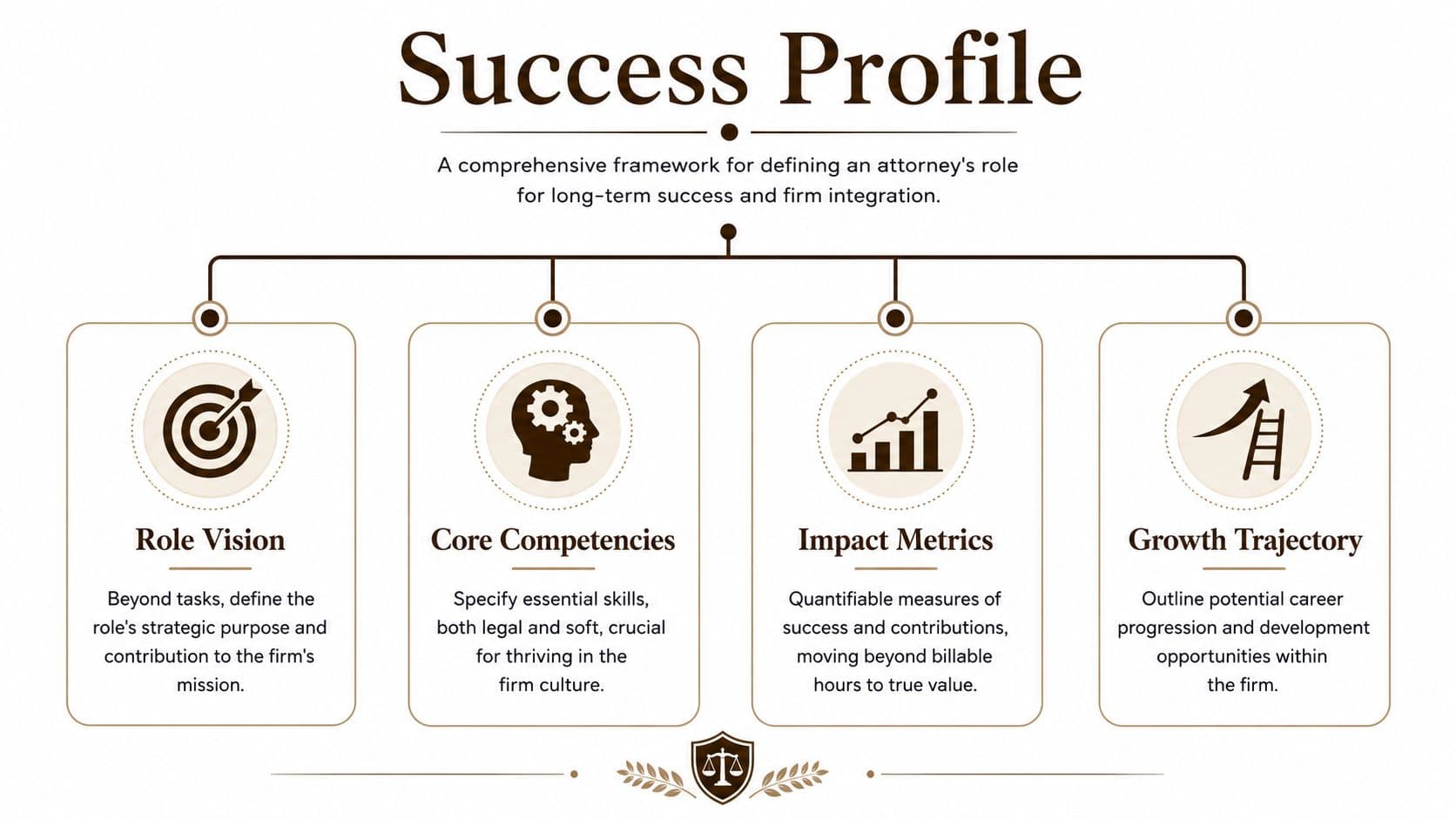
Start with the eighteen-month outcome
Before you list qualifications, define what success looks like after the lawyer has been in the seat long enough to matter. Not in week two. In month eighteen.
Ask questions like these:
- What work will they own: First-chair hearings, drafting responsibility, client contact, supervising juniors, or business development support.
- What friction must they reduce: Partner bottlenecks, matter overflow, missed deadlines, inconsistent client updates, or weak handoffs.
- What style fits here: High autonomy, close supervision, collaborative staffing, aggressive advocacy, or high-empathy client counseling.
- What future are you offering: A platform for book-building, a path to partnership, a quieter practice environment, or broader substantive exposure.
This exercise usually reveals that the role is narrower or broader than the original requisition. A family law firm may say it needs “more experience,” when its true need is someone who can de-escalate conflict with clients and opposing counsel. A litigation boutique may insist on elite credentials when the actual need is someone who can manage discovery volume without constant partner intervention.
Build a scorecard instead of a wish list
Once you know the outcome, build a scorecard around it. Keep it simple enough that interviewers will use it.
A practical scorecard can include four lanes:
| Area | What to define |
|---|---|
| Technical floor | Practice area exposure, matter complexity, bar status, writing strength |
| Behavioral traits | Judgment, responsiveness, ownership, composure, interpersonal style |
| Business fit | Billing model comfort, client-service style, pace, reporting structure |
| Retention signals | Motivation for change, market realism, growth goals, likely longevity |
That framework keeps the team from drifting back into prestige shorthand.
One adjustment matters a lot here. Successful firms often define a minimum viable experience threshold of 2 to 5 years, rather than building rigid requirements that shrink the pool before the search begins, according to the law firm hiring roadmap discussion at Rocket Clicks. The same source notes that prioritizing interpersonal skills is especially important in areas like family law or litigation, and that hiring for capacity before it becomes urgent can reduce turnover by 30% to 40% when firms plan around cash flow visibility.
If the role truly requires judgment built over time, say that. If the role can be taught to a strong midlevel with the right support, don't block your own search with inflated requirements.
A few practical mistakes show up repeatedly:
- Overwriting the job description: Long requirement lists attract the wrong kind of self-selector and repel strong lawyers who don't match every line.
- Confusing pedigree with readiness: A brand-name firm on a resume doesn't tell you how much responsibility the candidate actually carried.
- Ignoring growth trajectory: Good lawyers often move for a better platform, not because they dislike their current firm.
If you're serious about how to find qualified attorneys for your law firm, the work starts by defining the role. The role has to be defined around contribution and retention. Otherwise every later step gets noisier, slower, and more expensive.
Source Top Attorneys Who Are Not Looking
The strongest attorney on your eventual shortlist often won't apply.
That's the first sourcing reality most firms resist. They post a role, wait for inbound interest, and then complain that the market is thin. In legal hiring, especially for lateral associates, counsel, and partners, the better candidates are usually busy, reasonably compensated, and not spending evenings refreshing job boards.

Use market mapping, not job board hope
Start with a target list. Not a generic talent pool. A target list.
Map the firms, practice groups, and attorney profiles that plausibly produce the kind of lawyer your success profile requires. If you need an employment litigator who can work directly with founders, a lawyer from a massive institutional defense shop may or may not fit. If you need a trusts and estates attorney with strong bedside manner, focus on firms where attorneys manage relationship-heavy portfolios rather than only document production.
Useful sourcing channels include:
- State bar attorney search tools: These help verify real-time license status, disciplinary history, and administrative records. Some also identify certified specialists and local practitioners by relevant area, which makes them useful for early credential validation and market mapping. The University of Michigan Law Library guide to legal employer research highlights state bar attorney search systems and explains that the NALP Directory of Legal Employers has been publicly free and searchable since 2000 and collects annual data from over 1,000 legal employers, including practice areas, lawyer demographics, and associate compensation ranges such as $60,000 to $250,000+.
- Law school alumni networks: Alumni directories and affinity groups can surface lawyers with the right geography and practice mix, especially in regional markets.
- Court filings and published matters: If you need real litigation experience, look at who is appearing, drafting, and arguing.
- Referral sources inside your ecosystem: Former colleagues, trusted opposing counsel, and local bar section leaders often know who is under-placed.
The point isn't to contact everyone. The point is to know whom you'd hire before the requisition goes live.
Validate before you approach
Targeted outreach works better when it's informed. Before contacting a lawyer, confirm the basics and benchmark the move.
Use a quick validation checklist:
-
License and standing
Confirm active status and look for disciplinary or administrative issues using the relevant bar tool. -
Practice match
Compare their likely work mix against market norms and employer profile data, including practice area context from NALP. -
Career inflection point
Ask why this person, at this stage, might move. Plateaued advancement, workload pressure, relocation, origination limits, or management fatigue all create openings. -
Your value proposition
Tailor the message. Don't send “We have an exciting opportunity.” Send the actual reason this move may make sense.
For example, a targeted outreach note to a fifth-year litigator at a high-pressure competitor might mention first-chair opportunities, closer client access, or a more realistic partnership path. A note to an in-house attorney might focus on scope, business-facing exposure, or compliance leadership.
A general posting can still help. But proactive sourcing is what changes the quality of the pool. It's the difference between screening whoever showed up and pursuing lawyers who already resemble your best people. For firms that want more practical hiring intelligence, the Five Star Placements blog covers topics across attorney and legal staff recruiting.
The Four-Question Framework for Effective Interviews
Most attorney interviews are too conversational to be predictive. A partner likes a candidate. Another partner doesn't. Someone says the person was “sharp.” Someone else says they seemed “a little flat.” Then the team either hires on instinct or loses momentum in committee.
That's avoidable if every interviewer is working from the same diagnostic framework.
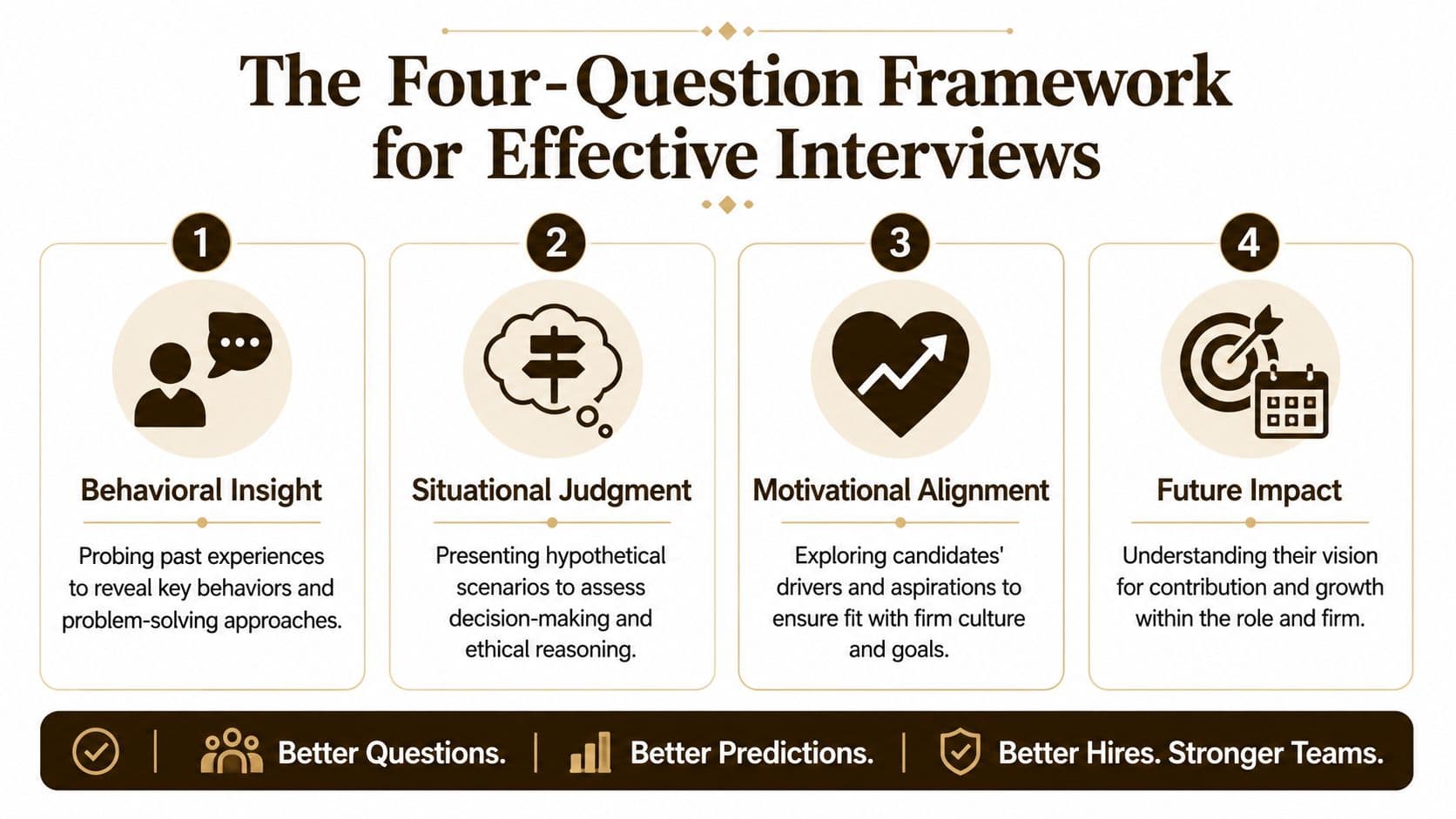
The most useful interview structure I've seen in legal hiring reduces to four questions:
- Can they do the job?
- Can they be managed?
- Will they do the job long-term?
- Do they really want the job?
That framework comes from attorney recruiting practice summarized by BCG Attorney Search, which also notes that attorneys with stable tenure and clear reasons for leaving show 85% higher retention rates, and that using pre-submission screening for firm-specific criteria can reduce mis-hires by 50%.
Question one and two test execution and coachability
The first question is not “Do they sound smart?” It's whether they can perform your actual work with your level of oversight.
Ask for specifics:
- Walk me through the last matter where you personally drove the result.
- What part of the brief, deal, investigation, or negotiation was yours?
- Where did a partner have to step in?
- What would your current supervising attorney say you do well, and where would they still want tighter execution?
This separates exposure from ownership.
The second question, can they be managed, matters just as much. Strong lawyers still fail if they can't take direction, calibrate to partner preferences, or handle feedback without defensiveness.
A few behavioral prompts work well:
- Tell me about a time a partner significantly revised your work. What did you change afterward?
- Describe a matter where deadlines moved fast and instructions were incomplete. How did you proceed?
- When you disagree with a supervising attorney's strategy, what do you do?
The interview should produce evidence, not adjectives.
One useful internal practice is to assign interviewers different jobs. One person tests technical depth. Another tests client presence. Another tests management fit. If everyone asks the same broad questions, you get repetition, not signal.
Question three and four test staying power and intent
The third question, will they do the job long-term, is where many firms get lazy. They hear a polished answer about “new challenges” and move on.
Don't.
Tenure tells you something. So does the explanation. A lawyer who made thoughtful moves tied to training, platform, geography, or practice focus is different from someone who keeps leaving under vague circumstances. You're not punishing mobility. You're evaluating whether this move makes narrative sense.
Use this table during debriefs:
| Signal | Better indicator | Risk indicator |
|---|---|---|
| Tenure pattern | Steady progression and reasonable duration | Frequent short stays with little explanation |
| Reason for leaving | Specific, non-defensive, tied to fit or growth | Generic dissatisfaction or blame-heavy answers |
| View of prior firms | Balanced and professional | Bitter, evasive, or performative |
| Future goals | Aligned with what your firm can actually offer | Ambition mismatch or uncertainty |
The fourth question, do they really want the job, is often obvious if you know what to look for. Serious candidates ask pointed questions about workflow, economics, supervision, advancement, client base, and expectations. Casual candidates ask almost nothing or ask only about title and compensation.
This is also the stage to look outside the interview room. Reputation matters in legal hiring. 82% of individuals seeking legal services rely on online reviews as their primary source, and 40% cite reviews as the decisive factor when selecting an attorney to contact, according to FindLaw's lawyer search statistics. For firms, that makes reputational diligence part of screening, not a side issue. The same source also notes that less than 1% of attorney applicants meet the hiring standards of top-tier firms, which is why strong screening goes beyond resumes and includes validating actual case history through tools such as Lexis+ Litigation Profile Suite.
A good interview process doesn't just tell you who can start. It tells you who is worth investing in.
Craft Offers That Top Candidates Actually Accept
Many firms lose good candidates after doing the hard part well. They source intelligently, interview carefully, and then send a generic offer package that treats every lawyer as interchangeable.
That doesn't work in a lateral market.
A strong offer starts before the written offer
If you wait until the offer letter to learn what matters to the candidate, you're already behind. The best offers are shaped during the interview process.
By the time you're ready to move, you should know:
- why the candidate would leave a stable platform
- what they need more of in the next role
- what they need less of
- what would make them hesitate
- which parts of your opportunity matter to them
A parent of young children may value predictability more than nominal upside. A senior associate may care more about origination runway and direct client contact than title. An in-house lawyer returning to private practice may need clarity on pace, support, and expectations, not just pay.
Generic outreach attracts curiosity. Specific offers close serious candidates.
That also means your verbal offer should sound different depending on whom you're recruiting. If you're hiring from a high-stress environment, frame the move around support, staffing, and sustainability. If you're recruiting someone blocked on advancement, frame it around progression and authority.
Sell the whole platform, not just base pay
Compensation matters. So does context.
The offer should explain the total package in plain terms:
- Base compensation: Position it competitively within your local market and the candidate's level.
- Bonus mechanics: Explain what drives it and whether the targets are realistic.
- Benefits and flexibility: Be concrete about schedule expectations, hybrid structure, parental support, and time off.
- Professional growth: Spell out training, mentoring, business development exposure, and the path to larger responsibility.
- Role design: Clarify client contact, supervision, matter ownership, and what success looks like in the first year.
Candidates also read inconsistency very quickly. If the interview process sold autonomy and the offer hints at heavy oversight, trust drops. If the team talked about partnership but no one can explain the criteria, the candidate notices.
One practical move often helps. Deliver the offer live before you send documents. Let the hiring partner explain why the firm chose the candidate, what role they'll play, and why the move makes sense now. Lawyers are trained skeptics. They respond well when the logic is clear and the expectations are candid.
When to Partner with a Legal Recruiter for Faster Results
Some searches should stay internal. Others shouldn't.
If the role is straightforward, the market is familiar, and your internal team has time to source and screen properly, you may not need outside help. But firms usually call a recruiter when the search is already costing them more than they want to admit. Work is backing up, partners are covering below their level, and a vacancy that looked temporary is now affecting revenue, morale, or client service.
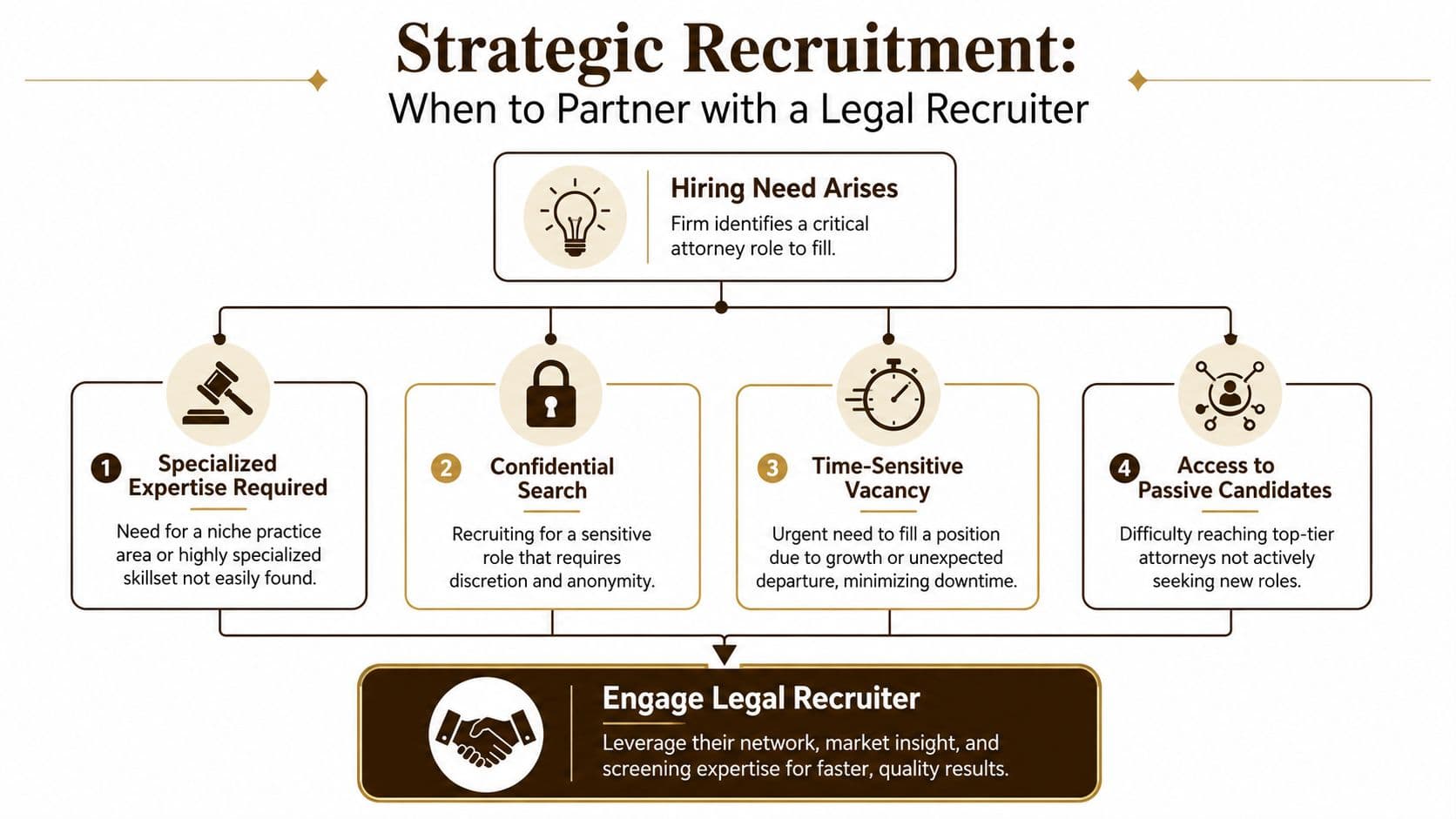
The trigger points are usually obvious
You should strongly consider outside help when one or more of these conditions is true:
- The search is specialized: Niche practices and hybrid roles are harder to fill through general postings.
- The search must stay quiet: Partner replacements, team buildouts, and sensitive reporting-line changes usually require confidentiality.
- The search has stalled: Plenty of applicants, no acceptable finalists.
- The internal team lacks bandwidth: Busy firms often don't have time to run disciplined outreach, screening, and follow-up.
- You need passive candidates: The right lawyer is unlikely to apply directly.
This is also where recruiter economics matter. Some firms hesitate because they don't trust the fee model or can't define success beyond speed. The market has made that concern more visible. Recent 2025 to 2026 data shows that 68% of mid-sized firms hesitate to engage external recruiters due to unclear outcome-linked fee structures, 52% of HR leaders can't articulate recruiter success metrics beyond time-to-fill, and prolonged vacancies average 112 days. In that context, contingency-based recruiting changes the decision because it links fees to actual hiring outcomes rather than upfront spend.
Why contingency changes the risk calculation
A contingency model won't fix a confused search. But it does reduce financial risk when the role is hard to fill and the opportunity cost of delay is real.
The best use of a recruiter isn't resume volume. It's curation.
A legal recruiter should narrow the market, pressure-test the role, approach passive candidates, and present a shortlist that has already been screened for experience, motivations, and likely fit with your environment. That's particularly useful when your hiring team knows law but doesn't have the time to chase down every market conversation.
One factual example in this space is Five Star Placements' company overview, which describes a contingency-based permanent placement model for law firms and corporate legal departments, covering attorneys, partners, in-house counsel, legal support staff, and legal operations roles. The practical value of that model is simple. You get outside sourcing and screening support without committing upfront fees before a hire is made.
Not every search needs a recruiter. But when the role is specialized, confidential, time-sensitive, or repeatedly unfilled, keeping it internal can become the more expensive choice.
If your firm needs help finding attorneys who fit the work, the culture, and the long-term plan, Five Star Placements is one option to evaluate. The firm works on a contingency basis and supports law firms and legal departments with permanent placement across attorney, partner, in-house, legal support, and legal operations roles.
Need help filling a legal role?
Five Star Placements partners with law firms and legal departments nationwide.
Schedule a Call