
Legal Operations Director: A Guide to Hiring and Strategy
July 2, 2026 · 19 min read · Five Star Placements
Table of contents
A Legal Operations Director now commands a median base salary of $204,000, higher than the $195,000 median for senior attorneys according to the ACC Legal Ops findings. That number reframes the role immediately. This isn't an administrative coordinator tucked under the legal department. It's an execution leader who owns how the department runs.
For a General Counsel making a first legal ops hire, that distinction matters. Most failed searches happen because the company says it wants “someone strategic,” then writes a job that mixes executive vision, systems administration, procurement, analytics, and outside counsel management into one vague brief. The better approach is simpler. Decide whether you need the person who sets direction or the person who turns direction into operating reality.
Table of Contents
- What Is a Legal Operations Director
- Core Responsibilities and Performance Metrics
- The Ideal Candidate Profile Skills and Background
- Structuring and Compensating the Role
- Sample Job Description and Key Interview Questions
- Overcoming Common Hiring Challenges
- Finding Your Next Legal Operations Leader
What Is a Legal Operations Director
A Legal Operations Director is the senior operator inside the legal department. The role exists to make legal work scalable, measurable, and manageable across people, process, technology, and spend. In practical terms, this person keeps the department from running on attorney goodwill and tribal knowledge.
The clearest way to understand the role is by contrasting it with a Head of Legal Operations. The Head sets the operating model, aligns legal with business priorities, and decides where the function should go. The Director executes that plan. The Director installs the intake process, owns the budget mechanics, manages the technology rollout, and makes sure reporting gets produced and used.
That distinction sounds subtle on paper. It's not subtle in hiring.
The Director is the execution engine
If your department already knows what needs to improve, intake chaos, poor visibility into outside counsel invoices, too many manual workflows, weak matter reporting, then you probably need a Director before you need a Head. The Director is the person who translates broad goals into repeatable systems.
The role usually includes work like this:
- Workflow ownership: Building and enforcing intake paths, approval steps, templates, and matter-routing rules.
- Technology implementation: Leading adoption of legal operations software, intake platforms, and analytics tools.
- Budget discipline: Tracking spend, partnering with finance, and making legal costs visible before they become surprises.
- Operational consistency: Standardizing how the department handles recurring requests so lawyers don't reinvent the process every week.
A legal department doesn't become more efficient because it buys software. It becomes more efficient because someone owns implementation, adoption, and accountability.
Why the market values the role differently now
The compensation shift tells you how companies now view legal operations. When the operator responsible for budgets, systems, workflows, and department performance earns more than a senior attorney, the organization is saying something important. Operational leadership is no longer overhead. It's part of legal's core business capability.
That's why the strongest GCs don't frame this hire as support. They frame it as a force multiplier.
A good Legal Operations Director reduces friction between legal and the business. Finance gets cleaner budget conversations. IT gets a credible partner on systems decisions. Procurement gets someone who understands vendor discipline. Attorneys get time back for legal judgment instead of chasing invoices, fixing intake mistakes, or rebuilding status reports.
For companies making this hire for the first time, it also helps to work with a recruiting partner that understands how legal and operational talent overlap. Firms with experience in legal department hiring, such as Five Star Placements and its legal recruiting background, tend to understand that the role sits between legal, business operations, and change management rather than inside any one silo.
Core Responsibilities and Performance Metrics
Legal departments that install new tools without clear ownership usually end up with the same old problems in a more expensive system. A Legal Operations Director earns their keep by turning process, spend, and vendor activity into something the GC can control week to week.
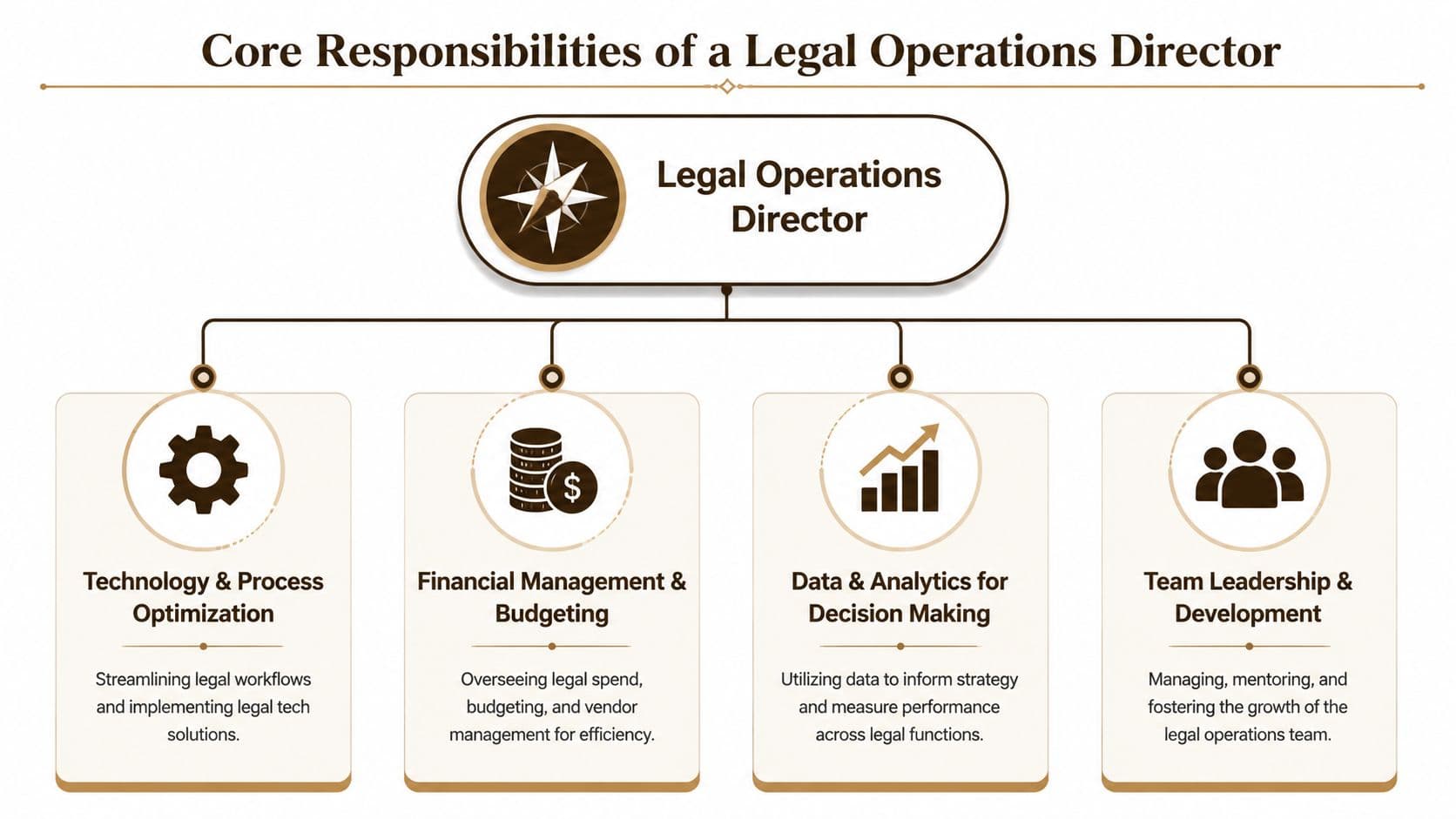
At the Director level, the job is execution-heavy. This person is usually the operator who gets intake live, tightens billing rules, cleans up reporting, and pushes vendors and internal stakeholders to follow the process. A Head of Legal Operations may set the roadmap. The Director is the one who makes the roadmap real.
The four pillars of the job
Some teams make the role sound broader than it is. In practice, the work usually sits inside four operating pillars.
Technology and process optimization
The first problem is usually basic. Requests arrive through email, Slack, hallway conversations, and copied threads. Nobody has a clean view of demand, ownership, or turnaround time.
The Director fixes that by putting structure around intake and repeatable work.
- Intake design: Build one front door for legal requests, with routing and priority rules that match business risk and capacity.
- Workflow standardization: Create templates, approvals, and common steps for routine matters so work does not get reinvented every time.
- System ownership: Run legal tech implementation, training, adoption tracking, and post-launch issue cleanup.
- Usability focus: Keep the process simple enough that lawyers and business users will use it instead of bypassing it.
I see this mistake often in first-time hires. The department buys a platform and assumes usage will follow. It rarely does. Someone has to own configuration, adoption, exception handling, and the uncomfortable follow-up when partners ignore the new process.
Financial management and vendor control
This is the part many GCs underrate at the start. In a well-run department, the Legal Operations Director is not just tracking invoices. They are managing legal's operating model through budget discipline, outside counsel controls, and vendor performance.
Typical responsibilities include:
- Budget development: Build annual budgets based on matter mix, expected external spend, technology costs, and staffing assumptions.
- Spend tracking: Monitor internal and external costs and flag variance early enough to do something about it.
- Invoice discipline: Improve e-billing rules, accrual accuracy, coding quality, and approval workflows to reduce leakage.
- Vendor oversight: Run law firm panels, review service levels, compare rate proposals, and hold providers to agreed terms.
- Commercial judgment: Assess whether a tool or service is worth renewing, renegotiating, consolidating, or replacing.
This capability matters more than many job descriptions suggest. A Director who cannot challenge a rate increase, spot weak staffing on a matter, or explain why legal tech spend is drifting will struggle, even if they are strong on systems.
Data and reporting
Legal data has a habit of looking polished and being useless. The Director's job is to build reporting that helps the GC make staffing, budget, and workflow decisions.
A practical dashboard usually answers questions like these:
| Focus area | What the Director should make visible |
|---|---|
| Intake | Volume, source, category, and status of requests |
| Matters | Open work by type, owner, and stage |
| Spend | Budget versus actuals, by vendor or matter group |
| Throughput | Cycle time, backlog, and handoff delays |
| Adoption | Whether teams are using required systems and templates |
Practical rule: If a KPI does not change a staffing, budget, or process decision, it is noise.
How performance should be measured
First-time hires often get evaluated against vague goals like “improve efficiency.” That creates confusion on both sides. The Director role should be measured against operating outcomes the GC can see and defend.
Use metrics such as:
- Budget reliability: Legal leaders receive timely, credible spend reporting and fewer quarter-end surprises.
- Process compliance: Requests come through defined channels instead of side-door workarounds.
- System adoption: Lawyers and business users complete work inside approved tools, not in shadow processes.
- Vendor management quality: Outside providers are reviewed against cost, responsiveness, and work quality, not just approved for payment.
- Decision support: The GC can use department data in conversations with Finance, Procurement, and business leadership.
The role is about disciplined execution and financial stewardship. Strong Directors are usually steady operators who can enforce process, manage vendors with backbone, and keep the department honest about where money and time are going.
The Ideal Candidate Profile Skills and Background
Legal departments that hire this role well usually make one adjustment early. They stop looking for a mini-GC with an interest in process and start looking for an operator who can run the business side of legal with discipline.
That distinction matters because the Director role is execution-heavy. A Head of Legal Operations may set the roadmap, shape department strategy, and represent legal ops at the executive level. The Director is the person who gets the systems adopted, keeps reporting credible, forces follow-through across vendors and internal teams, and makes sure budget controls hold up under pressure.
The best candidates rarely come from one neat track. Strong profiles usually combine legal department exposure, operational ownership, financial control, and enough technical fluency to question software vendors and implementation partners without getting pulled into feature theater.
Experience level matters, but title inflation makes years alone a poor screen. In most first-time hires, I would rather see someone who has owned legal tech rollouts, vendor relationships, and budget reporting than someone with a longer resume full of support work. A JD can help with credibility in some departments. It does not substitute for operating range.
What to screen for first
Resume polish is cheap. Evidence of ownership is not.
Screen for candidates who can point to work they personally drove inside a legal environment, especially where the outcome depended on adoption, process compliance, or spend control. Director-level people should be able to explain what problem existed, what they changed, where resistance came from, and how they measured whether it worked.
The strongest profiles usually show:
- Operational ownership: They led implementation, governance, and issue resolution. They did not just coordinate meetings or track a project plan.
- Financial fluency: They can talk through budget assumptions, accrual discipline, invoice controls, and why legal spend moved up or down.
- Cross-functional credibility: They have worked productively with Finance, IT, Procurement, Security, and attorneys, and they understand the different incentives each group brings.
- Vendor judgment: They know how to assess technology providers, ALSPs, and outside firms based on service model, cost, implementation risk, and fit with department needs.
- Execution discipline: They can keep work moving after kickoff, which is where many legal ops initiatives stall.
A pure project manager often struggles in this seat. So does a former practicing lawyer who understands the department but has never owned systems, budgets, or vendor performance.
Financial stewardship is often the deciding factor
The most overlooked part of this profile is financial stewardship. That is a hiring mistake, especially in departments making their first Director hire.
Analysts at MLA Global found that external legal spend in 2024 saw a 45% increase. In the same analysis, outside counsel and vendor management accounted for 30% of a Director's strategic impact, and market examples included compensation reaching $261K for AbbVie's Associate Director role.
Those numbers are useful because they clarify what the market now expects. Financial control is not a side skill. It is a core part of the job, particularly for a Director who sits closer to daily execution than a more strategic Head of Ops.
In practice, that means the candidate should be able to do more than report spend after the fact. They should know how to set billing rules, review compliance, compare firms on outcome and cost, support rate negotiations, and work with Procurement or Finance when vendor performance slips. They also need enough judgment to know where tighter controls help and where they slow down urgent legal work.
Here is what strong spend-management capability looks like in interviews:
- Panel management experience: They have helped rationalize firm rosters, direct work to the right providers, or review performance across firms.
- Invoice control knowledge: They can explain billing guideline enforcement, common leakage points, and what invoice review technology can and cannot catch.
- Commercial discipline: They have participated in RFPs, fee arrangement discussions, or vendor negotiations and can describe trade-offs, not just process steps.
- Analytical maturity: They have used reporting or AI-assisted review tools to identify anomalies, track trends, and support budget decisions with real evidence.
- Vendor accountability: They have managed implementation partners or service providers with clear expectations on scope, timeline, and service quality.
If a candidate speaks confidently about legal technology but cannot explain how they would control outside counsel spend, that is a systems administrator profile, not a Director-level legal ops hire.
Backgrounds that tend to translate well
Good candidates often come from three places.
One group comes out of in-house legal operations teams where they already owned e-billing, matter management, reporting, or vendor administration. This is usually the cleanest transition.
Another group comes from consulting, Big Four, or legal services environments and brings stronger process discipline and analytics. They can work well if they have spent enough time inside legal departments to understand attorney behavior and the slower pace of change.
A third group comes from adjacent enterprise operations roles, especially Procurement, Finance, or enterprise systems, and has supported legal closely enough to understand confidentiality, matter structures, and outside counsel dynamics. These hires can be strong on financial control and vendor rigor, but they need credibility with lawyers early.
Soft skills that actually matter
Soft skills matter here, but not in the generic sense.
The role calls for someone who can push standardization without turning every process change into a political fight. They need enough confidence to challenge senior lawyers, enough restraint to choose the right battles, and enough clarity to explain why a new intake rule or vendor policy exists in business terms.
Look for someone who can:
- Handle resistance calmly
- Translate operational issues into legal and finance language
- Hold boundaries on process
- Build trust through accuracy and follow-through
- Stay steady when senior stakeholders ignore the system they approved
Patience helps. Backbone matters more.
A first Legal Operations Director should be the person who can take a department from informal habits to repeatable operations, with tighter vendor management and clearer financial control, without needing constant executive intervention.
Structuring and Compensating the Role
The reporting line shapes the role more than most companies realize. If you want a legal operations director to change workflows, tighten spend controls, and force adoption of systems, that person needs clear authority and visible backing from leadership.
In most first-time builds, the cleanest structure is a direct line to the General Counsel or the senior legal executive with true budget and process authority. If the Director sits too low in the org chart, attorneys often treat the role as optional support. That kills adoption.
How to place the role in the department
The Director should sit high enough to do three things well:
- Challenge existing habits: Intake, matter management, vendor usage, and reporting all require behavior change.
- Work laterally across functions: Finance, IT, and Procurement need a peer-level operational contact.
- Manage the legal ops team as it grows: In mature departments, the Director often oversees managers, analysts, or specialists.
This isn't a role to bury under an administrator who lacks authority over legal process. If you expect the person to own technology, budgets, and vendor discipline, the title and reporting line should reflect that expectation.
Market compensation ranges
Compensation should match both scope and complexity. Director-level roles typically fall into the ranges below.
| Experience Level / Company Type | Typical Salary Range |
|---|---|
| Director-level roles requiring about eight years of experience | $150,000 to $202,000 |
| Professionals with three to five years of experience | $130,000 to $180,000 |
| More seasoned leaders in large public companies | $240,000 to $275,000 |
These figures reflect the compensation ranges discussed in Zac Ferren's analysis of in-house legal operations leadership roles.
Compensation also needs to reflect what you're asking the person to own. A Director responsible for technology implementation, outside counsel management, budgeting, analytics, and cross-functional leadership is carrying a broader mandate than someone focused mainly on process administration.
Common compensation mistakes
First-time buyers of this talent often make the same errors:
- Underscoping the role: The company wants a Director but budgets for a manager.
- Overloading the remit: The job combines strategy, execution, and specialist work with no support structure.
- Ignoring market context: A candidate with proven budget and vendor-management capability won't price like a general operations coordinator.
- Misaligning incentives: If performance matters, bonus structure should reinforce delivery against operational goals.
A fair offer isn't just about cash. It's also about giving the person enough authority, access, and organizational air cover to succeed.
Sample Job Description and Key Interview Questions
The easiest way to lose strong candidates is to post a vague job description and run unstructured interviews. Good legal operations leaders can tell quickly whether a company understands the role. If the brief reads like a recycled operations posting with legal jargon added in, serious candidates will opt out.

A workable starting point is to anchor the role around proven execution responsibilities. As reflected in Duke's Director of Legal Operations profile, successful candidates typically bring at least 8 years of experience, including management of legal teams and complex processes, while coordinating budgets, operating plans, technology strategy, and cross-functional relationships with Finance, IT, and Procurement.
Sample job description
Title: Director of Legal Operations
Role summary
The Director of Legal Operations leads the execution of the legal department's operating model. This role owns legal technology implementation, budget oversight, vendor management, process standardization, and reporting. The Director partners closely with legal leadership and business stakeholders to reduce administrative burden on attorneys and improve visibility into legal work and spend.
Core responsibilities
- Own department operations: Manage intake, workflows, templates, and process governance across the legal function.
- Lead legal technology execution: Evaluate, implement, and improve systems used for matter management, intake, reporting, e-billing, and related legal operations work.
- Manage financial operations: Support annual planning, budget tracking, invoice review practices, and legal spend reporting.
- Oversee outside counsel and vendors: Coordinate panel management, RFP activity, service reviews, and vendor performance monitoring.
- Build management reporting: Develop dashboards and recurring operational reporting for legal leadership.
- Partner across the business: Serve as a working liaison to Finance, IT, Procurement, and other internal teams.
- Drive adoption and change management: Ensure new processes and systems are implemented consistently across the department.
Key qualifications
The screen should be practical, not ornamental.
- Required experience: Significant experience in legal operations, legal department management, or a comparable operations role in a law firm or in-house setting.
- Leadership background: Clear ownership of complex, cross-functional programs.
- Financial capability: Comfort with budgets, spend analysis, and vendor economics.
- Systems experience: Hands-on exposure to legal tech implementation and reporting tools.
- Communication style: Able to work credibly with lawyers, executives, and operational partners.
This is a useful point to calibrate the interview team before first rounds. A short explainer can help:
Interview questions that reveal real capability
Use questions that force specificity.
- Tell me about a legal workflow you standardized. What was happening before, what changed, and what resistance did you face?
- How have you managed outside counsel spend? Walk through your role in invoice review, firm management, or fee discussions.
- Describe a legal tech implementation you led. How did you handle adoption after go-live?
- How do you decide which KPIs belong on a GC dashboard?
- Give an example of working with Finance or Procurement on a difficult issue.
- What part of legal operations do attorneys usually underestimate, and how do you address that?
The best candidates answer with operating detail. The weaker ones answer with broad principles and very few decisions they personally made.
Overcoming Common Hiring Challenges
This is one of the harder searches in a legal department because the talent profile is narrow. You're looking for someone who understands legal work well enough to earn attorney trust, but who also thinks like an operator, budget owner, process architect, and vendor manager. Most candidates are strong in two of those areas. Fewer are strong in all of them.
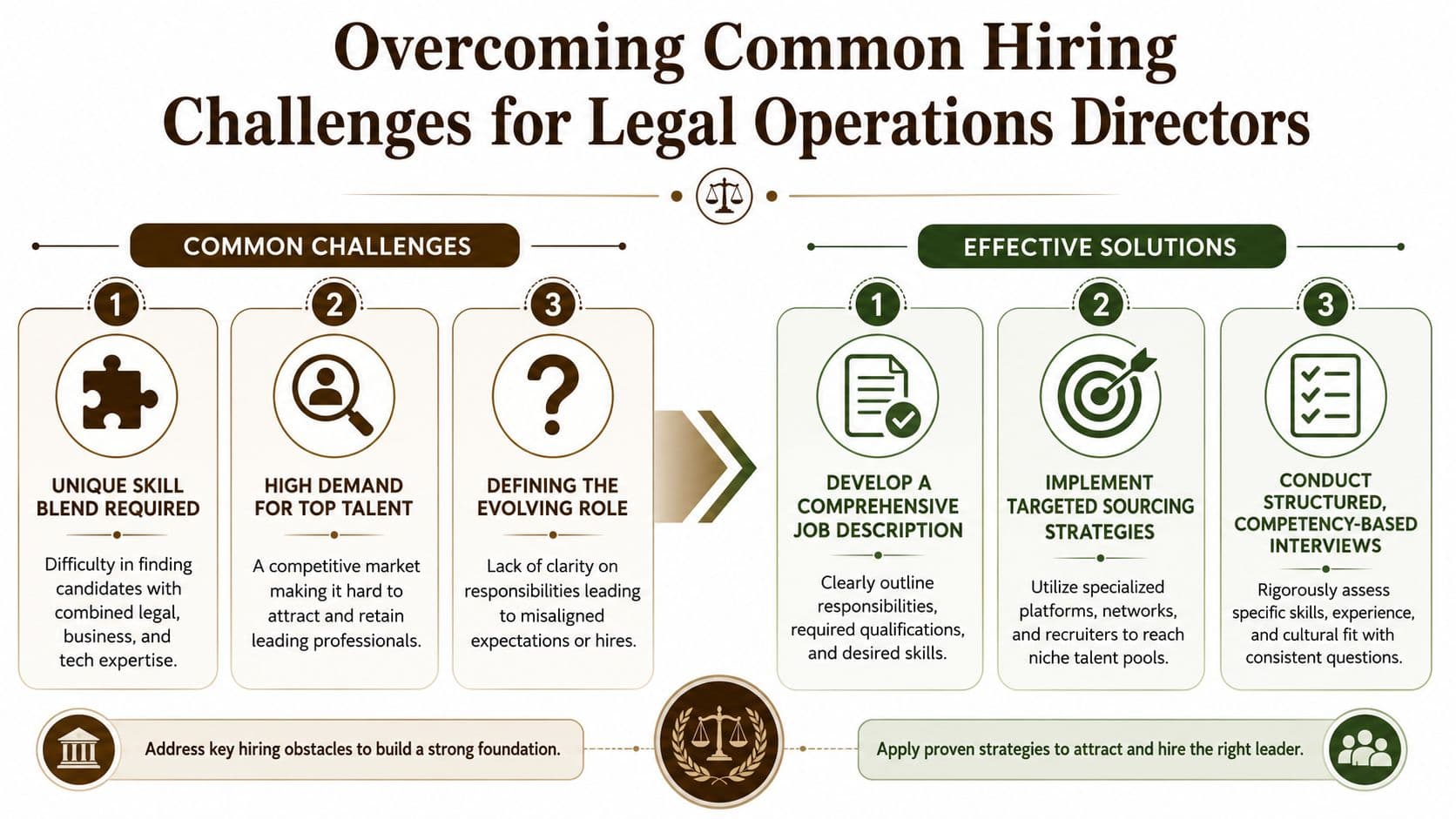
The first challenge is role definition. Companies say they want a “strategic” hire, but what they really need is an execution leader. That mismatch creates a bad brief, a confused interview process, and a shortlist full of candidates who don't fit the actual work.
Where searches usually go sideways
Three patterns show up repeatedly.
- The role is too broad: The company combines Head of Ops vision work with Director-level execution and specialist tasks.
- The screen is too shallow: Interviews focus on personality and general leadership rather than budgets, systems, workflows, and vendor control.
- The process is too slow: Strong candidates won't wait through multiple rounds of internal uncertainty.
The second challenge is access. Many of the best legal ops leaders aren't actively applying. They're already employed, often well compensated, and selective about platform, reporting line, and mandate.
What improves the odds
A disciplined search process fixes more than people think. Start with a specific mandate, align the interview panel on what the role owns, and test for operating evidence instead of presentation polish.
A stronger hiring process usually includes:
- A tightly written job brief: Separate strategy-setting duties from execution duties.
- Competency-based interviews: Ask for examples involving budgets, intake, vendor management, technology rollout, and reporting.
- Scenario testing: Give candidates realistic problems such as law firm panel sprawl, weak invoice controls, or poor intake compliance.
- Faster decision-making: Keep internal alignment tight so good candidates don't drift away.
The market doesn't reward indecision. If your process suggests the company still doesn't know what the role is, the best candidates will read that correctly.
Specialized search support often matters here because this talent doesn't sit neatly in standard legal or standard operations pipelines. Recruiters who spend time in legal hiring can often reach candidates outside the visible applicant pool and pressure-test whether a profile is Director-level. Teams that want a better sense of how legal hiring markets behave can review broader legal recruiting insights on the Five Star Placements blog, but the operational lesson is straightforward. Precision beats volume in this search.
Finding Your Next Legal Operations Leader
A first legal operations director hire is usually a sign that the department has hit a complexity threshold. Work is coming in from too many directions. Costs need tighter control. Technology exists but isn't fully adopted. Attorneys are spending too much time on work that isn't legal judgment.
That's why this role matters so much. The right Director doesn't just keep the trains running. The right Director builds the track, sets the routing rules, and gives the GC a clearer view of cost, capacity, and performance.
The strongest hires share a few traits. They're execution-first. They're credible with Finance, IT, Procurement, and lawyers. They can manage vendors without becoming vendor-led. They care about adoption, not just implementation. And they understand that legal operations only works when process discipline survives contact with real people and real deadlines.
For a GC, the practical takeaway is simple. Hire for operating evidence. Test for budget ownership, workflow design, technology implementation, and outside counsel management. Keep the scope of the role honest. Give the person enough authority to enforce process. Then measure the work through visibility, control, and consistency.
If you're preparing for that search and want experienced support on role definition, candidate calibration, or market mapping, you can start the conversation through Five Star Placements contact options.
Five Star Placements helps law firms and corporate legal departments hire legal talent with a practical, search-driven approach. If you need support hiring a Legal Operations Director or another legal leadership role, connect with Five Star Placements.
Need help filling a legal role?
Five Star Placements partners with law firms and legal departments nationwide.
Schedule a Call