
Legal Recruiting Fees Explained: A 2026 Guide for Firms
June 24, 2026 · 16 min read · Five Star Placements

Table of contents
You open the recruiter agreement, scan to the fee line, and your eye goes straight to the percentage. That reaction is normal. For a General Counsel or hiring partner under budget pressure, a recruiting fee can look expensive in isolation.
But legal recruiting fees explained properly aren't just about the invoice. They're about total cost of hire, risk allocation, and whether the search process produces a candidate who joins, performs, and stays. A cheaper search that drags on, floods your team with weak resumes, or ends in a fast backfill usually costs more than the higher-quality search you hesitated to approve.
In legal hiring, the fee structure also tells you something important about incentives. If the recruiter is paid only when the right person starts, the recruiter carries part of the search risk. If the recruiter is engaged on a retained or hybrid basis, the client is buying commitment, focus, and often better market access for a harder role. Those are strategic choices, not just billing mechanics.
That's why experienced buyers don't ask only, “What percentage is the fee?” They ask, “What am I buying, how is risk shared, and what happens if the hire doesn't stick?” If you're evaluating a search partner, it helps to understand the operating model behind the paper. The firm background here reflects the kind of employer-side service model many legal departments and firms use when they want specialized permanent placement support.
Table of Contents
- The Three Core Legal Recruiting Fee Models
- Deconstructing the Numbers Fee Percentages and Benchmarks
- Factors That Influence Legal Recruiting Fees
- Beyond the Percentage Payment Terms Guarantees and ROI
- Strategic Negotiation and Ethical Considerations
- Frequently Asked Questions About Legal Recruiting Fees
The Three Core Legal Recruiting Fee Models
A General Counsel needs to fill a regulatory leadership role in six weeks, keep the search quiet, and avoid a miss that leads to another search fee in nine months. In that situation, the fee model is not just a pricing choice. It sets the recruiter's incentives, the amount of market work that happens before the first slate, and the odds of making a hire that sticks.
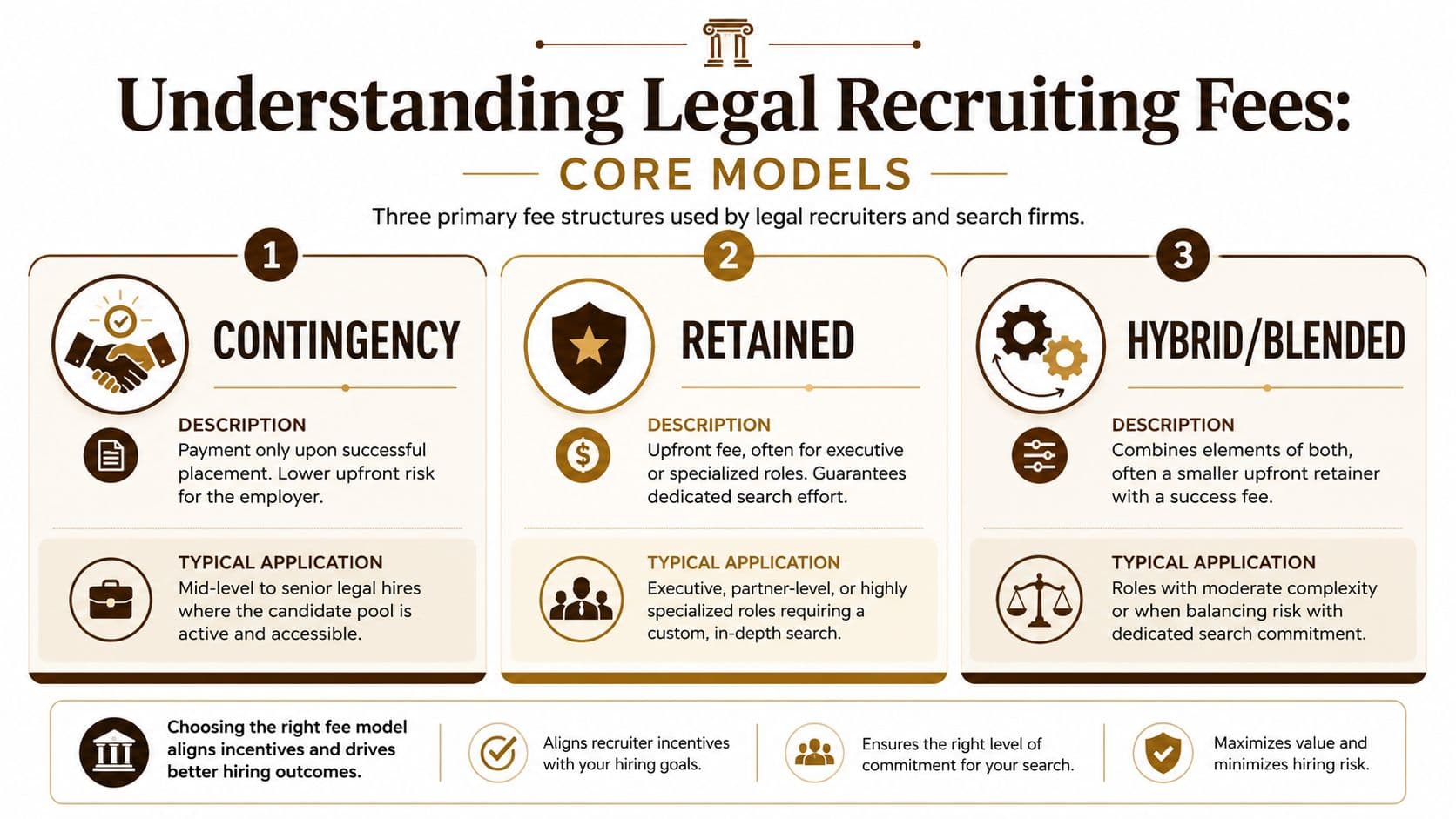
Most legal searches fall into three models: contingency, retained, and hybrid. Each one shifts cost and risk differently between client and recruiter. The right choice depends on the total cost of hire, not just the percentage on the invoice.
Contingency search
Contingency means the recruiter is paid only after a successful hire starts. If there is no hire, there is no fee.
That structure lowers upfront cash risk and gives legal departments a fast way to open a search. It can work well for standard attorney hiring, legal ops roles, compliance positions with a broad market, and legal support searches where qualified candidates are active and multiple firms can produce quickly.
The trade-off is straightforward. A contingency recruiter has to allocate time across many live searches, so effort usually follows fill probability. If your process is slow, compensation is below market, or the role requires careful outreach to passive candidates, the search can lose momentum. The invoice may be deferred, but the hidden cost can show up in vacancy drag, weaker candidate quality, and a restart three months later.
Retained search
Retained search includes an upfront commitment from the client, usually for a senior, confidential, or specialized role. In return, the recruiter commits dedicated search time, deeper market mapping, calibrated outreach, and tighter process management.
This model fits searches where a miss is expensive. A deputy general counsel hire, a practice group leader move, or a niche in-house role in tax, privacy, or IP often needs more than resume flow. It needs disciplined identification of candidates who are not applying, careful qualification, and direct advice on compensation, reporting lines, and close strategy.
I usually tell legal buyers to use retained search when the business risk of being wrong is higher than the discomfort of paying part of the fee upfront. That is a better way to frame the decision.
Hybrid search
Hybrid search combines an upfront payment with a success-based balance. It is often the most practical middle ground for hard legal searches where the recruiter must invest real time at the front end, but the client still wants some fee risk tied to outcome.
The advantage is alignment. The recruiter has enough commitment to prioritize the work and run a real search, while the client avoids paying the full fee before results materialize. For senior in-house roles, niche partner searches, and specialist mandates where candidate persuasion matters as much as sourcing, that shared-risk structure often produces a better process than pure contingency.
Industry groups have reported increased use of blended and retained models for executive and specialist search work, including within professional services and legal-adjacent functions, as noted by the Association of Executive Search and Leadership Consultants. Retention is one reason buyers choose that structure. A cheaper model that produces a short-tenured hire is rarely cheaper in total.
Recruiting fee models at a glance
| Feature | Contingency Search | Retained Search | Hybrid Search |
|---|---|---|---|
| Payment timing | Paid only on successful hire | Partial fee paid upfront | Partial upfront, balance on hire |
| Client risk upfront | Lower | Higher | Shared |
| Recruiter commitment model | Performance-based | Exclusive and dedicated | Shared-risk commitment |
| Best use case | Standard permanent legal hires | Senior, confidential, or highly specialized roles | Hard-to-fill niche roles |
| Speed profile | Can move fast when role is marketable | Usually more structured | Often structured but still practical |
| Main trade-off | Less guaranteed exclusivity | More client commitment required | Requires client buy-in before completion |
A common buying mistake is to treat these as interchangeable fee options. They are different operating models. The structure you choose affects recruiter attention, candidate access, process discipline, and ultimately whether the fee buys a hire or just another vacancy.
Deconstructing the Numbers Fee Percentages and Benchmarks
A General Counsel approves a search, sees a 25% fee, and assumes the math is straightforward. Then the offer package takes shape, the role proves harder than expected, and a deeper budgeting question becomes clear. What is the total cost of filling this seat well, and what fee structure puts the recruiter's incentives in line with that outcome?
In legal recruiting, percentage ranges are common. What matters is what sits underneath them.
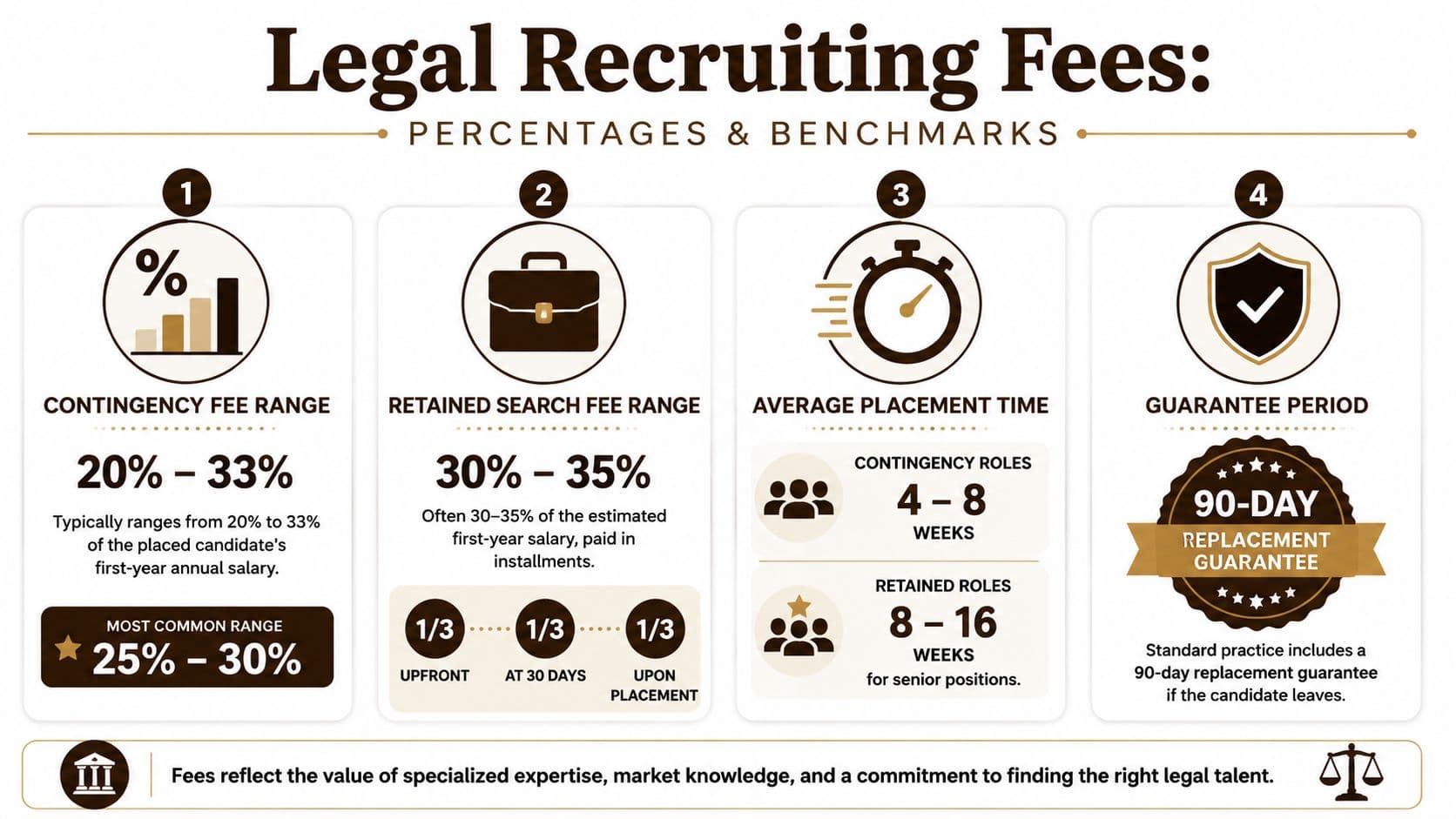
A standard legal search fee is often quoted as a percentage of first-year base salary. In many searches, that percentage falls around 20% to 25%. Complex, niche, or senior roles can price higher. Applied to salary bands, that can mean a mid-level attorney hire in the $120,000 to $150,000 range produces a fee in the tens of thousands, while a highly compensated partner search can produce a fee well into six figures, as discussed by the American Bar Association.
What the percentage is applied to
This point drives a surprising number of disputes. The fee is usually calculated on first-year base salary, not total compensation, unless the agreement says otherwise.
That distinction matters in legal hiring because compensation packages are often layered. Signing bonuses, annual bonuses, guaranteed bonuses, draw arrangements, equity, and deferred compensation can change the economics quickly. A GC should not assume the recruiter and the company define "compensation" the same way. The search agreement needs to spell it out.
I tell clients to focus on the fee base before they focus on the fee percentage. A lower percentage tied to a broader compensation definition can cost more than a higher percentage tied only to base salary.
Why percentages rise so quickly
Legal compensation is high enough that even a conventional percentage creates large dollar figures. That is not automatically a pricing problem. It is a risk allocation question.
If a recruiter is expected to access passive candidates, protect confidentiality, qualify for business fit, and keep a sensitive process on track, the fee is paying for more than introductions. It is paying for market access, screening judgment, and a lower chance of a failed hire. For a revenue-producing partner or a senior in-house leader, the cost of a miss often exceeds the fee.
The wrong comparison is fee versus no fee. The better comparison is fee versus vacancy cost, management time, interview drag, compensation missteps, and early attrition.
A budgeting lens that helps
For budgeting, start with three questions.
First, what will the role cost if it stays open for another 90 days. Second, what is the cost of a wrong hire who exits in under a year. Third, does the fee model push the recruiter toward speed only, or toward candidate quality and retention too.
That is why two identical percentage quotes can represent very different value. One recruiter may be running a volume process with limited calibration and little protection against a short-tenure outcome. Another may be pricing in heavier front-end assessment, tighter candidate control, and a guarantee structure that shares more risk.
A legal recruiting fee should be judged as part of total cost of hire. The percentage is only the starting number. The better question is whether the search economics support a durable hire and align the recruiter's incentives with that result.
Factors That Influence Legal Recruiting Fees
Two legal searches can carry very different fees even if both are “attorney hires.” That's because the percentage reflects more than title. It reflects difficulty, scarcity, process demands, and recruiter risk.
Role seniority and business impact
Seniority changes the search economics immediately. A junior associate search usually involves a broader candidate pool, more visible market data, and a lower business-disruption cost if the role stays open briefly.
A partner, deputy GC, or legal operations leader is different. The pool is smaller, discretion matters more, and the cost of a miss is higher. Recruiters often spend more time on outreach, qualification, reference development, and compensation navigation before a serious shortlist exists.
Practice area scarcity and selectivity
Some roles are hard because the title is senior. Others are hard because the practice area is narrow. Tax, IP, highly specialized healthcare, complex employment, and certain in-house compliance mandates often require a recruiter to identify candidates with very specific experience that doesn't show up neatly in a resume search.
The problem isn't just sourcing names. It's separating people who look adjacent from people who can step into the work with minimal ramp time.
Consider this checklist when evaluating a quoted fee:
- Scarce specialization: The narrower the practice area, the smaller the qualified pool.
- Passive-candidate dependency: If the best candidates aren't actively applying, the recruiter has to run a more deliberate outreach campaign.
- Client selectivity: Some legal employers hire against exceptionally high standards, which increases screening work and reduces margin for error.
Geography and local market pressure
Location still matters, even in a more flexible hiring market. Some cities have deeper legal talent pools. Others have intense competition for the same candidates, especially when elite firms, regional leaders, and corporate legal departments are all chasing the same profile.
Geography also affects candidate behavior. In one market, a recruiter can move a strong slate quickly. In another, candidates may have multiple options, longer decision cycles, or relocation concerns that complicate the close.
Exclusivity and process quality
Search exclusivity often influences pricing and performance more than buyers expect. If several recruiters are racing on the same role with no meaningful process control, each has an incentive to move fast, not necessarily deep.
If the employer gives one recruiter a cleaner brief, fast feedback, and genuine access to decision-makers, the recruiter can usually invest more thoughtfully. That doesn't automatically mean the fee goes up. It does mean the value of the fee improves.
A search becomes expensive when the process is sloppy. A clear brief, disciplined interviews, and fast decisions make the same fee work harder.
Beyond the Percentage Payment Terms Guarantees and ROI
The fee itself is only part of the agreement. Payment timing, guarantee terms, and the practical economics of the hire matter just as much.

When the invoice is triggered
Legitimate legal recruiting fees are employer-paid, calculated on first-year base salary, and contingent on the candidate's start date. Standard terms often include payment within 30 days and a 3 to 6 month guarantee period in which the recruiter offers a replacement if the candidate leaves early, as outlined in these recruiting terms and conditions.
That structure is important because it answers two concerns at once. First, the candidate isn't being charged. Second, the employer doesn't pay for effort alone. Payment is tied to an actual completed hire.
Why the guarantee matters
A guarantee doesn't eliminate hiring risk, but it changes the economics. Reputable firms use it to stand behind their screening and to preserve long-term client trust.
What buyers should look for isn't only the existence of a guarantee. Look at the practical conditions around it. Is the process for invoking it clear? Does it require the original fee to be paid on time? Does it provide replacement search support rather than vague “best efforts” language?
A later-stage conversation on search economics usually gets more useful after both sides review the guarantee details. That's where the agreement moves from sales language to operating reality.
For a quick primer on how search agreements work in practice, this overview is a useful reference:
Thinking in total cost of hire
The wrong comparison is recruiter fee versus zero. Internal hiring isn't free. Your team still spends time on intake meetings, resume review, scheduling, screening, interviews, compensation discussions, and offer management.
The better comparison is fee versus outcome. Ask:
- Vacancy cost: What work is delayed while the role stays open?
- Manager time: How many senior hours are being diverted into recruiting activity?
- Mishire exposure: What happens if the candidate joins and exits quickly?
- Retention probability: Does the search model support a better long-term fit?
If you frame the decision that way, ROI becomes less abstract. A one-time fee can be rational if it shortens a difficult search, improves candidate quality, and reduces the odds of a costly restart.
Strategic Negotiation and Ethical Considerations
Fee negotiation works best when both sides treat it as an alignment discussion, not a street-market haggle. The goal isn't to squeeze a recruiter into saying yes to a lower number and then expect premium execution anyway. The goal is to decide whether the scope, search difficulty, and incentives make sense for both parties.

What you can negotiate productively
Some buyers fixate on the headline percentage and ignore the rest of the paper. Often, the smarter negotiation points sit elsewhere.
You may be able to discuss:
- Guarantee language: A stronger replacement commitment can be more valuable than a minor fee reduction.
- Exclusivity terms: A short exclusivity window can improve recruiter focus without locking you into a long obligation.
- Payment mechanics: Timing, invoicing details, and how offer changes are handled can all affect the practical cost experience.
- Role definition: Narrowing or clarifying the brief can improve results more than arguing over points on the fee.
What usually doesn't work
A procurement-style push for a lower fee with no change in search conditions often backfires. If the role is difficult, the market is tight, and your process is slow, asking for a discount may just reduce recruiter commitment or push the assignment behind better-structured searches.
Another bad move is engaging multiple recruiters with overlapping briefs and little coordination, then judging all of them by who sends resumes fastest. That usually creates duplication, candidate confusion, and shallow qualification.
If you want a recruiter to act like a strategic partner, give the assignment the structure of a real partnership.
Ethical rules that aren't optional
There is one industry norm that is absolute. Candidates do not pay legal recruiting fees. The hiring law firm or corporate legal department bears the cost. Any recruiter asking a candidate for payment is a serious red flag and falls outside standard legitimate practice.
That rule protects both sides. Candidates can engage openly without fearing hidden charges. Employers can trust that the recruiter's incentive is tied to placement success, not to collecting money from vulnerable job seekers.
If you remember only one ethical point from any legal recruiting fees explained guide, remember that one.
Frequently Asked Questions About Legal Recruiting Fees
A General Counsel often asks the hardest fee questions after the search starts. By then, the actual issue is not the headline percentage. It is total cost of hire, internal time spent managing the process, and who carries the risk if the search goes sideways.
How are fees handled in a lateral team move
Lateral team moves are usually priced differently from a one-off attorney search. Firms and legal departments often negotiate a package structure instead of applying a full fee to each lawyer as if every hire were unrelated.
The right way to evaluate that proposal is by looking at the whole transaction. A lower blended fee can make sense if the recruiter is helping coordinate timing, conflicts, resignations, and offer strategy across multiple hires. A cheap-looking structure can become expensive if the team move falls apart halfway through, key partners do not join, or guarantees do not reflect the complexity of the assignment.
For more practical analysis on legal hiring strategy, fee models, and search execution, see the legal recruiting insights on the Five Star Placements blog.
Do fees apply only to attorneys
No. Recruiter fees can apply to paralegals, legal operations leaders, compliance professionals, contract managers, and senior legal support staff.
The fee model may change by role. The business question does not. If you are paying a recruiter to identify, qualify, and close a direct hire in a competitive market, the economics still turn on difficulty, speed, and the cost of a bad hire.
What if the recruiter presents someone already in our database
This issue should be settled in the engagement terms before resumes start moving. Strong agreements define prior candidate ownership, what counts as meaningful prior contact, and how long the employer has to dispute a submission.
In practice, fast confirmation matters more than perfect contract language. If a recruiter sends a candidate your team already interviewed, say so immediately and document it. Waiting until the offer stage usually creates a fee dispute that distracts from the hire and damages trust on both sides.
Is the cheapest recruiter the best value
Usually, no.
A lower fee can produce a higher total cost of hire if your team spends extra weeks reviewing weak candidates, repairing candidate confusion, or replacing someone who never should have been hired. The better question is whether the recruiter's process lowers risk. That includes market access, screening quality, candidate management, reference discipline, and the odds that the hire stays.
I tell clients to compare fees against outcomes, not in isolation. A recruiter charging more but delivering a stronger slate, tighter process control, and better retention is often the less expensive option.
Should we use contingency for every legal hire
Use the model that fits the assignment.
Contingency can work well for straightforward searches with a broad candidate pool and low confidentiality concerns. Retained or hybrid structures usually make more sense where the role is sensitive, senior, specialized, or difficult to fill. Those models can align effort and accountability more clearly because the recruiter is being paid to run the search properly, not just to win a race to submit resumes.
The fee structure is a strategic choice. It affects recruiter commitment, candidate experience, and the risk profile of the search.
If you're evaluating legal hiring support and want a straightforward conversation about fee structure, search strategy, and total cost of hire, Five Star Placements can help you assess the right approach for attorneys, partners, in-house counsel, legal support staff, and legal operations roles across the United States.
Need help filling a legal role?
Five Star Placements partners with law firms and legal departments nationwide.
Schedule a Call